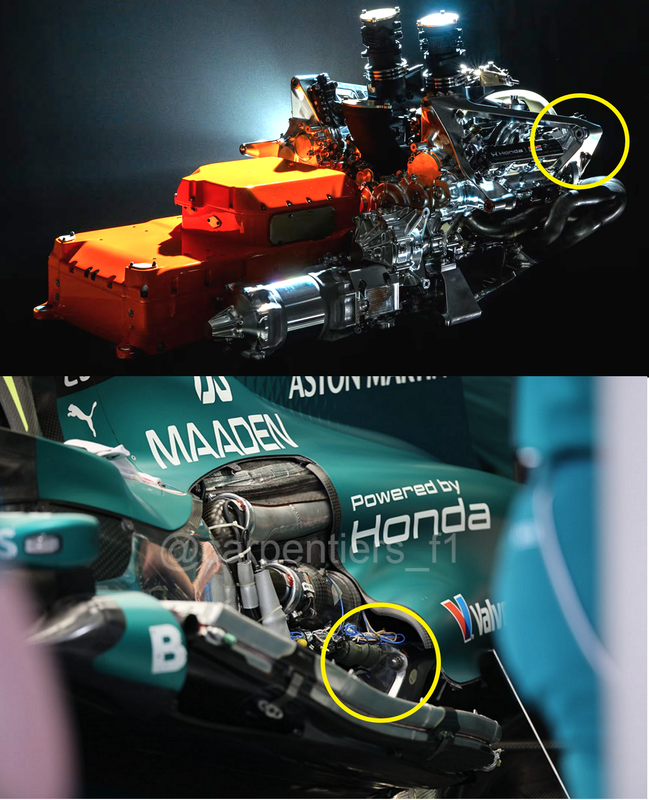
Honda Power Unit Hardware & Software

All that has to do with the power train, gearbox, clutch, fuels and lubricants, etc. Generally the mechanical side of Formula One.
User avatar
AR3-GP
537
Joined: 06 Jul 2021, 01:22

Re: Honda Power Unit Hardware & Software

Post

RA626H. You can make out parts of the induction system here.
Image
Beware of T-Rex

krich
krich
1
Joined: 07 Apr 2024, 19:10

Re: Honda Power Unit Hardware & Software

Post

AR3-GP wrote:
21 Feb 2026, 17:19
RA626H. You can make out parts of the induction system here.
https://pbs.twimg.com/media/HBmiHSXaEAA ... ame=medium
That’s some serious tight packaging lol

User avatar
lio007
327
Joined: 28 Jan 2013, 23:03
Location: Austria

Re: Honda Power Unit Hardware & Software

Post

Similar to aero testing restrictions the PU manufacturers also have a limited amount of test bench runs at their disposal. They already have to do extra reliability test runs and use some testing allocation... which hampers them on future development. Will be interesting to see how they dig themselves out of the mud.

ObsessiveHamster
ObsessiveHamster
0
Joined: 17 Feb 2026, 15:08

Re: Honda Power Unit Hardware & Software

Post

You’ve been posting this AI slop in other threads as well, without adding anything of value of your own thoughts and input.

Cold Fussion
Cold Fussion
94
Joined: 19 Dec 2010, 04:51

Re: Honda Power Unit Hardware & Software

Post

delsando53 wrote:
22 Feb 2026, 14:05
Increase in compression ratio?


1. Piston Crown with Gradient Thermal Expansion Profile

Concept: Machine the piston crown (dome) with a tapered thickness gradient (thinner at center, thicker at edges) from allowed single-piece iron-based alloy (e.g., 42CrMo4 per 15.8.1). This promotes uneven axial expansion: the hotter center bulges more than the periphery, reducing chamber volume at runtime. Pair with aluminum block/head for radial bore expansion that complements the effect without conflicting.
Achieving 20:1+ CR: Cold test: 16:1 compliant. Hot (~100-150°C): ~0.15-0.25mm axial growth shrinks volume by 6-12%, yielding 20-23:1 effective. Practical via precise CNC machining (no major changes).
Reliability/Low Failure: Gradient reduces stress concentrations; oil cooling jets (per 5.25) prevent overheating. Proven in endurance testing (Appendix 4); <0.5% failure risk with standard tolerances (±0.1mm bore per 5.6.1).
Outside-the-Box Twist: Incorporate allowed micro-texturing (laser-etched patterns per 15.7) on the crown to create "thermal pockets" that trap heat locally, amplifying targeted expansion like a passive heat sink—enhances stability without added mass.

2. Cylinder Head with Embedded High-Expansion Inserts

Concept: Use permitted "other inserts" (non-combustion-exposed initially, up to +1% volume per 5.3.7/15.8.8) in the aluminum head, made from high-expansion aluminum-lithium alloy (≤2.5% Li per 15.9.3). Position annular inserts around valve seats or spark plug bosses; they expand inward at heat, encroaching on chamber space. Head remains single-piece; inserts interference-fitted.
Achieving 20:1+ CR: Cold: Inserts recessed, CR=16:1. Hot: 0.08-0.15mm protrusion reduces volume 4-8%, for 19-21:1. Combines with deck height min 168mm (5.6.8) for fine control.
Reliability/Low Failure: Inserts limited size; coatings (up to 0.8mm thick per 15.7.2) prevent galling/loosening. Thermal cycling tested (dyno runs per Appendix 4); negligible risk with vibration isolation.
Outside-the-Box Twist: Design inserts as hollow "bladders" filled with compliant low-melt wax (phase-change material per 15.2 exemptions), which expands volumetrically at temp—acts like a mini-piston, boosting effect reliably without mechanics.

3. Special Exhaust Valves with Extended Tulip Expansion

Concept: Optimize hollow, sodium-filled exhaust valves (per 15.8.6, min stem Ø4.95mm per 5.6.12) with an elongated tulip head geometry (head Ø27-29mm per 5.6.14). Use nickel-based alloy for higher axial expansion; at heat, the tulip "stretches" deeper into the chamber when seated, reducing volume. Intake valves (solid) balanced for symmetry.
Achieving 20:1+ CR: Cold: Standard seating, 16:1. Hot: ~0.1mm deeper seating cuts volume 3-6%, achieving 18-20:1 (stackable with other methods for 22:1+). Fixed cam profile (no VVT per 5.9.2).
Reliability/Low Failure: Sodium cooling aids heat dissipation; proven valve tech with <1% failure in high-rev ops (up to 10,500 rpm per 5.5). No changes to conrod length (119.5-120.5mm per 5.6.9).
Outside-the-Box Twist: Angle valves slightly (allowed within tolerances) with a "canted" seat insert that warps minimally at temp, creating a conical volume reduction—like a passive iris, enhancing combustion without wear.

Additional Outside-the-Box Ideas for Power Gains (Beyond CR)
These exploit other 2026 rules gray areas for +15-30 hp, reliable and practical without major redesigns:

Optimized Fuel Atomization via Injector Geometry: Use high-pressure direct injection (up to 500 bar per 5.10) with multi-hole nozzles shaped for thermal vaporization enhancement. At hot temps, fuel pre-heats passively in lines, improving combustion efficiency (sustainable fuels per Article 16). Gain: 10-15 hp; reliable with standard filters.
Passive Turbo Spool Assist via Exhaust Pulse Tuning: Tune exhaust manifold lengths (fixed per 5.8) for harmonic resonance at mid-revs, reducing lag without MGU-H. Pair with valve overlap minimization—boosts torque by 5-10%. Low risk; dyno-tuned.
ERS Battery Thermal Management Loophole: Exploit no explicit temp limits on ERS components by using phase-change insulation (per 15.2) around the battery (4 MJ delta per 5.14). Maintains optimal 60-80°C for efficiency, adding 10-20 kW deployment. Passive, reliable.
Crankshaft Bearing Surface Optimization: Maximize allowed bearing areas (≥2500mm² mains per 5.6.6) with micro-grooved coatings for reduced friction at high temps. Lowers parasitic losses for +5-10 hp; no failure risk with oil systems.
Why do you constantly post LLM crap without disclosure? Is this a crappy bot account or someone trying to role play as an engineer?

gansaraku
gansaraku
0
Joined: 10 Mar 2017, 07:51

Re: Honda Power Unit Hardware & Software

Post

Cold Fussion wrote:
delsando53 wrote:
22 Feb 2026, 14:05
Increase in compression ratio?


1. Piston Crown with Gradient Thermal Expansion Profile

Concept: Machine the piston crown (dome) with a tapered thickness gradient (thinner at center, thicker at edges) from allowed single-piece iron-based alloy (e.g., 42CrMo4 per 15.8.1). This promotes uneven axial expansion: the hotter center bulges more than the periphery, reducing chamber volume at runtime. Pair with aluminum block/head for radial bore expansion that complements the effect without conflicting.
Achieving 20:1+ CR: Cold test: 16:1 compliant. Hot (~100-150°C): ~0.15-0.25mm axial growth shrinks volume by 6-12%, yielding 20-23:1 effective. Practical via precise CNC machining (no major changes).
Reliability/Low Failure: Gradient reduces stress concentrations; oil cooling jets (per 5.25) prevent overheating. Proven in endurance testing (Appendix 4); <0.5% failure risk with standard tolerances (±0.1mm bore per 5.6.1).
Outside-the-Box Twist: Incorporate allowed micro-texturing (laser-etched patterns per 15.7) on the crown to create "thermal pockets" that trap heat locally, amplifying targeted expansion like a passive heat sink—enhances stability without added mass.

2. Cylinder Head with Embedded High-Expansion Inserts

Concept: Use permitted "other inserts" (non-combustion-exposed initially, up to +1% volume per 5.3.7/15.8.8) in the aluminum head, made from high-expansion aluminum-lithium alloy (≤2.5% Li per 15.9.3). Position annular inserts around valve seats or spark plug bosses; they expand inward at heat, encroaching on chamber space. Head remains single-piece; inserts interference-fitted.
Achieving 20:1+ CR: Cold: Inserts recessed, CR=16:1. Hot: 0.08-0.15mm protrusion reduces volume 4-8%, for 19-21:1. Combines with deck height min 168mm (5.6.8) for fine control.
Reliability/Low Failure: Inserts limited size; coatings (up to 0.8mm thick per 15.7.2) prevent galling/loosening. Thermal cycling tested (dyno runs per Appendix 4); negligible risk with vibration isolation.
Outside-the-Box Twist: Design inserts as hollow "bladders" filled with compliant low-melt wax (phase-change material per 15.2 exemptions), which expands volumetrically at temp—acts like a mini-piston, boosting effect reliably without mechanics.

3. Special Exhaust Valves with Extended Tulip Expansion

Concept: Optimize hollow, sodium-filled exhaust valves (per 15.8.6, min stem Ø4.95mm per 5.6.12) with an elongated tulip head geometry (head Ø27-29mm per 5.6.14). Use nickel-based alloy for higher axial expansion; at heat, the tulip "stretches" deeper into the chamber when seated, reducing volume. Intake valves (solid) balanced for symmetry.
Achieving 20:1+ CR: Cold: Standard seating, 16:1. Hot: ~0.1mm deeper seating cuts volume 3-6%, achieving 18-20:1 (stackable with other methods for 22:1+). Fixed cam profile (no VVT per 5.9.2).
Reliability/Low Failure: Sodium cooling aids heat dissipation; proven valve tech with <1% failure in high-rev ops (up to 10,500 rpm per 5.5). No changes to conrod length (119.5-120.5mm per 5.6.9).
Outside-the-Box Twist: Angle valves slightly (allowed within tolerances) with a "canted" seat insert that warps minimally at temp, creating a conical volume reduction—like a passive iris, enhancing combustion without wear.

Additional Outside-the-Box Ideas for Power Gains (Beyond CR)
These exploit other 2026 rules gray areas for +15-30 hp, reliable and practical without major redesigns:

Optimized Fuel Atomization via Injector Geometry: Use high-pressure direct injection (up to 500 bar per 5.10) with multi-hole nozzles shaped for thermal vaporization enhancement. At hot temps, fuel pre-heats passively in lines, improving combustion efficiency (sustainable fuels per Article 16). Gain: 10-15 hp; reliable with standard filters.
Passive Turbo Spool Assist via Exhaust Pulse Tuning: Tune exhaust manifold lengths (fixed per 5.8) for harmonic resonance at mid-revs, reducing lag without MGU-H. Pair with valve overlap minimization—boosts torque by 5-10%. Low risk; dyno-tuned.
ERS Battery Thermal Management Loophole: Exploit no explicit temp limits on ERS components by using phase-change insulation (per 15.2) around the battery (4 MJ delta per 5.14). Maintains optimal 60-80°C for efficiency, adding 10-20 kW deployment. Passive, reliable.
Crankshaft Bearing Surface Optimization: Maximize allowed bearing areas (≥2500mm² mains per 5.6.6) with micro-grooved coatings for reduced friction at high temps. Lowers parasitic losses for +5-10 hp; no failure risk with oil systems.

Why do you constantly post LLM crap without disclosure? Is this a crappy bot account or someone trying to role play as an engineer?
The thermal expansion argument doesn’t hold up physically.
Typical coefficients of thermal expansion:
Steel (e.g. 42CrMo4): ~11–13 µm/m·°C
Aluminum alloys: ~21–23 µm/m·°C
If a 40 mm piston crown heats up by 100–150°C, the real axial growth is only:
≈ 0.04–0.06 mm
Not 0.15–0.25 mm.

And that’s best case.

In reality, the head and block expand too, so the net chamber volume change would be even smaller.
There simply isn’t enough thermal expansion available in these materials to shift compression ratio from 16:1 to 20:1.

Physics limits it long before regulations do


Enviado desde mi M2007J3SG mediante Tapatalk


User avatar
Craigy
86
Joined: 10 Nov 2009, 10:20

Re: Honda Power Unit Hardware & Software

Post

gansaraku wrote:
22 Feb 2026, 16:33
There simply isn’t enough thermal expansion available in these materials to shift compression ratio from 16:1 to 20:1.
If I put a void in the top of the cylinder head with a reed valve (simple bimetallic strip) tuned to be closed at combustion temperatures but open during room-temp and/or 130C testing (as you like), I can make practically any compression ratio I want.

If I put this void in the TJI injector assembly I can make it exceptionally fast to swap out and/or tune the void volume, the reed valve open/close temp and/or shape of the throat for resonation.

I was shouted down for saying this a few weeks ago. What exactly would stop it from being possible, and what exactly would stop it from being legal to the currently written rules?

From where I sit, nothing and nothing are the two answers, but I'd be happy to listen.

Rodak
Rodak
37
Joined: 04 Oct 2017, 03:02

Re: Honda Power Unit Hardware & Software

Post

What exactly would stop it from being possible, and what exactly would stop it from being legal to the currently written rules?
What exactly would make it work, and what exactly would make it legal?

delsando53
delsando53
0
Joined: 16 Feb 2023, 14:58

Re: Honda Power Unit Hardware & Software

Post

ObsessiveHamster wrote:
22 Feb 2026, 15:29
You’ve been posting this AI slop in other threads as well, without adding anything of value of your own thoughts and input.
Fair enough if my posts came across as low effort to you I can see how that might look from the outside.
Just to clarify where I'm coming from:
I'm not an engineer, researcher or expert. I'm a regular person who's genuinely curious about this topic. I find it interesting to feed real questions into AI, see what it says, and then bring those answers here to see if people think they're plausible, complete nonsense, or somewhere in between. That's literally all I was doing testing ideas in a discussion space and hoping for some actual thoughts in return.

I didn't post to spam, promote, or annoy people. I thought forums like this were exactly for exchanging ideas (even half-baked ones) without instant judgment. If I dropped it in the wrong thread or over-posted, that's on me I apologise

But calling someone's genuine curiosity " zero value…. It basically tells normal people "stay in your lane, only experts allowed to be curious here". Anyways point taken :)

Cold Fussion
Cold Fussion
94
Joined: 19 Dec 2010, 04:51

Re: Honda Power Unit Hardware & Software

Post

delsando53 wrote:
22 Feb 2026, 23:16
Fair enough if my posts came across as low effort to you I can see how that might look from the outside.
Just to clarify where I'm coming from:
I'm not an engineer, researcher or expert. I'm a regular person who's genuinely curious about this topic. I find it interesting to feed real questions into AI, see what it says, ...
If you are genuinely curious then perhaps do some actual reading on the topic, idle curiosity existed before 2022 so I have full faith in your ability to intelligently engage in topics that interest you.
delsando53 wrote:
22 Feb 2026, 23:16
... and then bring those answers here to see if people think they're plausible, complete nonsense, or somewhere in between. That's literally all I was doing testing ideas in a discussion space and hoping for some actual thoughts in return.
You and I have a fundamentally different view as to what constitutes a discussion. Writing a prompt and then posting a firehose of --- onto a message board devoid of any context or original thought is not a discussion, it's just yet more useless noise everyone else has to deal with.
delsando53 wrote:
22 Feb 2026, 23:16
I didn't post to spam, promote, or annoy people. I thought forums like this were exactly for exchanging ideas (even half-baked ones) without instant judgment. If I dropped it in the wrong thread or over-posted, that's on me I apologise
What ideas are you exchanging? The point of messages boards is talking to real people, and the value of this board specifically is there are a lot of qualified. technical people here which can provide real insight to complex topics. Diluting that by bombarding the forums with a firehose of nonsense from LLM's makes the experience worse for everyone else. Perhaps you can ask your preferred LLM about the concept of dead internet theory.
delsando53 wrote:
22 Feb 2026, 23:16
But calling someone's genuine curiosity " zero value…. It basically tells normal people "stay in your lane, only experts allowed to be curious here". Anyways point taken :)
No one is saying stay in your lane if your not an expert, in fact there has been a lot of inane posts here over the years and they still at times provide interesting discussion, but just showing up and dumping ai slop on everyone and saying "how about that" leaves a poor taste in peoples mouths.

User avatar
urbanglowcam
0
Joined: 31 Oct 2011, 21:05

Re: Honda Power Unit Hardware & Software

Post

AR3-GP wrote:
21 Feb 2026, 17:19
RA626H. You can make out parts of the induction system here.
https://pbs.twimg.com/media/HBmiHSXaEAA ... ame=medium
Wow. Thanks for sharing this shot. I haven't seen the same glimpse from other teams' powertrains but is having the powertrain this tightly packed typical or does this lean more towards the "size zero" 2015 McLaren Honda philosophy?

ryaan2904
ryaan2904
36
Joined: 01 Oct 2020, 09:45

Re: Honda Power Unit Hardware & Software

Post

AR3-GP wrote:
21 Feb 2026, 17:19
RA626H. You can make out parts of the induction system here.
https://pbs.twimg.com/media/HBmiHSXaEAA ... ame=medium
Any reason why Honda stick to A2A intercoolers unlike Mercedes or Ferrari?
CFD Eyes of Sauron

gearboxtrouble
gearboxtrouble
1
Joined: 17 Jan 2026, 19:17

Re: Honda Power Unit Hardware & Software

Post

ryaan2904 wrote:
23 Feb 2026, 03:28
AR3-GP wrote:
21 Feb 2026, 17:19
RA626H. You can make out parts of the induction system here.
https://pbs.twimg.com/media/HBmiHSXaEAA ... ame=medium
Any reason why Honda stick to A2A intercoolers unlike Mercedes or Ferrari?
Guessing same reason as Red Bull - weight and packaging. A2A intercoolers are lighter and can be mounted higher up which lets you shrink the sidepod intakes.

User avatar
AR3-GP
537
Joined: 06 Jul 2021, 01:22

Re: Honda Power Unit Hardware & Software

Post

AR3-GP wrote:
21 Feb 2026, 17:19
RA626H. You can make out parts of the induction system here.
https://pbs.twimg.com/media/HBmiHSXaEAA ... ame=medium
I think we can see more than at first glance. The rear left mounting hardpoint in the launch photos of the RA626H is visible under the bodywork. So this gives a reference for how the intercooler, intake and the rest of the components are installed relative to the chassis.

Image
Beware of T-Rex

User avatar
diffuser
259
Joined: 07 Sep 2012, 13:55
Location: Montreal

Re: Honda Power Unit Hardware & Software

Post

gearboxtrouble wrote:
23 Feb 2026, 03:40
ryaan2904 wrote:
23 Feb 2026, 03:28
AR3-GP wrote:
21 Feb 2026, 17:19
RA626H. You can make out parts of the induction system here.
https://pbs.twimg.com/media/HBmiHSXaEAA ... ame=medium
Any reason why Honda stick to A2A intercoolers unlike Mercedes or Ferrari?
Guessing same reason as Red Bull - weight and packaging. A2A intercoolers are lighter and can be mounted higher up which lets you shrink the sidepod intakes.
Cooling is not a PU thing, It's a chassis thing. PU tell the chassis how much cooling they need a chassis delivers...or suffers.