16:1 to 18:1

All that has to do with the power train, gearbox, clutch, fuels and lubricants, etc. Generally the mechanical side of Formula One.
User avatar
BassVirolla
16
Joined: 20 Jul 2018, 23:55

Re: 16:1 to 18:1

Post

gruntguru wrote:
23 Dec 2025, 03:35
FW17 wrote:
22 Dec 2025, 12:05
The engine regulations do not mention anything on the type on injectors that an be used.

The manufacturer can therefore use a compressed air assisted injector that could inject more air into the cylinder as it reaches TDC to increase the compressed air pressure from 77bar to 87bar by adding 2cc of compressed air.
Two posts above yours, it was stressed that high "compression" is not the goal. (The goal is high "expansion"). The current engines deliberately reduce the "compression" using Miller cycle valve timing. The 18:1 permitted CR is utilised in order to achieve a high expansion ratio.
There's some confusion in the facts that:

- More air (which tragically / inefficiently equates to more compression pressure) allows for more / better burning of fuel, which release more energy.
- More expansion allows for better conversion from heat to mechanical.

But no, more pressure / compression don't release more energy from such combustion.

So, I doubt we are researching ways to compress more, but:

- Options to shove more air in the cylinder.
- Options to expand more such air.

But a geometrical 18:1 allows for more expansion of a given mass of air than 16:1.

With a Miller cycle, more CR does not necessarily equate to more maximum in cylinder pressure. Even more, increase such pressure without increasing the expansion is (thermodinamically) a nonsense, but opens the possibility to burn more fuel less efficiently, which I doubt is the goal of this ruleset.

User avatar
AR3-GP
560
Joined: 06 Jul 2021, 01:22

Re: 16:1 to 18:1

Post

FW17 wrote:
22 Dec 2025, 12:05
The engine regulations do not mention anything on the type on injectors that an be used.

The manufacturer can therefore use an compressed air assisted injector that could inject more air into the cylinder as it reaches TDC to increase the compressed air pressure from 77bar to 87bar by adding 2cc of compressed air.
You can't inject air through the fuel injector. It's not allowed.
Beware of T-Rex

basti313
basti313
29
Joined: 22 Feb 2014, 14:49

Re: 16:1 to 18:1

Post

maddim wrote:
20 Dec 2025, 09:30
So what do we know and what we do not know?
I will try to add some points as time progressed:
maddim wrote:
20 Dec 2025, 09:30
3. From the technical side of things, that means around 1.8cc of combustion engine decrease. No thermal expansion can meet these numbers and also no way of controlling it inside a combustion chamber. So, what is this mechanism that can allow them to run on 18:1 during running, measured 16:1 and not having any moving parts? Interesting...
My calculations show, that you can work with a sub 0.3mm orifice at +30mm length would do the job. There is no pressure wave propagation and no flame entry, so this orifice does not play any role in combustion. So you can add any volume behind this orifice as a dead volume.
This is quite easy to manufacture, just a hole in a manufacturable length and thickness.
maddim wrote:
20 Dec 2025, 09:30
Do moving parts cover the injector or the igniter coil (spark plugs)? I am wondering if there is this loophole there?
I do not think from the point of movability.
But if it is really some orifice...it would be smart to add this into a replaceable part like a spark plug or injector instead of the Al head. Like this any edge wear can be controlled.
maddim wrote:
20 Dec 2025, 09:30
4. 18:1 means surely heavier fuel to gain from it, isn't it? With the new fuels that is bigger task. Will they be reliable?
Very interesting point.
As they run a Miller cycle (most likely), this is a more complicated story. A higher CR would not only help with thermal efficiency, but in the Miller cycle also with knocking tendency. So you win more than just the obvious thermal efficiency.
Thermal will of course affect aero.
Don`t russel the hamster!

Dex35
Dex35
0
Joined: 11 Jul 2018, 02:55

Re: 16:1 to 18:1

Post

Consider a titanium intake valve with a hollow valve head, partially filled with water. How would the flat titanium disc used to form the hot face of the ~32 mm diameter valve head potentially distort under the internal steam pressure?
This though hit me while reading about Sam Heron, the British-born aeronautical engineer who invented the sodium-cooled exhaust valve in 1923. As it turned out, water was the first heat transfer fluid he tested; but some of the experimental sealed valves exploded from steam pressure.

Image

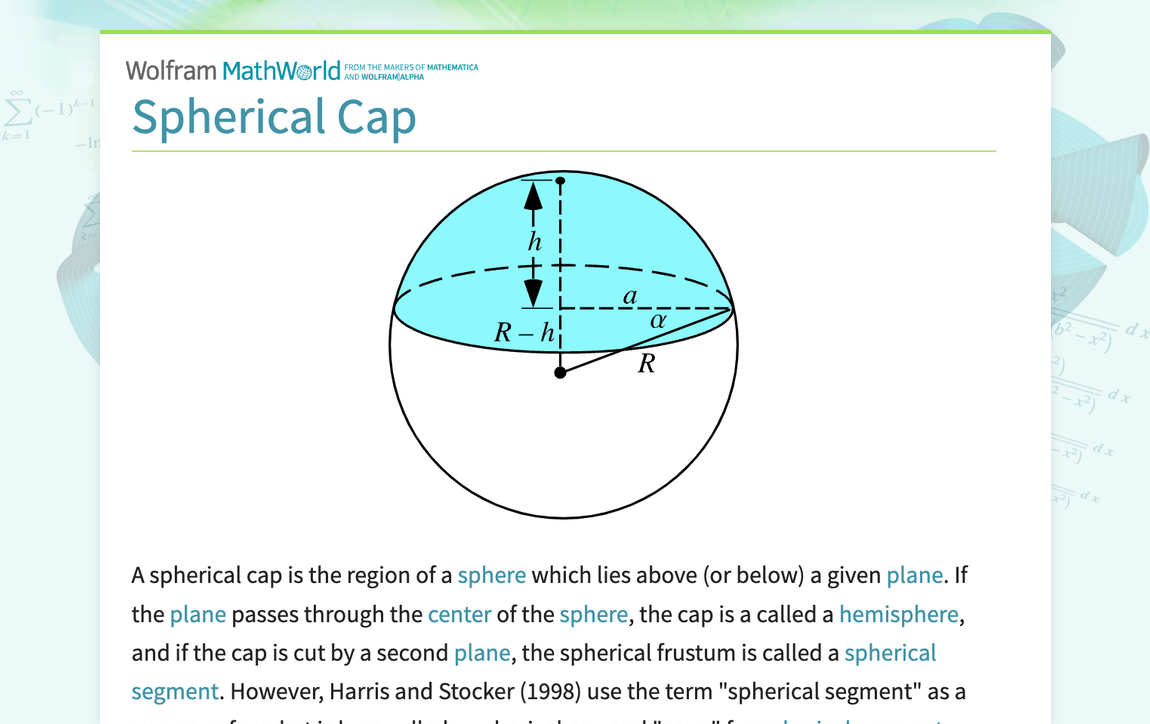
Surface area of a spherical cap
S.A. = 2 Pi *R *h
Volume of a spherical cap
V=0.333 * π * h *h *(3R−h)
Where:
R: Radius of the entire sphere.
h: Height of the cap (distance from the cutting plane to the top of the sphere).
NOTE: h = R - H
Using the following dimensions, plugged into the appropriate geometry formulas gives:
Radius of sphere 38 mm
h height of bulge 3 mm
H (= R-h) 35 mm
Circumference of spherical cap at height H
C=2π SQRT [h(2R−h)] 92.93 mm
Dividing the above circumference by Pi gives a diameter of the "Flat Plate" at the plane of cut thru sphere of 29.59 mm
V=0.333 * π * h *h *(3R−h)
This gives the volume of bulge as 988 mm3 or 0.988 cubic centimeters.
Note that this is for only one of the two intake valves. The concept of a hollow intake valve head, bowing outward when pressurized by steam whilst at operating temperature, appears to easily the geometrical change necessary to increase the C.R. from 16:1 to 18:1.
Doing a quick and dirty look at how much stretch is needed by the flat sealing plate (not exactly a rigorous determination of the % elongation) to balloon outwards gives:
Surface area of flat plate 688 mm2
Surface area of spherical cap 716 mm2
% increase in surface area 4.11%.
The % elongation of Titanium alloy Ti-6Al-4V is 10 – 18%; purer grades of titanium can get up to 30% elongation.
All of the above seems to be within the grasp of reality; your thoughts?

gruntguru
gruntguru
578
Joined: 21 Feb 2009, 07:43

Re: 16:1 to 18:1

Post

Light-years from reality IMO.
The pressure change required to bulge a metal valve face is not going to come from water heated from 30*C (ambient) to 800*C (operating exhaust valve). One can think about making the face of the valve weak and expanding a liquid metal or salt to "bulge" it. Now we are back to finding a liquid that has a significantly higher coefficient of thermal expansion than the material the valve is made of. Expanding the piston crown would be easier and produce far greater volume change. Bear in mind you have to raise the entire surface of the piston crown by 0.41mm to get from 16:1 to 18:1.
je suis charlie