2025/2026 Hybrid Powerunit speculation

All that has to do with the power train, gearbox, clutch, fuels and lubricants, etc. Generally the mechanical side of Formula One.
User avatar
BorisTheBlade
40
Joined: 21 Nov 2008, 11:15

Re: 2025/2026 Hybrid Powerunit speculation

Post

venkyhere wrote:
02 Jan 2026, 07:32
gruntguru wrote:
02 Jan 2026, 06:40
Happy to hear any suggestions on how to apply this info to try and analyse the breakdown further for 2025 or 2026 drivetrains.
Similar to the suggestion I made to @BorisTheBlade, the most interesting thing would be a plot/analysis of a race lap from 2025 (from a stint with laptimes having very low standard deviation) so that we can discount 'quali-like' full deployment of battery. And we can 'save' this lap analysis as reference for later, for the same race lap from 2026, and then compare and find out exactly what the differences are. I am most interested to know what the 'floor'/base-level charge that has to remain in the battery (unusable) over a target laptime stint, and how it's different b/w 2025 and 2026.
Yes, the trouble with that request is, that Australia 25 happened under very mixed conditions. Lando spent most of his time on intermediums, and his fastest Lap - the lap analysed - was one of very few on hards. I just realized that after picking Australia, because I initially wanted to just get an idea for the first race. Maybe China would be better for these kinds of comparisons.

User avatar
venkyhere
31
Joined: 10 Feb 2024, 06:17

Re: 2025/2026 Hybrid Powerunit speculation

Post

gruntguru wrote:
02 Jan 2026, 08:45
venkyhere wrote:
02 Jan 2026, 07:32
gruntguru wrote:
02 Jan 2026, 06:40
Happy to hear any suggestions on how to apply this info to try and analyse the breakdown further for 2025 or 2026 drivetrains.
Similar to the suggestion I made to @BorisTheBlade, the most interesting thing would be a plot/analysis of a race lap from 2025 (from a stint with laptimes having very low standard deviation) so that we can discount 'quali-like' full deployment of battery. And we can 'save' this lap analysis as reference for later, for the same race lap from 2026, and then compare and find out exactly what the differences are. I am most interested to know what the 'floor'/base-level charge that has to remain in the battery (unusable) over a target laptime stint, and how it's different b/w 2025 and 2026.
If someone wants to pick a lap from the same race (probably another Lando lap), I will run the numbers. I doubt a second or two of lap-time will change the numbers much - less than the uncertainty inherent in my assumptions and calculations.
I reckon it will not be a second or two. A typical race lap is minimum 6-7 seconds slower than the quali lap and minimum 4-5 seconds slower than the fastest lap of the race from the final few laps, for a typical 90 second quali lap ; in the just concluded regulation set itself. Of course, the numbers will show some std deviation, track to track. With the new 2026 regulation, with the power contribution balance shifting so much towards battery power, a quali lap wont be much different from 2025, but a race lap will, since ultimately it's ICE alone that contributes energy for the race ; and by my estimate a 90s quali lap will translate to a 98s/100s race lap (smaller, drag reduced car with movable aero won't matter, since it's a comparison b/w two laps by the same car).
Let's wait and see and come back to these KW numbers after the first few races are over. I will be glad to be proven wrong.
Last edited by venkyhere on 02 Jan 2026, 20:55, edited 1 time in total.

DDopey
DDopey
0
Joined: 02 Nov 2022, 09:54

Re: 2025/2026 Hybrid Powerunit speculation

Post

I see a lot of talk about the challenge that RB faces regarding building their own engine. Now I know nothing about building an engine, but is there also an advantage in such an undertaking or is it only a handicap and a knowledge and experience gap that exists. Is there something like a technical debt in the infrastructure of building such an engine which exists in the current motor manufacturers or a maybe lack of innovation, or even political ? There is a reason why innovation often comes from startups, it's because they are not hindered by current tech or experience. Just wondering.

mzso
mzso
71
Joined: 05 Apr 2014, 14:52

Re: 2025/2026 Hybrid Powerunit speculation

Post

wuzak wrote:
27 Dec 2025, 03:21
mzso wrote:
27 Dec 2025, 00:58
scuderiabrandon wrote:
24 Dec 2025, 00:33


Are SSB's anywhere near advanced enough to be considered for use in F1? I believe Mercedes, who are the only relevant manu here that has also conducted real life prototyping and testing, say they are at least still 4 years away, from producing EVs using SSB'S. I believe it was developed in-house, in conjunction with HPP.
I think everyone and their mother are developing solid-state batteries. And I think many have tested it as well.

Ultimately they don't need to be mass market viable to be included in F1. Loosening the battery pack limits is easy, if they want better energy density.
Is it energy density or power density required?

There is already multiple times the energy storage than the regulations allow (4MJ) for the cell weight allowed.
Both. Depending on how you loosen the regulations.

wuzak
wuzak
518
Joined: 30 Aug 2011, 03:26

Re: 2025/2026 Hybrid Powerunit speculation

Post

mzso wrote:
02 Jan 2026, 23:19
wuzak wrote:
27 Dec 2025, 03:21
mzso wrote:
27 Dec 2025, 00:58

I think everyone and their mother are developing solid-state batteries. And I think many have tested it as well.

Ultimately they don't need to be mass market viable to be included in F1. Loosening the battery pack limits is easy, if they want better energy density.
Is it energy density or power density required?

There is already multiple times the energy storage than the regulations allow (4MJ) for the cell weight allowed.
Both. Depending on how you loosen the regulations.
Why do the regulations need loosening?

vorticism
vorticism
373
Joined: 01 Mar 2022, 20:20
Location: YooEssay

Re: 2025/2026 Hybrid Powerunit speculation

Post

Tommy Cookers wrote:
01 Jan 2026, 22:05
having thin steel combustion chambers could liberate design from the constraints (eg 'CR-related) of ....
valve seats separate from the head
heads separate from the cylinders


Stewart Tresilian chose steel heads for a 'small & light' but very high power aero engine for R-R
didn't the late Bristol Hercules have (or need) steel heads ?
bronze heads had outstanding conductivity and hot-strength (but were heavy)
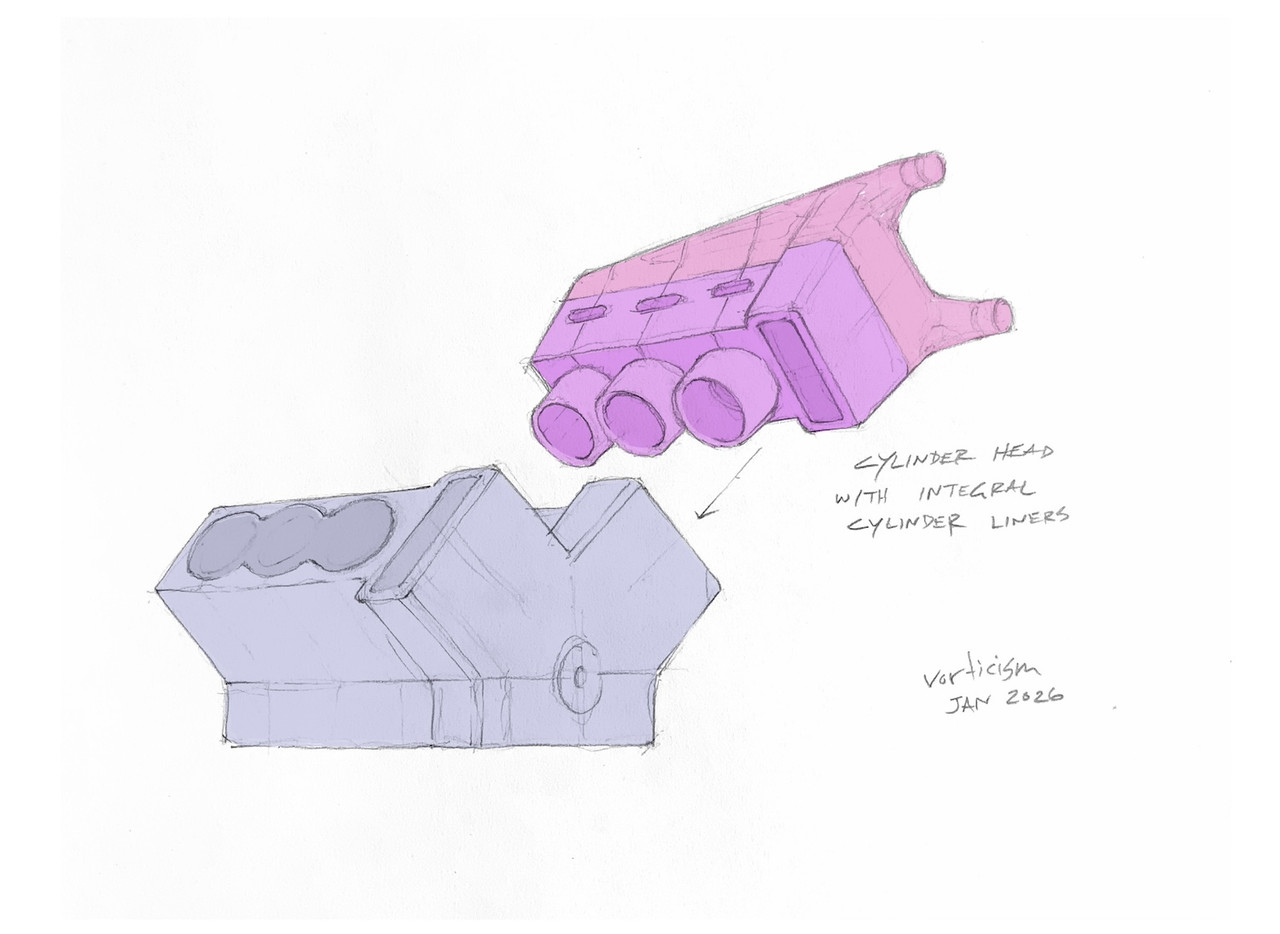
Integral valve seats are permitted. As for an integral head, at first glance it seemed like this would not be be permitted:
C5.1.4 Engines must have two intake and two exhaust valves per cylinder. Only reciprocating poppet valves with axial displacement mechanically actuated by the camshafts are permitted. The sealing interface between the moving valve component and the stationary engine component must be circular. The sealing surfaces on the stationary engine component must be either the Cylinder Head itself defined by 1C5.7.8 g), any coating on the Cylinder Head permitted by 1C5.6.2, or the conventional Inserts permitted by C5.1.7 a).
So you wouldn't be able to to make the cylinder heads integral with the crankcase. Although...
“Cylinder Liner”: A component installed into the crankcase whose primary function is to provide a
durable surface on which the piston and piston rings run. There must be only a single Cylinder Liner
per cylinder bore and the liner may also provide the sealing interface between the cylinder bore and
the cylinder head.
So rather than make the heads integral to the crankcase, you could instead make the cylinder liners integral with the head.

Increases manufacturing and assembly complexity. To what benefit? A seamless CC periphery, with perhaps some benefits as a pressure vessel. No gasket exposed to the CC. Opens up new assembly and fastening options with respect to the cam covers (where the chassis attachments are) and the crankcase (where the other chassis attachments are). If the cylinder liners are integrally cooled, the entire cylinder head & cylinder liner could share the same water jacket. Cost no object, it might be an interesting concept to study.

Image
🏴󠁧󠁢󠁥󠁮󠁧󠁿

Hoffman900
Hoffman900
220
Joined: 13 Oct 2019, 03:02

Re: 2025/2026 Hybrid Powerunit speculation

Post

So an Offy? Been around since 1913 and the reason they were so successful is because the head and cylinders were cast together and they could have massive anounts of boost.

The Cosworth GBA had cylinders that registered into the head slightly.

A number of racing engines have done this to solve the whole head gasket issue.

I knew of a few high boost wet liner engines that are machined the same way, common in high boost diese tractor pulling as well.

vorticism
vorticism
373
Joined: 01 Mar 2022, 20:20
Location: YooEssay

Re: 2025/2026 Hybrid Powerunit speculation

Post

Sounds like I might be in good company. AFAIK something like this could have been done in the prev regs. The wording around "top deck" and "cylinder head" and "cylinder liner" doesn't seem to exclude it.
🏴󠁧󠁢󠁥󠁮󠁧󠁿

wuzak
wuzak
518
Joined: 30 Aug 2011, 03:26

Re: 2025/2026 Hybrid Powerunit speculation

Post

Hoffman900 wrote:
03 Jan 2026, 23:44
So an Offy? Been around since 1913 and the reason they were so successful is because the head and cylinders were cast together and they could have massive anounts of boost.
Offenhauser engine started as a Miller in 1930.

Tommy Cookers
Tommy Cookers
657
Joined: 17 Feb 2012, 16:55

Re: 2025/2026 Hybrid Powerunit speculation

Post

all engines until c 1925 had head (or rather combustion chamber) and cylinder integral
ie all engines had closed cylinder(s) ie combined as 1 part with combustion chamber integral
ie valve seats were part of the parent metal

Curtiss went to open-topped cylinders (separate valve seats shrunk into detachable heads ?) with their V-1400 of 1925
as did Rolls-Royce (aircraft engines) in 1925/26 (responding to an official request that Napier had declined)

yes Miller the man and his employee Offenhauser the man saw the inside of Bob Burman's 1913 winning Peugeot in 1914
Miller bought the Eddie Rickenbacker Peugeot engine in 1915 and they rebuilt both engines
(parts from Peugeot being unavailable due to WW1 in France replacement parts were made in the USA)

User avatar
diffuser
252
Joined: 07 Sep 2012, 13:55
Location: Montreal

Re: 2025/2026 Hybrid Powerunit speculation

Post

Really good stuff guys. You're teaching me a ton.