- Login or Register
No account yet? Sign up
For rules please read the FIA regulation. It is in my opinion the simplest way to understand it. The minimum deployment (which is never 350kw) vary since this in-season-adjustment from corner to corner and are made public only on the FIA hompage mostly 1 day before the raceweekend (POWER UNIT INFORMATION).liuzka wrote: ↑08 Aug 2026, 14:29One more question about power delivery. Do rules mandate that they must deploy 350kw? I was wondering that does it make any sense to first accelerate to lets say 340 and then super clip to 300. While you could accelerate to 330 and super click less because you would face less drag and therefore use less energy.
Does the 2026 regulations document accurately reflect what the current rules are today with all the changes that have already occurred? As far as I know technical directives don't get publicly published (god only knows why).michl420 wrote: ↑08 Aug 2026, 15:40For rules please read the FIA regulation. It is in my opinion the simplest way to understand it. The minimum deployment (which is never 350kw) vary since this in-season-adjustment from corner to corner and are made public only on the FIA hompage mostly 1 day before the raceweekend (POWER UNIT INFORMATION).liuzka wrote: ↑08 Aug 2026, 14:29One more question about power delivery. Do rules mandate that they must deploy 350kw? I was wondering that does it make any sense to first accelerate to lets say 340 and then super clip to 300. While you could accelerate to 330 and super click less because you would face less drag and therefore use less energy.
About your clipping question.
Your first example reduce laptime, the second reduce energy. Because they are racing, the teams would like to do the first one but some old school racing fans don´t like clipping and so the FIA reduced the allowed energy harvesting and so sometimes the teams must go to the second example.
If you get the latest. In short, you don't not have to deploy the max. In fact sometimes you're not allowed to deploy the max.Cold Fussion wrote: ↑14 Aug 2026, 20:26Does the 2026 regulations document accurately reflect what the current rules are today with all the changes that have already occurred? As far as I know technical directives don't get publicly published (god only knows why).michl420 wrote: ↑08 Aug 2026, 15:40For rules please read the FIA regulation. It is in my opinion the simplest way to understand it. The minimum deployment (which is never 350kw) vary since this in-season-adjustment from corner to corner and are made public only on the FIA hompage mostly 1 day before the raceweekend (POWER UNIT INFORMATION).liuzka wrote: ↑08 Aug 2026, 14:29One more question about power delivery. Do rules mandate that they must deploy 350kw? I was wondering that does it make any sense to first accelerate to lets say 340 and then super clip to 300. While you could accelerate to 330 and super click less because you would face less drag and therefore use less energy.
About your clipping question.
Your first example reduce laptime, the second reduce energy. Because they are racing, the teams would like to do the first one but some old school racing fans don´t like clipping and so the FIA reduced the allowed energy harvesting and so sometimes the teams must go to the second example.
https://www.autosport.com/f1/news/what- ... /10845777/chipengineer wrote: ↑07 Aug 2026, 02:43
Seems to me that a solution would be to implement complete driver control, but limit battery capacity to just 1 to 2 MJ. That would:
reduce weight,
give great acceleration for a couple of seconds (but only to a speed that the ICE could still provide some acceleration),
and easily allow recharging just with braking.
More ICE power should be provided, though.

So...return to KERS. I'm good with that.chipengineer wrote: ↑18 Aug 2026, 18:10https://www.autosport.com/f1/news/what- ... /10845777/chipengineer wrote: ↑07 Aug 2026, 02:43
Seems to me that a solution would be to implement complete driver control, but limit battery capacity to just 1 to 2 MJ. That would:
reduce weight,
give great acceleration for a couple of seconds (but only to a speed that the ICE could still provide some acceleration),
and easily allow recharging just with braking.
More ICE power should be provided, though.
Pat Symonds:
"When discussing electrification, we must distinguish between power and energy. I would propose a high-power, low-energy system. Why? Well, the answer is that using high power to enable overtaking is a good thing but relying on energy to reduce lap times is not. I would propose keeping around 250kW of electrical power but reducing the available energy such that there was to around six to eight seconds of electrical boost available, enough to overtake but only requiring a smaller, lighter battery. "
That tells us that Ferrari didn't improve much with their SPEC 2. Nobody else changed anything in that window.KimiRai wrote: ↑26 Aug 2026, 18:14FIA announces ADUO results following first and second review periods of 2026
Mercedes in the 2-4% window, and will be allowed one additional homologation in 2026 and an additional one in 2027, together with corresponding cost cap and dyno testing increases.
Audi, Ferrari and Honda were determined to be above 4%, and will thus be allowed 2 additional homologations in 2026 and 2 in 2027, together with corresponding cost cap and dyno testing increases.
https://www.fia.com/news/fia-announces- ... riods-2026
It just says that no additional homologation upgrades were granted for the second period, it is possible that Ferrari was in the 2-4% window in the second perioddiffuser wrote: ↑26 Aug 2026, 19:46That tells us that Ferrari didn't improve much with their SPEC 2. Nobody else changed anything in that window.KimiRai wrote: ↑26 Aug 2026, 18:14FIA announces ADUO results following first and second review periods of 2026
Mercedes in the 2-4% window, and will be allowed one additional homologation in 2026 and an additional one in 2027, together with corresponding cost cap and dyno testing increases.
Audi, Ferrari and Honda were determined to be above 4%, and will thus be allowed 2 additional homologations in 2026 and 2 in 2027, together with corresponding cost cap and dyno testing increases.
https://www.fia.com/news/fia-announces- ... riods-2026
Oh, right, they might have moved up but they already have 1 left anyways so no change.karana wrote: ↑26 Aug 2026, 20:22It just says that no additional homologation upgrades were granted for the second period, it is possible that Ferrari was in the 2-4% window in the second perioddiffuser wrote: ↑26 Aug 2026, 19:46That tells us that Ferrari didn't improve much with their SPEC 2. Nobody else changed anything in that window.KimiRai wrote: ↑26 Aug 2026, 18:14FIA announces ADUO results following first and second review periods of 2026
Mercedes in the 2-4% window, and will be allowed one additional homologation in 2026 and an additional one in 2027, together with corresponding cost cap and dyno testing increases.
Audi, Ferrari and Honda were determined to be above 4%, and will thus be allowed 2 additional homologations in 2026 and 2 in 2027, together with corresponding cost cap and dyno testing increases.
https://www.fia.com/news/fia-announces- ... riods-2026

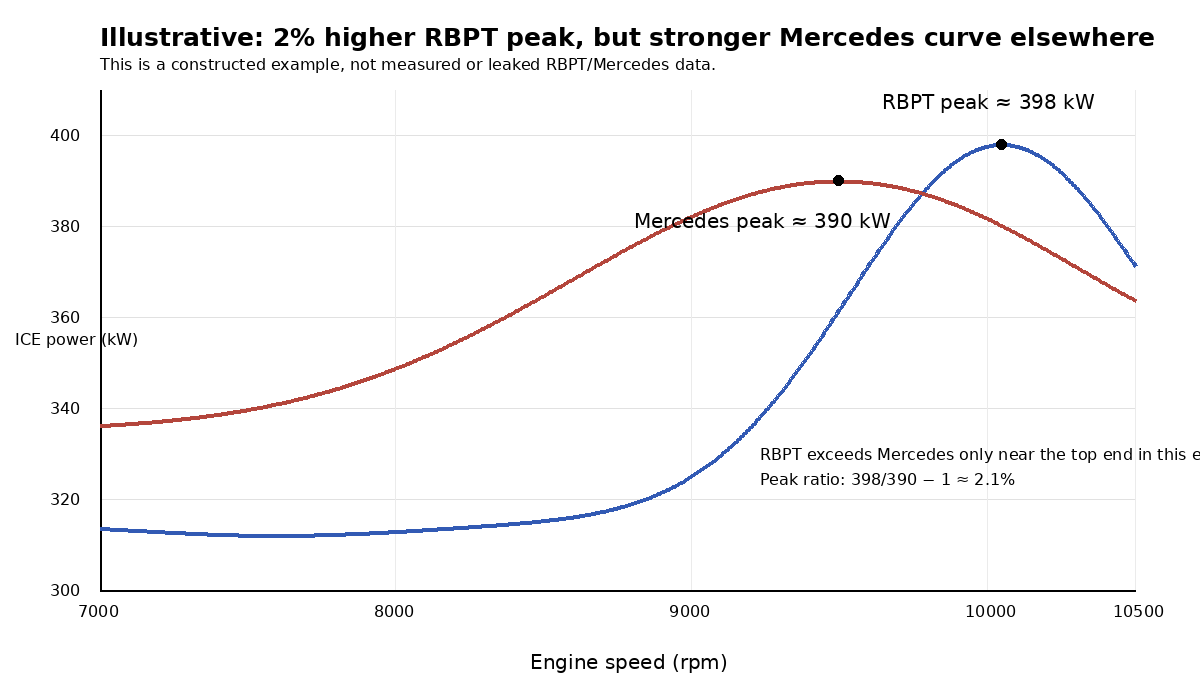
I don’t know how plausible but reasonably legit Italian F1 journalists released some estimates that showed RBPT at 575hp, Mercedes somewhere in the 560s, Ferrari and Audi both a bit below 550hp and Honda in the 520s.bigblue wrote: ↑28 Aug 2026, 00:00Hi, this must have been discussed in the heading towards 300 pages(!) here, but do we have any plausible estimates of ICE power output for the current engines? Say 540bhp-560bhp? More? Less? Outliers (I guess Honda at the moment)? Who produced the estimate (or at least disclosed the rumoured number)? I guess numbers per manufacturer may be rumoured, but an overall likely range may be stated by some generally accepted calculation? Thanks.