Isn't that just the root of the halo?De Wet wrote: ↑30 Oct 2025, 15:41https://i.ibb.co/wFFDdXJn/Mc-Laren-MCL3 ... ouvres.jpg
Nice attention to detail on this car...

- Login or Register
No account yet? Sign up
Isn't that just the root of the halo?De Wet wrote: ↑30 Oct 2025, 15:41https://i.ibb.co/wFFDdXJn/Mc-Laren-MCL3 ... ouvres.jpg
Nice attention to detail on this car...

YesSlahinki wrote: ↑30 Oct 2025, 15:55Isn't that just the root of the halo?De Wet wrote: ↑30 Oct 2025, 15:41https://i.ibb.co/wFFDdXJn/Mc-Laren-MCL3 ... ouvres.jpg
Nice attention to detail on this car...


Thank you. And regarding comparison, this a nice side by side from Mexico.Farnborough wrote: ↑31 Oct 2025, 13:07Interesting perspective SilviuAgo.
Myself and Venky have been noting that RB nose/wing combination in discussion elsewhere, this because it appears important in bringing their competitive plane closer to McL, subsequently to give us this current championship contention.
The Mcl appearing to making best use of conventional/normalised outlook across the field, while the RB engages quite different localised characteristics.
The RB appears to be running and flatter Chord orientation just out from nose cone, with more dramatic camber to the surface.
I can't see that going unnoticed by the McL team in looking at development (or others for that matter) but too late in this season to evrn think realistically about response in last races.
I like like to see good comparison images that let us see the variance in team's approach to the same problem.

Very useful picture.
Also this was my first attention point when I saw the two pictures side by side. Same rules but two different vision. I wonder how was MCL39 with some additional updates, like RBR brought? Was related to the floor/floor edges, different FW...? But will never have an answer for this.venkyhere wrote: ↑31 Oct 2025, 14:17Very useful picture.
To my eye, looks as if only the McL39's 1st element is downwash-y, but the RB21's 1st & 2nd elements are downwash-y. The 3rd element of the RB21 is huge (even if we take into account the scale difference b/w the pics) compared to the 3rd of the McL39. That the RB21 can get 'attached flow' on their large-chorded 3rd element's low pressure side, despite the downwash from the 1st+2nd elements, is very impressive.
What we are not seeing in this image is how larger the chord of the wing elements are, in lateral direction, in case of the RB21 (esp the 4th one) w.r.t McL39 ; and hence offer more DF and have more drag penalty (we anyway know that towards the lateral ends, all wings make the flow outwash-y).
What I am unable to conjecture, specifically in the portion of the front wing that's near to the nose, is the vector direction of the multi-element generated 'overall resultant force', to figure out what share is downforce (which will again depend on the front wheels' kingpin axis) and what share is drag.
Seems like a no-brainer for a technical director. Low hanging fruit. But there it is.vorticism wrote: ↑14 May 2025, 19:33...
most sophisticated internal aero
...
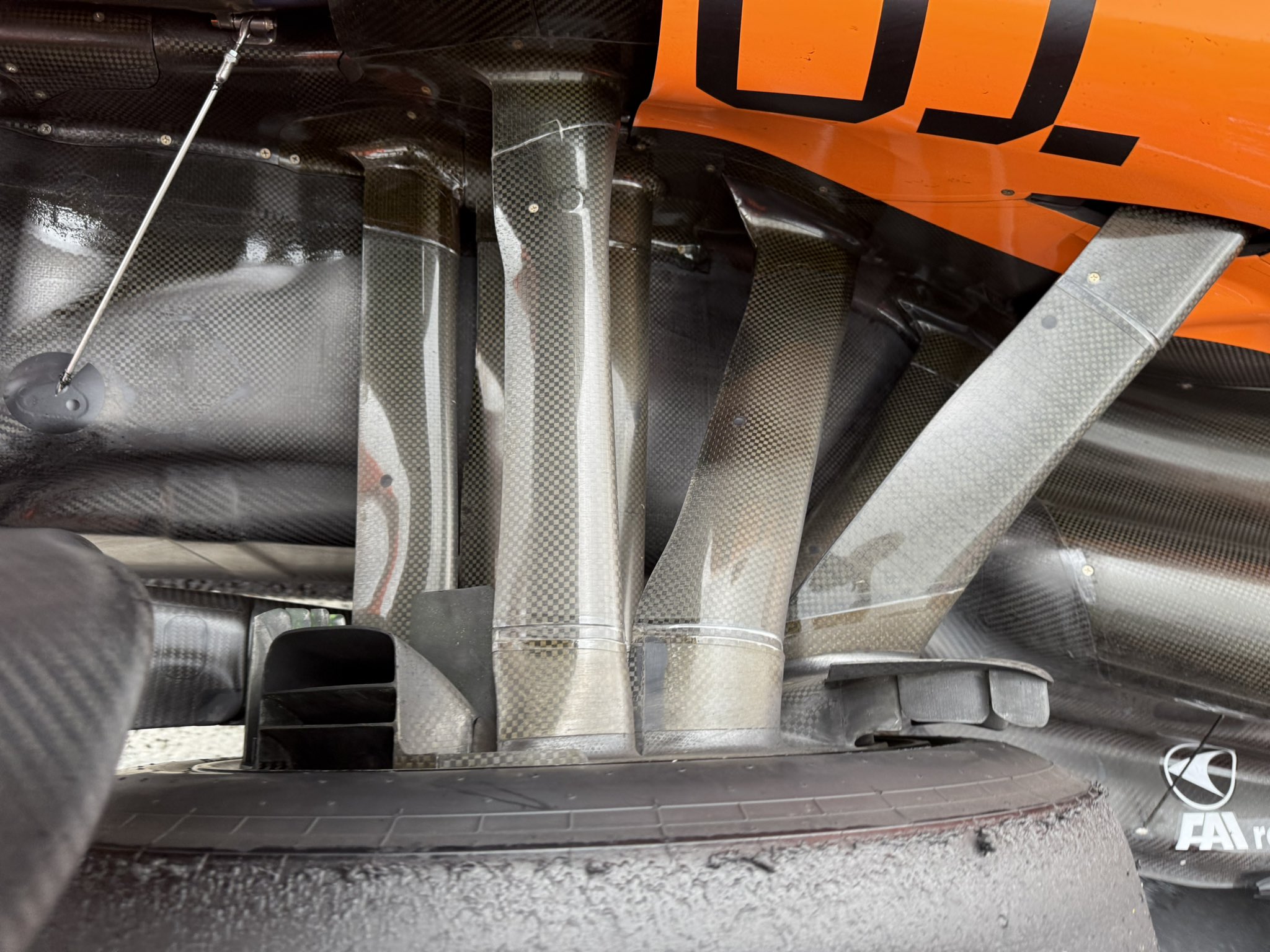
It is evident in some photos that the MCL39 has the most developed internal ducting; that’s the secret there, which is to say, nothing really to do with the radiators themselves nor the power unit or the coolant, all of which are so regulated anyway that I can't expect them to be performance differentiators on their own.
It's incorporated into that centerline radiator stack.

I would agree that what we are seeing is that Mclaren's internal cooling passages have much fewer flow losses. Therefore they don't require as much airflow.vorticism wrote: ↑01 Nov 2025, 18:28I think the explanation for their cooling outlet size is simple attention to detail. Look into the cannon of the other cars and what do you notice? Only partial ducting. What I was getting at back in May:
Seems like a no-brainer for a technical director. Low hanging fruit. But there it is.vorticism wrote: ↑14 May 2025, 19:33...
most sophisticated internal aero
...
It is evident in some photos that the MCL39 has the most developed internal ducting; that’s the secret there, which is to say, nothing really to do with the radiators themselves nor the power unit or the coolant, all of which are so regulated anyway that I can't expect them to be performance differentiators on their own.

Interesting that in the first image, the carbon "bridge" that passes over from top rear link in one side, to the same on other, looks to be broken and with jagged edge (that displayed in the circle) the assembly possibly being stripped after crash damage. The resolution a little difficult to get though in precisely describing that part.SilviuAgo wrote: ↑03 Nov 2025, 14:44McLaren MCL39 gearbox, according to formula1.pitstops:
And a close comparison between the rear suspension arms of the McLaren MCL39 and the Ferrari SF-25 reveals two very different aerodynamic philosophies.
McLaren goes for a sleek, flowing design that channels airflow cleanly toward the diffuser, enhancing stability in high-speed corners.
Ferrari, meanwhile, uses a more compact and enclosed shape to boost downforce and traction under acceleration.