


nicolas carpentiers

The exhaust blocker mods are starting to look like cartoon-animationLasssept wrote: ↑11 Sep 2026, 12:42https://pbs.twimg.com/media/HR7c_hAbkAA ... name=large
Rosario Giuliana
The put a face mask on their tail pipeLasssept wrote: ↑11 Sep 2026, 12:42https://pbs.twimg.com/media/HR7c_hAbkAA ... name=large
Rosario Giuliana


Un written rule of F1 car design. Put a slotted wing on just about any part of the car and it will unlock loads of efficient downforce.Lasssept wrote: ↑11 Sep 2026, 12:42https://pbs.twimg.com/media/HR7c_hAbkAA ... name=large
Rosario Giuliana
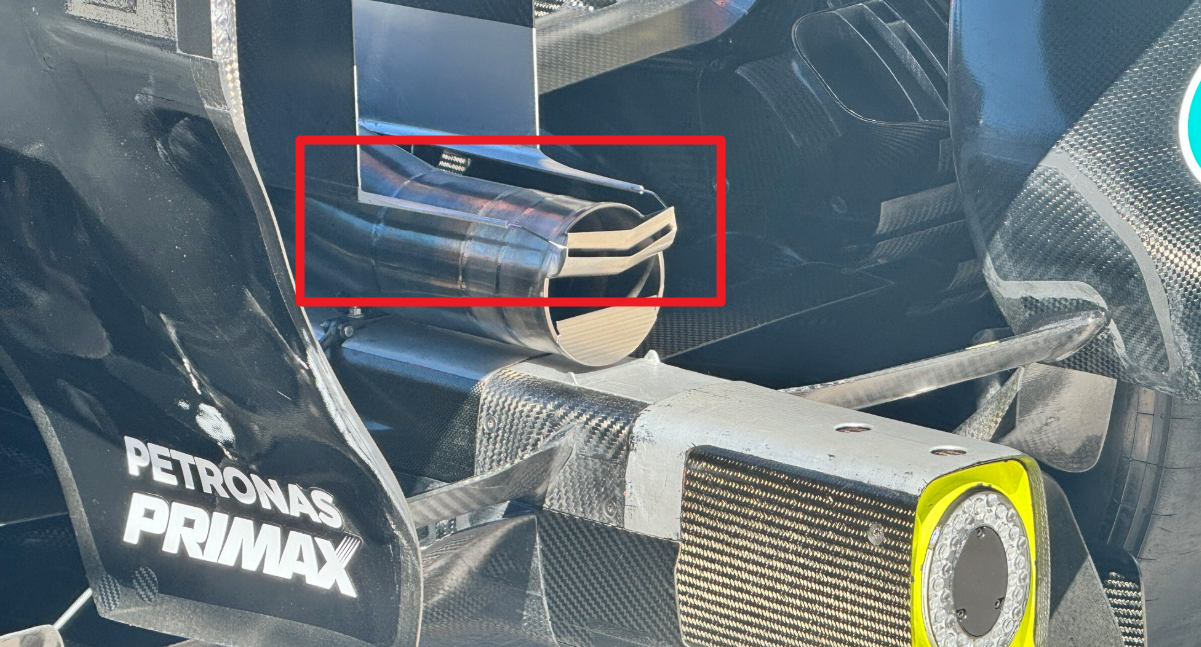
https://www.formula1.com/en/latest/arti ... q0MB7oSr8vRather than focussing the exhaust flow upon the diffuser and rear wing, within its more restricted space Mercedes have instead created winglet extensions of the rear wing support pillars and used the FTM exhaust to enhance the effect of those winglets.
The dimensional regulations mean that, unlike the FTM flap of the Ferrari with its more rearward differential, the Mercedes upper flap cannot sit this far back in free air. Instead, Mercedes have made it legal by physically connecting it to the wing support pillars. The whole pillars/winglets/flap assembly are defined as one component and in that way comply with the regulations.
However, the device was removed after second practice and the car reverted to the version used at Monza. Mercedes reported that while the downforce increase was measurable, the penalty it imposed on power unit performance was greater than the upside.
Without the extra effective length of the diffuser ramp that the Ferrari layout makes possible, the downforce boost of the FTM alone was evidently not enough on the Mercedes to make the PU power reduction worthwhile.
By blocking part of the exhaust outlet, the back pressure of the exhaust will increase. This is especially the case on a turbocharged engine. The turbo is spun by the pressure differential between the exhaust manifold and the exhaust outlet.
If you increase the back pressure of the outlet by blocking part of it, then there is less pressure differential to spin the turbo. It should still be able to reach its boost targets but will have to spin faster to do so.
There will also be more turbo lag, making the engine less driveable and consistent. The effect is amplified at high altitudes and the Madring is one of the highest altitude circuits on the calendar, roughly equal with the Red Bull Ring, though way lower than Mexico City.


