1) is true .... so ....
3) is false
ICE charging is within the PU torque demand/torque output map limits
ICE charging is exempt from the above for 200? msec per shift
1) is true .... so ....
Yes, for whatever reason, the F1 rule makers want to limit energy regeneration to standard internal combustion engine (ICE) use.Tommy Cookers wrote: ↑24 Aug 2025, 14:571) is true .... so ....
3) is false
ICE charging is within the PU torque demand/torque output map limits
ICE charging is exempt from the above for 200? msec per shift
Worth a read: https://www.the-race.com/formula-1/f1-2 ... ns-brembo/a first clue has emerged about one aspect that looks set to produce a “curious” variation across the grid - with squads having taken vastly different approaches.
I believe what prompted that discussion was drivers noting, based on their 2026 car simulations, that there are circuits where full power will not be available when it is most needed.Tommy Cookers wrote: ↑24 Aug 2025, 19:07people may not appreciate how much of the 'KE regeneration' is in the rotational energy of eg the rear wheels and PU
and downshifting they (presumably) with each shift use fuel and/or battery energy to raise the PU rpm
Maybe I'm misreading you, but there will be reduction gears between ICE and MGUK, as there are now. If you mean a transmission link to the wheels not involving the ICE, I suppose the logic is that it would be redundant, as the engine is always in gear and cycles through the gears during braking, giving the MGUK access to those ratio changes for regen.diffuser wrote: ↑24 Aug 2025, 16:06Yep, for whatever reason, the F1 rule makers want to prevent regeneration outside normal ICE use.Tommy Cookers wrote: ↑24 Aug 2025, 14:571) is true .... so ....
3) is false
ICE charging is within the PU torque demand/torque output map limits
ICE charging is exempt from the above for 200? msec per shift
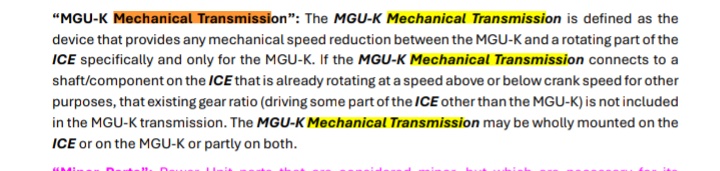
The MGU-K is also has to be connected directly to the crankshaft, so can't have gears...
Wonder if their is a specication for the size of those gears? Wouldn't be surprised.
I edited what I wrote, maybe it's clearer. I was just wondering if the gears between the crankshaft and the MGU-K could be whatever they want or is there a standard size.vorticism wrote: ↑24 Aug 2025, 21:14Maybe I'm misreading you, but there will be reduction gears between ICE and MGUK, as there are now. If you mean a transmission link to the wheels not involving the ICE, I suppose the logic is that it would be redundant, as the engine is always in gear and cycles through the gears during braking, giving the MGUK access to those ratio changes for regen.diffuser wrote: ↑24 Aug 2025, 16:06Yes, for whatever reason, the F1 rule makers want to limit energy regeneration to standard internal combustion engine (ICE) use.Tommy Cookers wrote: ↑24 Aug 2025, 14:57
1) is true .... so ....
3) is false
ICE charging is within the PU torque demand/torque output map limits
ICE charging is exempt from the above for 200? msec per shift
The MGU-K also has to be connected directly to the crankshaft, so it can’t use any gear reductions...
I wonder if there's a specific regulation regarding the size of those gear
The IndyCar system is much more manual and the driver has a paddle on the wheel which can trigger harvest while at full throttle or coasting (in addition to harvest during braking, of course). Bit of a fuel cost, but could be worth it to attempt a pass if the situation is right. Leaving T2/T4 at Indy with a full battery could definitely be an advantage worth spending some fuel on at the right time.lucafo wrote: ↑22 Aug 2025, 06:04Good point!
Don't how it works.
And, maybe, it won't work for F1...
The MGU-K is limited to 60,000rpm, so effectively a 4:1 ratio. I'd bet everyone is using that ratio to spin it as quickly as possible to 1.) keep size of the motor down and 2.) like Tommy says there is quite a lot of rotational energy stored in there - maybe 30-50kJ per upshift from the MGU-K alone if they can manage to grab it. That's not nothing.diffuser wrote: ↑24 Aug 2025, 22:56I edited what I wrote, maybe it's clearer. I was just wondering if the gears between the crankshaft and the MGU-K could be whatever they want or is there a standard size.vorticism wrote: ↑24 Aug 2025, 21:14Maybe I'm misreading you, but there will be reduction gears between ICE and MGUK, as there are now. If you mean a transmission link to the wheels not involving the ICE, I suppose the logic is that it would be redundant, as the engine is always in gear and cycles through the gears during braking, giving the MGUK access to those ratio changes for regen.diffuser wrote: ↑24 Aug 2025, 16:06
Yes, for whatever reason, the F1 rule makers want to limit energy regeneration to standard internal combustion engine (ICE) use.
The MGU-K also has to be connected directly to the crankshaft, so it can’t use any gear reductions...
I wonder if there's a specific regulation regarding the size of those gear
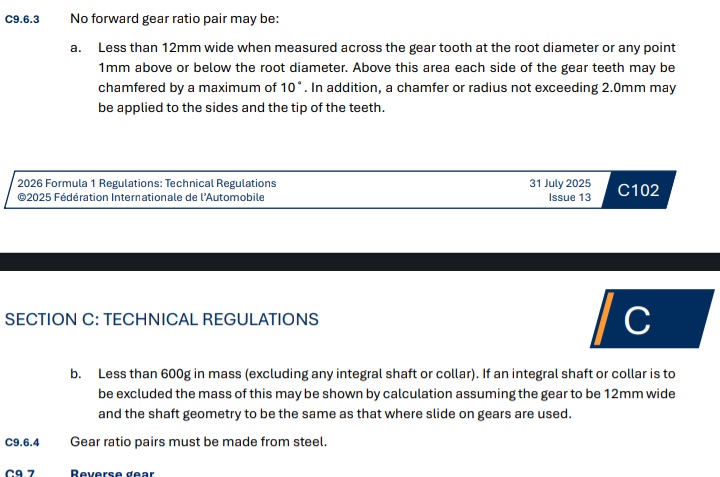
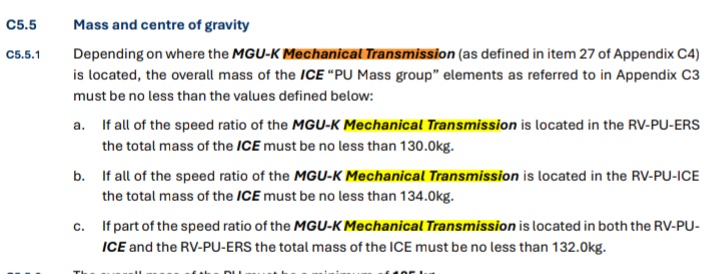
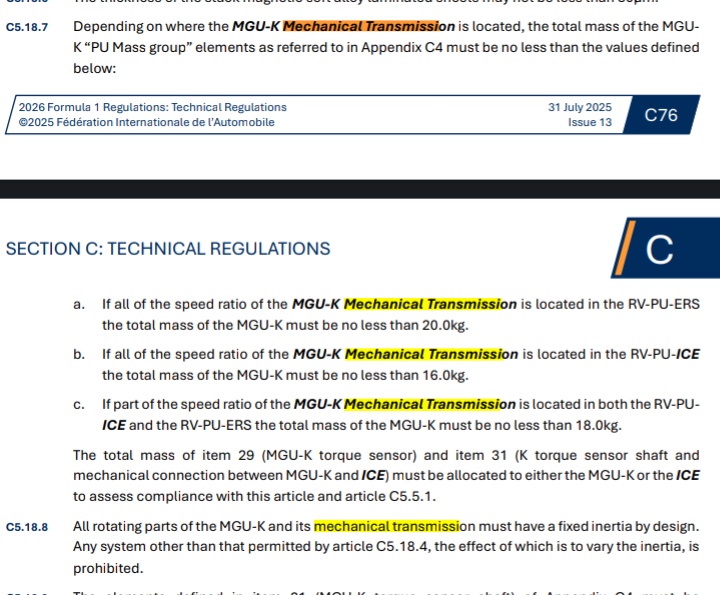
There’s a list of approved metals and alloys that can be used in the car in general, which would apply to the MGUK “mechanical transmission.” I don’t see any specific limits on the gears themselves or their materials. The ICE gearbox gears do have specifications (C9). The MGUK and its “MT” as an assembly has some regulations (C5). There’s three mounting options for it (I take it): fixed to the side of the engine (extant), fixed to the front of the engine (new), or fixed to the monocoque (new) by the ES. Each of these determines a different minimum PU weight. I assume if monocoque mounted there will be a propshaft connection to the ICE similar to the ICE-gearbox connection.


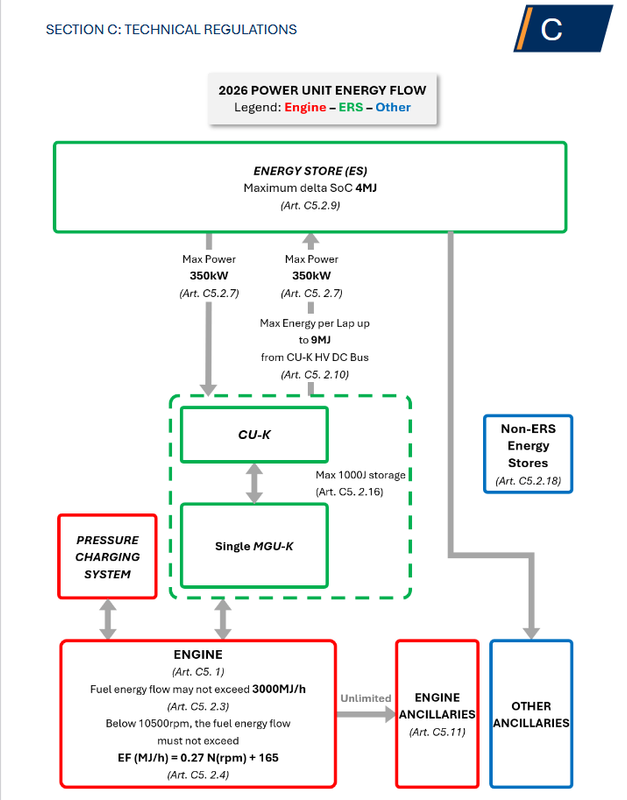
Under full trottle, the MGUK can harvest up to 100 kw, but not instantly, just down the straight.eyelid wrote: ↑27 Aug 2025, 14:50Let's make it more clear shall we?
If driver lifts of the throttle, is it allowed the ICE to charge the battery then like in Toyota Prius when car is just coasting? Can the ICE still charge the battery even when demanding 100% load full throttle? Like in same time?
This is the real thrill of the rules if allowed, like replacing the hybrid turbo with more simple approach ICE straightly charging the battery, and not via complex and costly turbocharger unit.