Post here all non technical related topics about Formula One. This includes race results, discussions, testing analysis etc. TV coverage and other personal questions should be in Off topic chat.
Earthquake risk
Today's Corriere dello Sport revealed some background of what is happening behind the scenes of Formula 1 in these days: "About 7 months ago a Mercedes engineer hired by Red Bull Powertrain reported the secret and Red Bull tried to reproduce this system". But there is a substantial difference according to the Roman newspaper, because Mercedes - which has already been working on it for a year - would not be able to bring to the track an engine that can comply with parameter 16 of the compression limit, unlike Red Bull.
And the trouble would obviously extend to all Mercedes-powered cars, i.e. world champion McLaren, Williams and Alpine.
You all can argue all you want and color bias your arguments all you want, but one thing is clear:
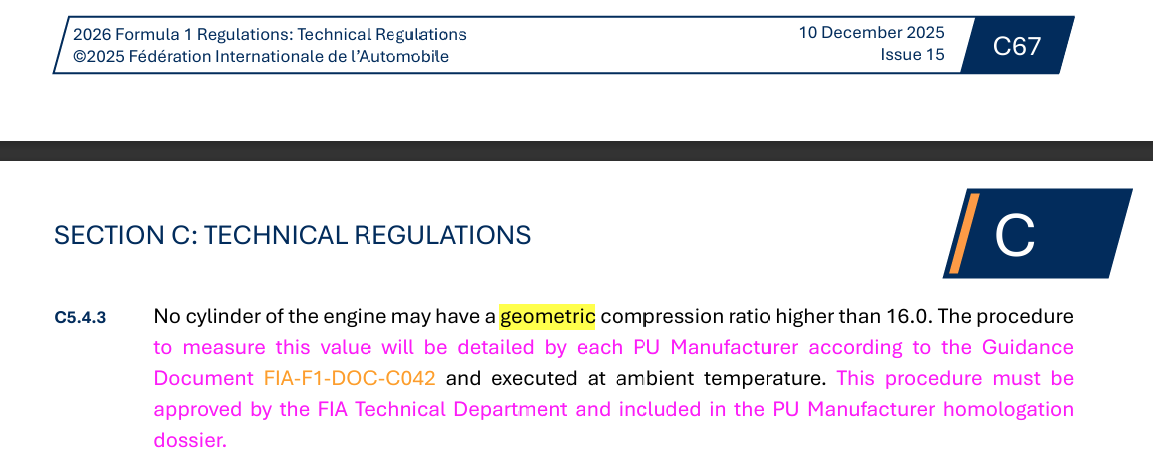
The rule intent is 16:1 AT ROOM TEMPERATURE. Not 16:1 at working conditions.
It is explicit, it is written.
There is no reason to try to achieve 16:1 at working conditions, 16.0 is no better or worse than 16.2:1 or 15.98:1. It is a limit, it is arbitrary (literally zero reason for a number without decimals), and it was set at an arbitrary value at an arbitrary temperature, where, incidentally, it is easiest to police.
As somebody pointed above, all engines run, likely, above the maximum allowed displacement due to thermal expansion of the whole engine. And that is OK. And nobody discussed the actual cylinder volume during a Q lap, not even before fuel flow limits.
We should know that F1 is an engineering contest, and if a limit is given with measuring conditions, then those conditions are part of the limit.
And we should know that teams will play politics and that journos will play drama.
But gray is no fun, I suppose.
This is 90% political drama and 10% engineering brilliancy (we don’t even know how much performance gain would be there, maybe it is 0.1%).
Let’s recognize it for what it is and lower the temperature of the discussion, lest the posts expand into personal spats beyond acceptable limits.
The rules states that engine compression ratio is not to exceed 16:1. The rules also state that cars must be in compliance with all rules at all times.
The measurement procedure outlines that the check is done at ambient temp, but to claim that therefore the measurement procedure IS the rule, isn’t right, IMO, as the FIA has routinely demonstrated in the past that when a team finds a way to circumvent the spirit of a rule via clever interpretation of the measurement procedure, they are more than willingly to intervene to amend the measurement procedure and/or the rule itself in the interest preserving the original spirit of the rule.
So, that (repeated) history rather clearly shows that the governing body regulating Formula 1 does not believe that the “measurement procedure” = “rule”.
As others have said, the FIA uses the measurement procedure as a means to enforce the rule, and (to repeat myself) are more than happy to amend the measurement procedure and/or the rule itself in order to ensure competitive fairness.
I think this was also completely same mentality behind cheating. If it says 100kg/h and you burn more than that, that is cheating. You can give something a new name but it stays same just with a new name.
If it measured in ambient temperature and it naturally rise compression ratio with heat, it is ok. But if you make a design to arise it, this is cheating.
No one outside of a few individuals at Ferrari and the FIA know what actually happened with Ferrari’s PU in 2019.
It seems quite easy to use your initial logic for this situation, too: “if the rules state that compression ratio is not to exceed 16:1 and you go higher than that, that is cheating”.
I don’t actually believe that, but it’s hard not to notice what seems to be a lot of logical inconsistencies in how some understand this situation compared to other previous grey-areas.
One of the major issues here is that the rules are not clear enough.
From my understanding, FIA is taking a stand that they only want to limit "geometric, ambient temperature" compression ratio. This is much easier to test and is not open to interpretation. That to me is a fine position to take especially given difficulties in measuring it in a working engine (who knows if a heat soak is enough, maybe it needs a running engine for the effect to manifest).
Problem is that they weren't that specific in the wording. It is similar to some other parts of the car, there are dimensions of the cars, are the cars always 100% inside those dimensions? Do they flex under load, does the rear wing tilt backwards (and exceeds total car width?). I think so.
However, I have to be honest and say that while I appreciate the innovation (and as a McLaren fan it may be good for them), I do think deliberately engineering an engine to break 16:1 under power seems borderline. It's like if we had a car that could extend it's width when hot and instead of 1900mm it was 2100mm. Should that be allowed? Don't think so.
I expect that FIA will probably rule this legal for this year but outlaw it for the next.
However, I have to be honest and say that while I appreciate the innovation (and as a McLaren fan it may be good for them), I do think deliberately engineering an engine to break 16:1 under power seems borderline. It's like if we had a car that could extend it's width when hot and instead of 1900mm it was 2100mm. Should that be allowed? Don't think so.
No car could extend its width by 200mm through simple thermal expansion. It's important to use real examples because not being able to find real examples underlines the point. Geometry changes from thermal expansion are minimal and occur all around the car. It's not realistic to police it when it is only worth tenths of a millimeter.
This whole story is basically the same as aero surfaces not being infinitly rigid.
FIA draws the line in the sand using static loads, and the teams cleverly go and design their carbon plys to have their bendy wings anyway.
I would normally agree. I would fully agree given how the rules were written previously. A better analogy would be if the rules now said (to this effect) "No moveable aero surfaces... while vehicle is not moving". I think static testing was/is used for both things like bendy wings and engine compression ratio before. However while there was a bit of a "wink wink nudge nudge" regarding the fact that there will always be thermal expansion and some level of movement of aero components, the rules did not explicitly allow them. Nothing would have prevented new testing procedures from being enacted if the regulators had decided to do so. You can watch bendy wings today and if something looks wrong, the regulators can change their process for validating legality. So teams knows there is at least a line somewhere even if not well defined. Now they explicitly limit conditions on compression ratio by narrowly defining when the rules apply. No line exists... for warm engines.
What if a more blatant solution was designed beyond utilizing thermal expansion? It may not be practical for various reasons, but lets say a servo/plunger operated system decreased the combustion chamber size when the engine was above a specific temperature? I am not saying this would be a viable or elegant solution, but that this is probably an area of development they didn't want power unit manufactures to play in. How much development (money spent) in this area before this becomes the next thing to be banned explicitly or by reverting to prior wording that doesn't open such a grey area?
Can somebody provide an exact extract of the wording mentioning ambient temperature in the rule set.
It may seem pedantic, but I think this is a good question. If memory serves, many of the various "temp" based rules are based upon official FIA meteorological values at circuits. But for this, what is used? Ambient temp in an A/C room when measured during homologation or trackside at the hottest circuit the series visits? How different might those two be? Probably minor, but it's worth asking. IMHO the rule is poorly written.
Richard
To paraphrase Mark Twain... "I'm sorry I wrote such a long post; I didn't have time to write a short one."
Can somebody provide an exact extract of the wording mentioning ambient temperature in the rule set.
Looks the same as the 100kg/h.
Compression should be 16:1, then they explain how they measure it, they don’t say it should be 16:1 at room temperature, but that the measurement will be.
Earthquake risk
Today's Corriere dello Sport revealed some background of what is happening behind the scenes of Formula 1 in these days: "About 7 months ago a Mercedes engineer hired by Red Bull Powertrain reported the secret and Red Bull tried to reproduce this system". But there is a substantial difference according to the Roman newspaper, because Mercedes - which has already been working on it for a year - would not be able to bring to the track an engine that can comply with parameter 16 of the compression limit, unlike Red Bull.
And the trouble would obviously extend to all Mercedes-powered cars, i.e. world champion McLaren, Williams and Alpine.
What does this mean? Mercedes not having a compliant engine would be an automatic disqualification for them and their customers? This seems made up to me.
Shared my thoughts on the topic elsewhere; copying/pasting here, as well.
-
What’s driving me insane about this compression ratio debate isn’t even the potential loophole itself; it’s the logical inconsistency in how some fans (and potentially the FIA) are treating it.
The rule is very clear: Engine compression ratio must not exceed 16:1. That’s the rule. The measurement procedure (checking it at ambient temperature) is not the rule, but rather the FIA’s chosen method to enforce the rule. Those two things are not the same, and Formula 1 history makes that distinction painfully obvious.
We’ve been here before, repeatedly. Take flexible aero. Teams passed static load tests, but the FIA could clearly see wings deflecting at speed in ways that violated the intent of the rules. The FIA didn’t say, “Well, you passed the test, fair play.” They changed the tests because the measurement wasn’t properly enforcing the rule.
Or take Ferrari’s 2022 floor. Ferrari found a clever way to comply with the existing plank tests while still achieving effective floor flex. Completely legal under the measurement procedure, but once it became clear that this violated the spirit of the rule (no underbody flex), the FIA stepped in with TD39 and changed the tests. Ferrari lost a massive performance advantage overnight. That was the precedent set by the FIA.
In this case, the spirit of the rule is obvious: compression ratio is capped at 16:1. If teams have found a way to be compliant during inspection but effectively run ~18:1 once the engine is hot, then yes, they’re passing the test, but they’re still violating the intent of the regulation. And the FIA has repeatedly shown that passing a test does not guarantee long-term legality.
What’s frustrating (especially as a Ferrari fan who already swallowed this exact pill in 2022) is seeing people argue that “the measurement is the rule” when the FIA themselves have proven, time and time again, that it isn’t.
Either:
loopholes that bypass the spirit of a given rule, but pass testing, are acceptable, always …
… or …
the FIA steps in to realign enforcement with intent, as they have many times before. You can’t pick and choose.
If Ferrari’s floor solution deserved intervention, then so does an engine concept that effectively bypasses a hard compression cap. If the FIA allows this to stand without adjustment, it will be a blatant double standard.
The FIA still has time to act. But if they don’t, and let this slide after past interventions, then it’s not just unfair, it’s logically incoherent. Consistency matters. Going by the FIA’s own precedents, this absolutely warrants intervention.
Another F1 2026 engine loophole shut down by FIA
This second area relates to the fuel-flow meter and comes as a consequence of a completely different way the relevant limits will be imposed for 2026, as F1 switches to fully sustainable fuels.
The previous ceiling, which measured a maximum mass flow of 100kg/h, is being replaced with a fuel energy flow limit of 3000MJ/h.
This significant change has meant a new way of compliance checks being introduced - with the previous use of two fuel-flow meters (one for teams and a control one for the FIA) being replaced by a single standard unit from company Allengra.
This compact, robust, ultrasonic flow meter will be fitted in all cars and will deliver data that is available to both the teams and the FIA.
But while such a standard system would appear to have been a straightforward exercise, a number of minor tweaks to the wording of the rules over recent weeks has suggested that the FIA has been moving to ensure there are no grounds for tricks to be used here.
The issue appears to revolve around teams potentially altering the temperature of the fuel-flow meter.
Doing so could bring benefits either in changing the composition of the fuel that is being measured, or in altering the measurements that the device is taking.
Earthquake risk
Today's Corriere dello Sport revealed some background of what is happening behind the scenes of Formula 1 in these days: "About 7 months ago a Mercedes engineer hired by Red Bull Powertrain reported the secret and Red Bull tried to reproduce this system". But there is a substantial difference according to the Roman newspaper, because Mercedes - which has already been working on it for a year - would not be able to bring to the track an engine that can comply with parameter 16 of the compression limit, unlike Red Bull.
And the trouble would obviously extend to all Mercedes-powered cars, i.e. world champion McLaren, Williams and Alpine.
If Mercedes was crazy enough not to do a legal version on top of the other one... well that is their problem.
Then, I understand that they cannot do another one before the season.
So the only fair solution is to reduce something else, electric energy or something else to get anyone back at the same level.