Why bother using new tech if you can't utilize it? You can't make use of superior battery cells if there's a minimum weight that defeats the advantage.

- Login or Register
No account yet? Sign up
They'll be able to use thinner sections in some places, and there is a minimum CoG height.mzso wrote: ↑05 Jan 2026, 15:11So there are these rumors of Ferrari testing steel cylinder heads. How does this make sense? It just seems to me that it's just more weight rather high up.
And as far as I know, the minimum weight increase of 35kg is exactly the minimum weight of the now included energy storage. So no extra leeway there.
I can't get my head around the idea either, so I did some reading.mzso wrote: ↑05 Jan 2026, 15:11So there are these rumors of Ferrari testing steel cylinder heads. How does this make sense? It just seems to me that it's just more weight rather high up.
And as far as I know, the minimum weight increase of 35kg is exactly the minimum weight of the now included energy storage. So no extra leeway there.
The rules state the head must be aluminum or iron alloy's. Steel by its definition is an alloy, an iron alloy with less than 2% carbon as defined by the World Steel Organisation, a material with more than 2% carbon is therefore iron alloy.5.18.8 Static components:
a. Other than inserts within them, engine crankcases including sump, cylinder heads and cylinder head cam covers must be manufactured from aluminium or iron alloys.
No composite materials or metal matrix composites are permitted either for the whole component or locally.
Europeans in my experience call iron heads “steel”Martin Keene wrote: ↑05 Jan 2026, 16:40I can't get my head around the idea either, so I did some reading.mzso wrote: ↑05 Jan 2026, 15:11So there are these rumors of Ferrari testing steel cylinder heads. How does this make sense? It just seems to me that it's just more weight rather high up.
And as far as I know, the minimum weight increase of 35kg is exactly the minimum weight of the now included energy storage. So no extra leeway there.
Now, this is my interpretation of the rules, and other may have a different view. But I don't see how a steel cylinder head is allowed in the rules.
What do the rules say:The rules state the head must be aluminum or iron alloy's. Steel by its definition is an alloy, an iron alloy with less than 2% carbon as defined by the World Steel Organisation, a material with more than 2% carbon is therefore iron alloy.5.18.8 Static components:
a. Other than inserts within them, engine crankcases including sump, cylinder heads and cylinder head cam covers must be manufactured from aluminium or iron alloys.
No composite materials or metal matrix composites are permitted either for the whole component or locally.
So the rules specifically exclude a steel alloy cylinder head. That's how I read it.

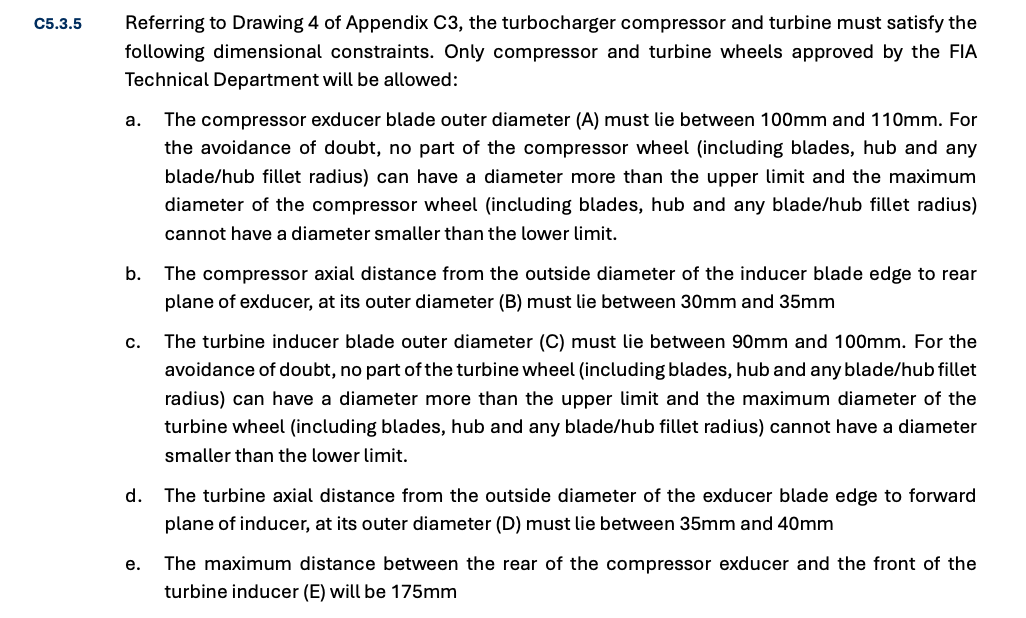
b & d have ensured the absence of a 'split turbo' haven't they ?vorticism wrote: ↑05 Jan 2026, 16:43There seems to be a few surprise freedoms within the turbocharger regs:
https://i.postimg.cc/3N591Byg/turbo-regs.png
If I perceive your Q at basic undergrad level, when is the turbine most effective ? when the compressor 'load' on the spindle can be attacked with the 'speed' of the exhaust gas molecules, rather than the 'pressure' of the exhaust gas molecules (temp = average RMS kinetic energy of N molecules, and pressure = volumetric density of the same average RMS kinetic energy of the N molecules ; from a simple viewpoint). To generate enough 'torque' to turn the turbine, how can anything other than radially attacking the blades of the turbine with the fast exhaust be optimal ? Doesn't this automatically mean an axial exit for the gases on the turbine side ?vorticism wrote: ↑05 Jan 2026, 16:43F.e. the turbine isn’t demanded to be single-sided, only the compressor is. A dual outlet turbine could provide some new options for wheel ramp profiles and oulet area (think of a double-sided compressor wheel). Also, directionality of flow is not specified, so a radial-outlfow turbine could be pursued. Is the inlet:outet area ratio of a turbocharger turbine considered to be a limiting factor in terms of geometry and packaging?
Keeping in mind the overall depth and diameter specs, and the rotational velocity limit, consider: inlet and outlet area can both be relatively greater, or I could provide up to twice the amount of outlet area relative to the inlet area, compared to a conventional design.
I am in Europe, UK specifically, and we definitely refer to iron heads as iron, not steel.Hoffman900 wrote: ↑05 Jan 2026, 17:10Europeans in my experience call iron heads “steel”Martin Keene wrote: ↑05 Jan 2026, 16:40I can't get my head around the idea either, so I did some reading.mzso wrote: ↑05 Jan 2026, 15:11So there are these rumors of Ferrari testing steel cylinder heads. How does this make sense? It just seems to me that it's just more weight rather high up.
And as far as I know, the minimum weight increase of 35kg is exactly the minimum weight of the now included energy storage. So no extra leeway there.
Now, this is my interpretation of the rules, and other may have a different view. But I don't see how a steel cylinder head is allowed in the rules.
What do the rules say:The rules state the head must be aluminum or iron alloy's. Steel by its definition is an alloy, an iron alloy with less than 2% carbon as defined by the World Steel Organisation, a material with more than 2% carbon is therefore iron alloy.5.18.8 Static components:
a. Other than inserts within them, engine crankcases including sump, cylinder heads and cylinder head cam covers must be manufactured from aluminium or iron alloys.
No composite materials or metal matrix composites are permitted either for the whole component or locally.
So the rules specifically exclude a steel alloy cylinder head. That's how I read it.
I believe Steel falls into the "iron alloy" designation, doesn't it? I mean, "Steel by its definition is an alloy, an iron alloy with ..." makes it pretty clear.Martin Keene wrote: ↑05 Jan 2026, 16:40
The rules state the head must be aluminum or iron alloy's. Steel by its definition is an alloy, an iron alloy with less than 2% carbon as defined by the World Steel Organisation, a material with more than 2% carbon is therefore iron alloy.
So the rules specifically exclude a steel alloy cylinder head. That's how I read it.
Yes, steel is very much an iron alloy.johnnycesup wrote: ↑05 Jan 2026, 18:08I believe Steel falls into the "iron alloy" designation, doesn't it? I mean, "Steel by its definition is an alloy, an iron alloy with ..." makes it pretty clear.Martin Keene wrote: ↑05 Jan 2026, 16:40
The rules state the head must be aluminum or iron alloy's. Steel by its definition is an alloy, an iron alloy with less than 2% carbon as defined by the World Steel Organisation, a material with more than 2% carbon is therefore iron alloy.
So the rules specifically exclude a steel alloy cylinder head. That's how I read it.
It can be extracted from the CAD. You could also do a tip-over test.
iron with more then 2% carbon is (by accident of history) called cast ironMartin Keene wrote: ↑05 Jan 2026, 16:40.....I don't see how a steel cylinder head is allowed in the rules.
.....The rules state the head must be aluminum or iron alloy's. Steel by its definition is an alloy, an iron alloy with less than 2% carbon as defined by the World Steel Organisation, a material with more than 2% carbon is therefore iron alloy.
So the rules specifically exclude a steel alloy cylinder head. That's how I read it.
C5.5.3 The centre of gravity of the Power Unit must be above Z=200. The parts considered are listed as “ICE” and “TC” in the “PU MASS GROUP” column of Appendix C3, with the exception of items 6 (ICE intake air system components), 20 (ICE-mounted electrical components), 29 (MGU-K Torque sensor), 30 (SCM), 41 (Powerbox), 43 (General electrical devices outside of the ESME) 44 (source of energy independent of the ES), 70 (PU air valve regulators) and 71 (PU air valve system equipment).
e does for the most part, but the center section can still be relatively long. 175mm between the wheels, 7 in.venkyhere wrote: ↑05 Jan 2026, 17:42b & d have ensured the absence of a 'split turbo' haven't they ?vorticism wrote: ↑05 Jan 2026, 16:43There seems to be a few surprise freedoms within the turbocharger regs:
https://i.postimg.cc/3N591Byg/turbo-regs.png