Concept power units from 2030

All that has to do with the power train, gearbox, clutch, fuels and lubricants, etc. Generally the mechanical side of Formula One.
saviour stivala
saviour stivala
43
Joined: 25 Apr 2018, 12:54

Re: Concept power units from 2030

Post

TeamKoolGreen wrote:
16 Jan 2026, 23:06
saviour stivala wrote:
16 Jan 2026, 06:32
TeamKoolGreen wrote:
16 Jan 2026, 04:52


The battery and PU is 35 kg heavier. Fuel has more energy density than batteries. Therefore the old PU is more thermally efficient

Yes, the 2026 power unit will be significantly more thermally efficient as will also be the car as a whole.
No. The 2026 PU is not more thermally efficient than the 2014-25 PU. And if you think it is , post your sources.
Yes, it will. How about your sources stating it will not?. While you started off on the 'ICE' only, and you might have had a point there, You carried that argument over to the 'power unit' which I was talking about. As for me, I technically do not need a source to tell me that the 2026 'power unit' is designed to be more thermally efficient than the 2025 'power unit'. The designed shift from 80/20 split of the combined electrical and ICE power, to a split of 50/50 leaves no doubt as to the intended designed efficiency advantage of the 2026 'power unit'. And, down-voting because one does not agree with what is being said, will not change anything for me, as I am used to that now.

TeamKoolGreen
TeamKoolGreen
-3
Joined: 22 Feb 2024, 01:49

Re: Concept power units from 2030

Post

Another slight of hand with the new power units is that they are 1000 horsepower ie more than the old power units. This isn't true. The peak power is higher. But if you were to use it for the same duration as the old PU, you are actually down about 134 horsepower.

Which was all explained a year ago by Engineering Explained


wuzak
wuzak
521
Joined: 30 Aug 2011, 03:26

Re: Concept power units from 2030

Post

BassVirolla wrote:
17 Jan 2026, 00:00
TeamKoolGreen wrote:
16 Jan 2026, 22:58
vorticism wrote:
16 Jan 2026, 20:35


" :o 35kg HEAVIER :evil:" is a meme at this point, has to be the most misunderstood part of these regulation and wuzak is single-handedly responsible for dispelling this myth online, lol.
So far nobody claiming that the 2026 PU is not 34 kg heavier hasn't produced a single source to prove it.

My source is The Race

The power units are getting a lot heavier again. The MGU-K is increasing from 7kg to 20kg total, and the battery from around 20-25kg to a minimum weight of 35kg. Even with no MGU-H, which is a saving of 4kg, some other ancillary part changes will up the total weight of the engine from 151kg to 185kg in 2026.


https://www.the-race.com/formula-1/what ... rovements.
Referring to the rulebook (5.7.1 - 5.7.3 - 5.20.7 and Appendix 3 in which the operational groups are defined), ICE + TC + MGUK equates to 150kg.

The 35kg are defined in 5.19.9 as the ES Main Enclosure. Appendix 3 defines ES Main Enclosure as:

- Enclosure
- Energy storage
- Control electronics
- All electric ancilliaries related to ES

So, minimum "engine" (ICE + TC + MGUK) mass is 150 kg.
C5.5 Mass and centre of gravity
C5.5.1 Depending on where the MGU-K Mechanical Transmission (as defined in item 27 of Appendix C4) is located, the overall mass of the ICE “PU Mass group” elements as referred to in Appendix C3 must be no less than the values defined below:
a. If all of the speed ratio of the MGU-K Mechanical Transmission is located in the RV-PU-ERS the total mass of the ICE must be no less than 130.0kg.
b. If all of the speed ratio of the MGU-K Mechanical Transmission is located in the RV-PU-ICE the total mass of the ICE must be no less than 134.0kg.
c. If part of the speed ratio of the MGU-K Mechanical Transmission is located in both the RV-PU-ICE and the RV-PU-ERS the total mass of the ICE must be no less than 132.0kg.

C5.18 MGU-K
C5.18.7 Depending on where the MGU-K Mechanical Transmission is located, the total mass of the MGU-K “PU Mass group” elements as referred to in Appendix C4 must be no less than the values defined below:
a. If all of the speed ratio of the MGU-K Mechanical Transmission is located in the RV-PU-ERS the total mass of the MGU-K must be no less than 20.0kg.
b. If all of the speed ratio of the MGU-K Mechanical Transmission is located in the RV-PU-ICE the total mass of the MGU-K must be no less than 16.0kg.
c. If part of the speed ratio of the MGU-K Mechanical Transmission is located in both the RV-PU-ICE and the RV-PU-ERS the total mass of the MGU-K must be no less than 18.0kg.
The total mass of item 29 (MGU-K torque sensor) and item 31 (K torque sensor shaft and mechanical connection between MGU-K and ICE) must be allocated to either the MGU-K or the ICE to assess compliance with this article and article C5.5.1.

C5.17 Energy Recovery System (ERS)
C5.17.9 The minimum mass for the ES Main Enclosure PU Mass group elements as defined in Appendix C4 is 35.0kg. The procedure which will be used to determine this value may be found in the document FIA-F1-DOC-Cxxx.

The following items are included in the ES Main Enclosure mass group exclusively (from Table 1, Appendix C4):
  • ES Main Enclosure (ESME)
  • Energy Store
  • Regulatory DC sensors and Insulation monitoring device
  • Safety devices (Fuses, Contactors, MSD, relays)
  • Busbars, connectors conductors, looms or any other component fitted inside the ESME that is not explicitly mentioned in any other rows of this table.
  • CU-K
  • DC-DC Unit
  • General electrical devices inside the ESME, including Power distribution board, Driver for PU electric pumps, LV fuse box and any electronic box exclusively used for PU functionalities.
  • Non ICE-mounted ERS cooling system including pumps, associated motors, actuators, excluding tubes and hoses
Items that can be counted in the ES mass or another "mass group":
  • MGU-K torque sensor signal conditioning module (SCM) (MGU-K or ICE or ESME)
  • General electrical devices outside or on the ESME, including Power distribution board, Driver for PU electric pumps, LV fuse box and any electronic box exclusively used for PU functionalities. (ES or ICE)
  • Source of energy independent of the ES exclusively used for PU functionalities (ES or ICE)

From the 2024 PU regulations (PU was frozen from 2022 to 2025):
5.5 Mass and centre of gravity
5.5.1 The overall mass of the power unit must be a minimum of 151kg.
5.5.2 The centre of gravity of the power unit must be above Z=200.
5.5.3 The total mass of the part of the ES that stores energy, i.e. the cells (including any clamping plates) and electrical connections between cells, must be no less than 20kg and must not exceed 25kg. [Energy Store in 2026]

5.13 Energy Recovery System (ERS)
5.13.6 The following elements of the power unit must be installed wholly within the survival cell:
a. ES elements as defined in lines 16 and 17 of Appendix 3 to these regulations.
b. Any DC-DC converter connected to ES HV DC bus. Includes active parts, enclosure, brackets and supports.
c. CU-K. Includes active parts, enclosure, brackets and supports.
d. CU-H. Includes active parts, enclosure, brackets and supports.
e. HV DC connections between ES and CU-K/CU-H/DC-DC converter. Includes all conductors, insulation, EMC screening, mechanical and thermal shielding.
The minimum values of volume and mass for these groups of components are 22.0 l and 31.0 kg respectively. The procedure which will be used to determine these values may be found in the Appendix to the Technical and Sporting Regulations.

These are some of the items are exluded from the PU mass (from Table 1, Appendix 3):
  • ES parts defined in Article 5.5.3
  • ES excluding parts defined in Article 5.5.3
The following is included in the PU mass for 2024:
  • PU-CE excluding associated brackets, supports, screws, nuts, dowels, washers or cables.
This includes the CU-K, which is in the ESME mass group for 2026.

To summarise:
2025 PU minimum mass = 151kg, excluding the ES.
2026 ICE + Turbo + MGUK + MGUK Transmission = 150kg.

2026 ESME minimum mass is 35kg.
The equivalent for 2025 is 31kg, though the Power Unit Control Electronics (including the CU-K) is also included in the PU.

mzso
mzso
72
Joined: 05 Apr 2014, 14:52

Re: Concept power units from 2030

Post

TeamKoolGreen wrote:
16 Jan 2026, 22:58
So far nobody claiming that the 2026 PU is not 34 kg heavier hasn't produced a single source to prove it.

My source is The Race

The power units are getting a lot heavier again. The MGU-K is increasing from 7kg to 20kg total, and the battery from around 20-25kg to a minimum weight of 35kg. Even with no MGU-H, which is a saving of 4kg, some other ancillary part changes will up the total weight of the engine from 151kg to 185kg in 2026.


https://www.the-race.com/formula-1/what ... rovements.
Why would you refer to tabloid websites with lazy journalists, when people here are quoting from the regulations?
They did it before this comment, you just didn't pay attention.

TeamKoolGreen
TeamKoolGreen
-3
Joined: 22 Feb 2024, 01:49

Re: Concept power units from 2030

Post

mzso wrote:
17 Jan 2026, 12:17
TeamKoolGreen wrote:
16 Jan 2026, 22:58
So far nobody claiming that the 2026 PU is not 34 kg heavier hasn't produced a single source to prove it.

My source is The Race

The power units are getting a lot heavier again. The MGU-K is increasing from 7kg to 20kg total, and the battery from around 20-25kg to a minimum weight of 35kg. Even with no MGU-H, which is a saving of 4kg, some other ancillary part changes will up the total weight of the engine from 151kg to 185kg in 2026.


https://www.the-race.com/formula-1/what ... rovements.
Why would you refer to tabloid websites with lazy journalists, when people here are quoting from the regulations?
They did it before this comment, you just didn't pay attention.
That isn't a link. How is anyone supposed to verify it ?

Why should i believe some posters on one forum when literally every search engine i use and every search query that I make says the power unit and battery of the 2026 regs is 34 kg more than last years.

The battery is getting bigger. Bigger batteries tend to weigh more than smaller ones.

wuzak
wuzak
521
Joined: 30 Aug 2011, 03:26

Re: Concept power units from 2030

Post

TeamKoolGreen wrote:
18 Jan 2026, 04:03
Why should i believe some posters on one forum when literally every search engine i use and every search query that I make says the power unit and battery of the 2026 regs is 34 kg more than last years.
I have given teh links to the current and previous regulations below so you can check yourself.

The answer as to why the journalists get it wrong, IMO, is that they see:
C5.5.2 The overall mass of the PU must be a minimum of 185 kg. for the 2026 regulations and compare it to
5.5.1 The overall mass of the power unit must be a minimum of 151kg. for the 2025 regulations.

The difference between them is 34kg.

But those lines do not specify what is included in the Power Unit mass.
That is shown in Appendix 4 (2026) and Appendix 3 (2025).

In the 2026 regulations theer are 84 items listed, showing which part of the PU they belong to (those not included in the PU are listed as EXC) for mass.

The 2025 regulations have 44 items, with one column indicating if an item is included or excluded from the PU mass.


TeamKoolGreen wrote:
18 Jan 2026, 04:03
The battery is getting bigger. Bigger batteries tend to weigh more than smaller ones.
From 2026 F1 Technical regulations, Issue 15:
C5.2.9 The difference between the maximum and the minimum state of charge of the ES may not exceed 4MJ at any time the car is on the track.

https://www.fia.com/system/files/docume ... 2-10_0.pdf

The 2025 F1 Technical Regulations Issue 3 can be downloaded from the following link:
https://www.fia.com/sites/default/files ... -04-07.pdf

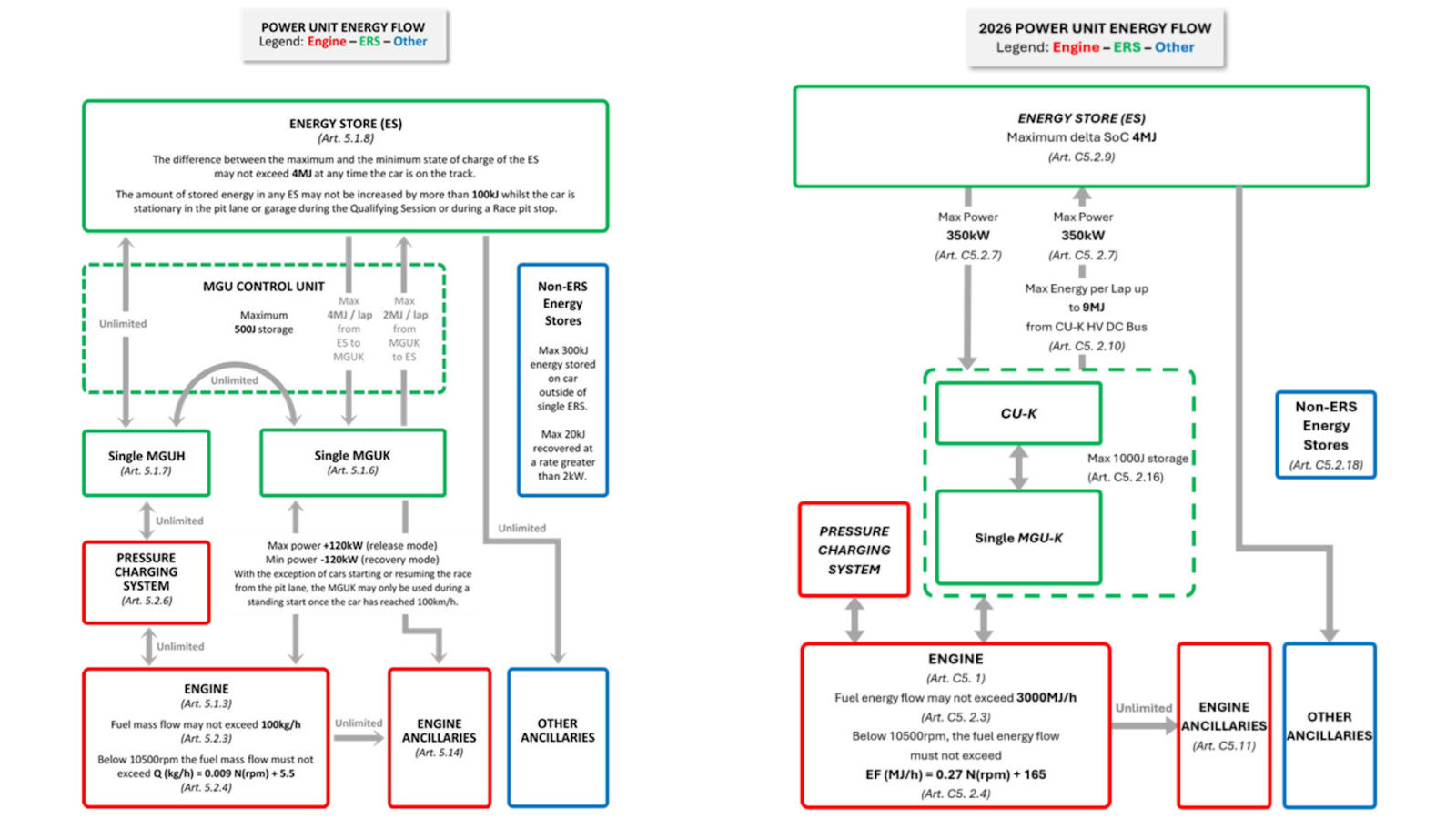
Image

https://www.planetf1.com/features/f1-un ... ms-in-2026

The diagram on the left is from the 2025 regulations and the right from 2026.

The battery (Energy Store/ES) is described in the top box.
In both cases, the nominal capacity of the battery is 4MJ.

wuzak
wuzak
521
Joined: 30 Aug 2011, 03:26

Re: Concept power units from 2030

Post

TeamKoolGreen wrote:
18 Jan 2026, 04:03
That isn't a link. How is anyone supposed to verify it ?
The F1 regulations can be downloaded from the FIA website: https://www.fia.com/

mzso
mzso
72
Joined: 05 Apr 2014, 14:52

Re: Concept power units from 2030

Post

TeamKoolGreen wrote:
18 Jan 2026, 04:03
That isn't a link. How is anyone supposed to verify it ?
What isn't?
They often link the documents in their quotes, if that is what you mean. Also you can look for them on the FIA website yourself... Even AI chatbots will look them up for you.
TeamKoolGreen wrote:
18 Jan 2026, 04:03
Why should i believe some posters on one forum when literally every search engine i use and every search query that I make says the power unit and battery of the 2026 regs is 34 kg more than last years.
Why do you believe tabloids in the first few results of google biased search, that don't quote regulations? A random journalist with no technical understanding is better?

TeamKoolGreen
TeamKoolGreen
-3
Joined: 22 Feb 2024, 01:49

Re: Concept power units from 2030

Post

So now the batteries aren't getting bigger anymore either or something :roll: 2 posters on a forum know more than the entire collective of the F1 media sphere, including independent Youtubers, former team principles and technical directors everyone. Whatever. I don't care anymore.

mzso
mzso
72
Joined: 05 Apr 2014, 14:52

Re: Concept power units from 2030

Post

TeamKoolGreen wrote:
18 Jan 2026, 22:15
So now the batteries aren't getting bigger anymore either or something :roll: 2 posters on a forum know more than the entire collective of the F1 media sphere, including independent Youtubers, former team principles and technical directors everyone. Whatever. I don't care anymore.
Not in weight anyway.

wuzak
wuzak
521
Joined: 30 Aug 2011, 03:26

Re: Concept power units from 2030

Post

TeamKoolGreen wrote:
18 Jan 2026, 22:15
So now the batteries aren't getting bigger anymore either or something :roll: 2 posters on a forum know more than the entire collective of the F1 media sphere, including independent Youtubers, former team principles and technical directors everyone. Whatever. I don't care anymore.
We know that the nominal capacity of the battery is remaining the same - 4MJ.
We know that the cells and connectors for 2025 must weigh between 20kg and 25kg, but this is not defined for 2026.
We know that the minimum weight of the enclosure has gone from 31kg to 35kg, though what is included in that weight is not exactly the same.
We know that the minimum weight of the PU in 2025 was 151kg without the battery, and 185kg in 2026 with the battery.

We also know that, given the energy density of lithium ion cells, the actual energy storage of the battery in 2025 was likely >10MJ.

You are welcome to read the regulations for yourself and point out where I am wrong.