Mclaren MCL40

A place to discuss the characteristics of the cars in Formula One, both current as well as historical. Laptimes, driver worshipping and team chatter do not belong here.
vorticism
vorticism
436
Joined: 01 Mar 2022, 20:20
Location: YooEssay

Re: Mclaren MCL40

Post

_cerber1 wrote:
30 Jan 2026, 07:14
There's a lot of interesting stuff in the back too, we desperately need pictures from there.
https://iimg.su/i/77yXXE
Image
My understanding is that there is a standard multi-element winglet that is attached to the diffuser. The brake duct mounted winglets were disallowed, and this must have been the compromise. To limit development on a part that everyone agreed was needed, so they standardized it and moved it inboard, off of the wheel. This paddle shaped top element is visible in early FIA press renderings.

vorticism wrote:
17 Jan 2026, 17:37
Visible in blue here.

Image
Screenshot from: https://x.com/Qvist_Designs/status/2012 ... 38357?s=20
🏴󠁧󠁢󠁥󠁮󠁧󠁿

User avatar
SilviuAgo
104
Joined: 15 Aug 2020, 16:08

Re: Mclaren MCL40

Post

Image

Francis Bacon
Francis Bacon
3
Joined: 03 Sep 2021, 20:07

Re: Mclaren MCL40

Post

haza wrote:
28 Jan 2026, 19:40
What’s the reasoning for that design Surely those endplate winglets are going to act as an aerofoil producing lift
To me, its looks like it might do two things: 1). Direct a structured flow down and around the tire, matching the direction of the tire's rotation. In addition to this possibly being a neatly effective way of reducing pressure and turbulence on the face of the tire, it would send highly energized air toward the barge boards, and help seal the floor with a more robust airstream. From the looks of that wing, and considering the downward motion of the tire, it'll make a mean Y250. 2). When you look at the airfoil alongside and imagine the effect it would have on the end plate, one can see how it might cause the endplate to bend inward, which could have the beneficial effect of sending more air inboard of the tires. At high speeds, one can imagine it causing wing flex that would aid in streamlining.

User avatar
SilviuAgo
104
Joined: 15 Aug 2020, 16:08

Re: Mclaren MCL40

Post

Francis Bacon wrote:
30 Jan 2026, 18:59
haza wrote:
28 Jan 2026, 19:40
What’s the reasoning for that design Surely those endplate winglets are going to act as an aerofoil producing lift
To me, its looks like it might do two things: 1). Direct a structured flow down and around the tire, matching the direction of the tire's rotation. In addition to this possibly being a neatly effective way of reducing pressure and turbulence on the face of the tire, it would send highly energized air toward the barge boards, and help seal the floor with a more robust airstream. From the looks of that wing, and considering the downward motion of the tire, it'll make a mean Y250. 2). When you look at the airfoil alongside and imagine the effect it would have on the end plate, one can see how it might cause the endplate to bend inward, which could have the beneficial effect of sending more air inboard of the tires. At high speeds, one can imagine it causing wing flex that would aid in streamlining.
Also my opinion is that the primary aerodynamic purpose of this design is flow conditioning and vortex generation, rather than direct load production.

1. Front tyre wake control
The front tyre generates a highly turbulent wake that interferes with airflow directed toward the floor and sidepods.
The dual horizontal elements likely:
a. Redirect high-energy flow outward and downward around the tyre,
b. Shape the tyre wake to prevent it from spilling into the underfloor inlet region,
c. Create a more coherent and predictable flow structure downstream.
This improves the quality of airflow delivered to the leading edge of the floor and diffuser.

2. Floor edge vortex generation and sealing
The geometry is well positioned to create a strong, stable vortex that travels along the floor edge.
This vortex acts as a virtual skirt by:
a. Preventing high-pressure ambient air from leaking under the floor,
b. Maintaining lower pressure beneath the car,
c. Increasing underfloor downforce efficiency.
Compared to a single-element endplate, the split horizontal structure may allow McLaren to control the strength and position of this vortex more precisely.

3. Improved robustness in yaw
In yaw conditions (cornering, crosswinds), airflow tends to detach more easily from sharp endplate geometries.
The horizontal elements likely help:
a. Keep the flow attached in yaw,
b. Maintain vortex stability,
c. Reduce sensitivity to steering angle and ride height changes.
This results in more consistent front-end balance across a wider operating window.

Image

LionsHeart
LionsHeart
17
Joined: 09 Mar 2023, 19:21

Re: Mclaren MCL40

Post

SilviuAgo wrote:
30 Jan 2026, 19:42
Francis Bacon wrote:
30 Jan 2026, 18:59
haza wrote:
28 Jan 2026, 19:40


What’s the reasoning for that design Surely those endplate winglets are going to act as an aerofoil producing lift
To me, its looks like it might do two things: 1). Direct a structured flow down and around the tire, matching the direction of the tire's rotation. In addition to this possibly being a neatly effective way of reducing pressure and turbulence on the face of the tire, it would send highly energized air toward the barge boards, and help seal the floor with a more robust airstream. From the looks of that wing, and considering the downward motion of the tire, it'll make a mean Y250. 2). When you look at the airfoil alongside and imagine the effect it would have on the end plate, one can see how it might cause the endplate to bend inward, which could have the beneficial effect of sending more air inboard of the tires. At high speeds, one can imagine it causing wing flex that would aid in streamlining.
Also my opinion is that the primary aerodynamic purpose of this design is flow conditioning and vortex generation, rather than direct load production.

1. Front tyre wake control
The front tyre generates a highly turbulent wake that interferes with airflow directed toward the floor and sidepods.
The dual horizontal elements likely:
a. Redirect high-energy flow outward and downward around the tyre,
b. Shape the tyre wake to prevent it from spilling into the underfloor inlet region,
c. Create a more coherent and predictable flow structure downstream.
This improves the quality of airflow delivered to the leading edge of the floor and diffuser.

2. Floor edge vortex generation and sealing
The geometry is well positioned to create a strong, stable vortex that travels along the floor edge.
This vortex acts as a virtual skirt by:
a. Preventing high-pressure ambient air from leaking under the floor,
b. Maintaining lower pressure beneath the car,
c. Increasing underfloor downforce efficiency.
Compared to a single-element endplate, the split horizontal structure may allow McLaren to control the strength and position of this vortex more precisely.

3. Improved robustness in yaw
In yaw conditions (cornering, crosswinds), airflow tends to detach more easily from sharp endplate geometries.
The horizontal elements likely help:
a. Keep the flow attached in yaw,
b. Maintain vortex stability,
c. Reduce sensitivity to steering angle and ride height changes.
This results in more consistent front-end balance across a wider operating window.

https://pbs.twimg.com/media/G_wFzGyXoAA ... ame=medium
Interesting opinions from two people. This is why I love technical forums—where you can discuss and discover the truth. Let's see how the teams implement updates throughout the year. Which car will everyone end up with the closest design?

Andi76
Andi76
471
Joined: 03 Feb 2021, 20:19

Re: Mclaren MCL40

Post

LionsHeart wrote:
27 Jan 2026, 08:56
Andi76 wrote:
27 Jan 2026, 07:53
LionsHeart wrote:
26 Jan 2026, 16:35
A comprehensive and detailed answer! Thank you. While I generally understand the underlying physics and, to some extent, suspension kinematics, the use of pullrods in Ferrari's in 2012 front suspension has always been somewhat of a mystery to me. Then, in 2013, they switched back to pushrods, but now McLaren has switched to pullrods, and then they switched back to pushrods in 2014. General physics suggests aerodynamic gains? That's what I usually hear from technical experts. If I'm not mistaken, the same thing was said about Red Bull and McLaren in 2022. And now, from Rob Marshall, I learn that pushrod front suspension is dictated by aerodynamics. Let's assume that's true. As someone with a technical background, it's clear to me that some processes, in terms of tire-road interaction and how the chassis affects the tires, must change. In civilian vehicles, everything seems simpler. How much does the presence of a pushrod or pullrods affect the tires longitudinally during braking?

You mentioned dive. But in terms of sensitivity and operating range depending on the wheelbase and chassis width, I'm still pretty clear. Well, it's kind of logical. A short wheelbase gives a go-kart-like agility. In this context, I remember how Mercedes started lengthening the wheelbase every year to slightly extend the underbody, thereby increasing downforce and making the chassis more stable overall.

Overall, I was just trying to understand the critical point of swapping pushrods for pullrods, or vice versa, from a mechanical standpoint, without taking into account aerodynamics, the difficulty of setup for mechanics, and even the center of gravity due to the placement of the mechanisms within the chassis. Is there a direct correlation between how this affects corner entry, corner exit, and braking? Are there any balance changes depending on the pushrod-pusher relationship? About 13-14 years ago, when I first thought about this, I didn't get any definitive answers. It all came down to aerodynamics and how airflow flows through the suspension arms toward the sidepods and floor. From my perspective, I figured if the front suspension had pushrods, then the rear should have pullrods. If the front had pullrods, then the rear should have pushrods. Of course, in my mind, this was justified in the context of balance, not aerodynamics. From an aerodynamic standpoint, I can understand and accept it.

In any case, thank you for your detailed answer. There's something to understand and remember for the future.
Now I have a little time to delve a little deeper into the subject matter. The confusion surrounding Ferrari in 2012/2013 and McLaren illustrates the dilemma perfectly: the aerodynamic advantages are often so great that they force mechanical compromises. But if we completely disregard aerodynamics and the center of gravity (CoG), what remains is a purely mechanical difference in load path efficiency and friction characteristics.

You mentioned braking. Mechanically speaking, a pushrod/pullrod system alone does not necessarily change the geometry of the suspension (the control arm points), but it does change how the vertical load is introduced into the chassis.
Pushrod during braking: Since the rod leads upward to the chassis, it generates a force component during compression (when diving) that tends to push against the upper suspension points.
Pullrod during braking: Here, the force is pulled "downward." The problem with pullrods at the front is often mechanical interference. In order to achieve good geometry for braking (anti-dive), the wishbones must be at certain angles. A pull rod often has to be installed at a very flat angle, which massively increases the internal friction forces in the bearings.

The result for the tire: A pushrod system is usually "stiffer" when it comes to small movements. When braking, this means more direct feedback for the driver. A pullrod system can have higher static friction (stiction) due to the flatter angles, which can make it harder to feel the tire's locking limit. When we talk about the mechanical core, the biggest difference is installation stiffness.

Corner entry: Here you want maximum precision. Since the rockers are located at the top of the chassis in the pushrod, the force path is shorter and the components can be made more solid without disturbing the airflow in the important lower area. This gives the driver a more direct feel for the front axle. When you throw the car into a corner, the pushrod responds more "honestly."

Corner exit (accelerating out): Here, the interaction between the front and rear is crucial. Your theory (push at the front, pull at the rear, or vice versa) is not so far-fetched mechanically! It's all about the pitch platform. When the rear squats during acceleration, the suspension determines how stable the floor plate remains in relation to the asphalt.

Why not always a mixture?
The reason why you often see "front pull/rear push" or vice versa is because of the response rate. A pull rod system at the rear (as was long standard) is great for lowering the dampers, but often has a more progressive spring rate mechanically.
When you combine this with a very linear pushrod front, you get a car that is very sharp when turning in, but "sits" stably when exiting corners. However, as you say, when you look at the mechanical balance, you have to be careful not to introduce too many variables. A car with two different systems is extremely difficult to harmonize in simulation and setup because the friction values and elastokinematics are completely different.

Without aerodynamics, the pushrod would almost always be the mechanically superior choice for the front because it gives the driver more feel through the steering wheel. It is easier to maintain, stiffer, and has less internal friction.

The fact that McLaren and Red Bull used pullrods was actually purely a "sacrifice" to the aerodynamics of the underbody. They accept the mechanical disadvantages (poorer adjustability, higher friction, more complicated load paths) because the gain in clean air to the diffuser and Venturi channels is so enormous that it far outweighs the mechanical losses.

I'm not an aerodynamicist, but to explain it simply and in layman's terms, aerodynamicists – correct me if I'm wrong or if my explanation is inadequate:

Pushrod (front axle): The strut runs from the wheel (bottom) to the chassis (top). It therefore rises towards the center of the vehicle. The air that hits this sloping barrier is deflected along the slope—i.e., upwards and inwards (inwash) towards the top of the chassis and the cockpit.

Pullrod (front axle): The strut runs from the wheel (top) to the chassis (bottom). It slopes down towards the center of the vehicle. The air is directed downwards and outwards (outwash) along this slope towards the tire sidewall and the outer edge of the floor.

In the 2022-2025 era, the Venturi effect was so strong that the underbody literally sucked in air like a vacuum cleaner.
The problem: if the air simply flows straight inwards (inwash), the underbody sucks the turbulent, "dirty" air from the front tires directly into the channels. This would make the ground effect unstable.
The solution: Use pullrod geometry to push the air down and out at the chassis inlet. This "outwash" acts like a protective shield. It pushes the dirty tire air outwards so that the Venturi channels further back can only suck in "clean" air from the front of the vehicle.

But why now pushrod (inwash) for 2026?

The philosophy is changing for 2026 because the cars will be narrower and the "vacuum cleaner effect" of the floor will be massively reduced.
The problem in 2026: Since the cars are narrower, the drag of the tires is the biggest obstacle to top speed (important for overtaking with the new "override" mode).

The solution (pushrod/inwash): The aim is no longer to force the air outwards (which creates drag), but to direct it inwards (inwash) over the chassis. Since the floor will be flatter in 2026, it will no longer be as sensitive to tire turbulence as the deep Venturi tunnels and will work differently. This means you can "afford" to direct more air inwards to make the car more aerodynamically slippery overall, what gives you more performance and - like i said above pushrod is "more honest" and easier to access, so easier to set-up and maintain, so Pushrod gives more advantages this time.

Ferrari's 2012 pullrod solution was actually purely aerodynamic in nature. It was possible to notably raise the lower plane of the monocoque and therefore, influence the aerodynamic flow directed towards the keel, radiator intakes and sidepods. If the FIA hadn't prohibited the passage of air between the upper and lower part of the nose the following seasons, many teams would have followed. But anyway - the high-nose also forced an extreme angle of the pullrods, the dimensions of which were increased. The mechanics and the greater operational difficulty created some problems.

From a structural point of view it imposed greater stress on the upper wishbone and the mounts to the chassis, which had to be reinforced. Also it changed the ratio of the suspension considerably. At equal wheel movement, the rotation of the rocker arm was much reduced compared to that which happens with a pushrod. Flexibility of the elastic elements had to be recalculated, and damper settings, too, to obtain equal ground stiffness.

But I don't think I need to go into any more detail, even though there are a few more interesting things to say about how this suspension worked – ultimately, it was purely aerodynamic, as I hope has become clear. This suspension was retained, even though its advantages disappeared the following year thanks to the FIA, as mentioned above. McLaren's choice the following year, even though the advantage was gone, was simply because they had already developed the suspension and wanted to take advantage of its benefits, and the FIA intervened with its rule change, so they had to live with it and didn't want to/couldn't waste resources on designing a new suspension.

User avatar
mwillems
48
Joined: 04 Sep 2016, 22:11

Re: Mclaren MCL40

Post

I love the front wing, it's a nice way of dealing with tyre wake when the wing is on "open" mode and when not- this goes for both with the FW elements and with the endplate philosophy.

It looks on face value a slightly more developed wing on the grid and I suspect that little winglet that is creating outer load and vortex will get copied.

The bargeboards are very much designed with that in mind and it does feel like the outer portion of the front wing is not just pushing air around the tyre, but already cleaning it. Does it then return to the car in a semi cleaned state and add to the airflow pushed to the rear?

It's really interesting that they need to design the front half of the car for two airflow states.

As someone mentioned, that wing looks like it might create a little lift. Will that lift be impactful with the airflow going to the floor it it raises the wing slightly (Or prevents it dropping so much) on the straight when the moveable elements are open?
I'm not taking advice from a cartoon dog

-Bandit

User avatar
organic
1141
Joined: 08 Jan 2022, 02:24
Location: Cambridge, UK

Re: Mclaren MCL40

Post

mwillems wrote:
31 Jan 2026, 21:15

It looks on face value a slightly more developed wing on the grid and I suspect that little winglet that is creating outer load and vortex will get copied.

Can you elaborate?

Are you talking about the outboard horizontal wing element on the FWEP?

User avatar
AR3-GP
535
Joined: 06 Jul 2021, 01:22

Re: Mclaren MCL40

Post

Beware of T-Rex

Emag
Emag
133
Joined: 11 Feb 2019, 14:56

Re: Mclaren MCL40

Post


It seems like there's quite a few things this car is currently doing differently than the others.
Developer of F1InsightsHub

User avatar
mwillems
48
Joined: 04 Sep 2016, 22:11

Re: Mclaren MCL40

Post

Emag wrote:
02 Feb 2026, 12:08


It seems like there's quite a few things this car is currently doing differently than the others.
Brilliant video, thanks.
I'm not taking advice from a cartoon dog

-Bandit

User avatar
SilviuAgo
104
Joined: 15 Aug 2020, 16:08

Re: Mclaren MCL40

Post


User avatar
AR3-GP
535
Joined: 06 Jul 2021, 01:22

Re: Mclaren MCL40

Post

SilviuAgo wrote:
03 Feb 2026, 19:01
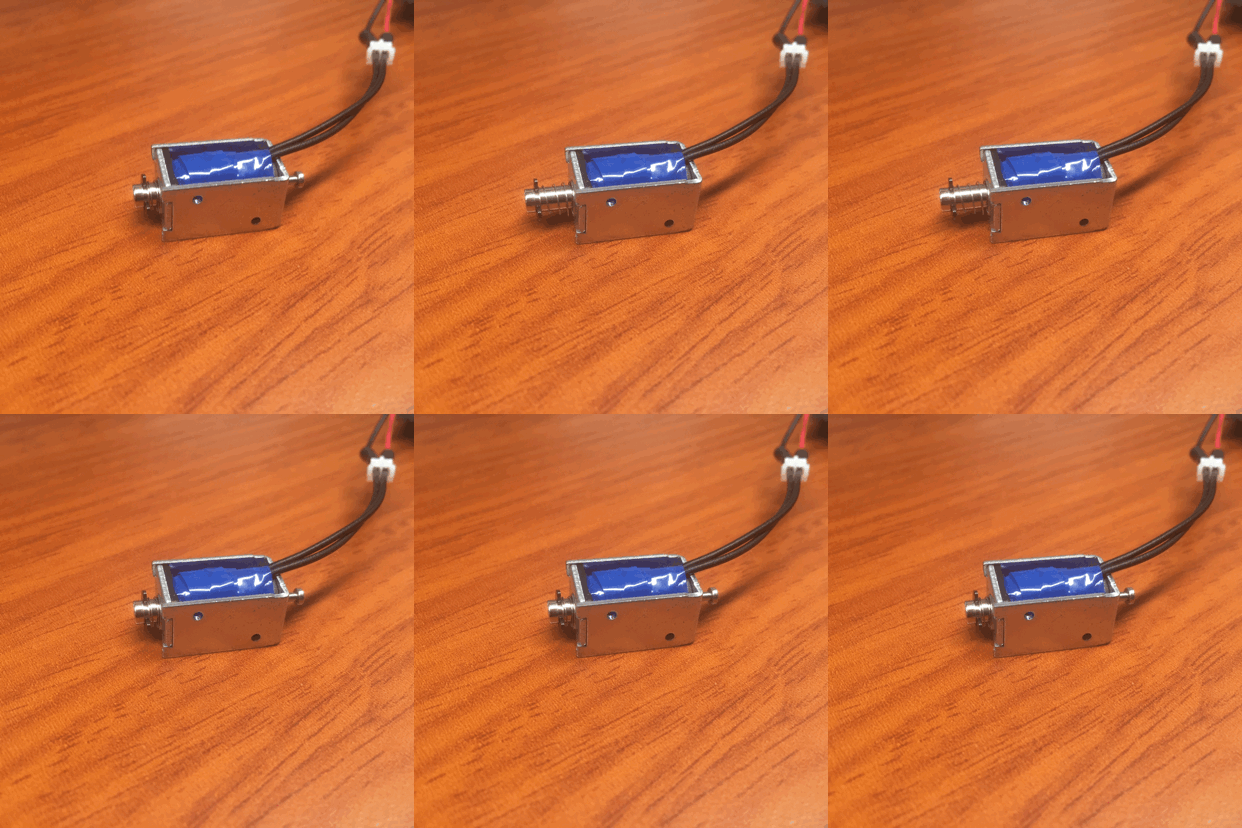
It is also possible that it is electric:

Image
Beware of T-Rex

LionsHeart
LionsHeart
17
Joined: 09 Mar 2023, 19:21

Re: Mclaren MCL40

Post

Andi76 wrote:
30 Jan 2026, 20:09
LionsHeart wrote:
27 Jan 2026, 08:56
Andi76 wrote:
27 Jan 2026, 07:53

A comprehensive and detailed answer! Thank you. While I generally understand the underlying physics and, to some extent, suspension kinematics, the use of pullrods in Ferrari's in 2012 front suspension has always been somewhat of a mystery to me. Then, in 2013, they switched back to pushrods, but now McLaren has switched to pullrods, and then they switched back to pushrods in 2014. General physics suggests aerodynamic gains? That's what I usually hear from technical experts. If I'm not mistaken, the same thing was said about Red Bull and McLaren in 2022. And now, from Rob Marshall, I learn that pushrod front suspension is dictated by aerodynamics. Let's assume that's true. As someone with a technical background, it's clear to me that some processes, in terms of tire-road interaction and how the chassis affects the tires, must change. In civilian vehicles, everything seems simpler. How much does the presence of a pushrod or pullrods affect the tires longitudinally during braking?

You mentioned dive. But in terms of sensitivity and operating range depending on the wheelbase and chassis width, I'm still pretty clear. Well, it's kind of logical. A short wheelbase gives a go-kart-like agility. In this context, I remember how Mercedes started lengthening the wheelbase every year to slightly extend the underbody, thereby increasing downforce and making the chassis more stable overall.

Overall, I was just trying to understand the critical point of swapping pushrods for pullrods, or vice versa, from a mechanical standpoint, without taking into account aerodynamics, the difficulty of setup for mechanics, and even the center of gravity due to the placement of the mechanisms within the chassis. Is there a direct correlation between how this affects corner entry, corner exit, and braking? Are there any balance changes depending on the pushrod-pusher relationship? About 13-14 years ago, when I first thought about this, I didn't get any definitive answers. It all came down to aerodynamics and how airflow flows through the suspension arms toward the sidepods and floor. From my perspective, I figured if the front suspension had pushrods, then the rear should have pullrods. If the front had pullrods, then the rear should have pushrods. Of course, in my mind, this was justified in the context of balance, not aerodynamics. From an aerodynamic standpoint, I can understand and accept it.

In any case, thank you for your detailed answer. There's something to understand and remember for the future.
Now I have a little time to delve a little deeper into the subject matter. The confusion surrounding Ferrari in 2012/2013 and McLaren illustrates the dilemma perfectly: the aerodynamic advantages are often so great that they force mechanical compromises. But if we completely disregard aerodynamics and the center of gravity (CoG), what remains is a purely mechanical difference in load path efficiency and friction characteristics.

You mentioned braking. Mechanically speaking, a pushrod/pullrod system alone does not necessarily change the geometry of the suspension (the control arm points), but it does change how the vertical load is introduced into the chassis.
Pushrod during braking: Since the rod leads upward to the chassis, it generates a force component during compression (when diving) that tends to push against the upper suspension points.
Pullrod during braking: Here, the force is pulled "downward." The problem with pullrods at the front is often mechanical interference. In order to achieve good geometry for braking (anti-dive), the wishbones must be at certain angles. A pull rod often has to be installed at a very flat angle, which massively increases the internal friction forces in the bearings.

The result for the tire: A pushrod system is usually "stiffer" when it comes to small movements. When braking, this means more direct feedback for the driver. A pullrod system can have higher static friction (stiction) due to the flatter angles, which can make it harder to feel the tire's locking limit. When we talk about the mechanical core, the biggest difference is installation stiffness.

Corner entry: Here you want maximum precision. Since the rockers are located at the top of the chassis in the pushrod, the force path is shorter and the components can be made more solid without disturbing the airflow in the important lower area. This gives the driver a more direct feel for the front axle. When you throw the car into a corner, the pushrod responds more "honestly."

Corner exit (accelerating out): Here, the interaction between the front and rear is crucial. Your theory (push at the front, pull at the rear, or vice versa) is not so far-fetched mechanically! It's all about the pitch platform. When the rear squats during acceleration, the suspension determines how stable the floor plate remains in relation to the asphalt.

Why not always a mixture?
The reason why you often see "front pull/rear push" or vice versa is because of the response rate. A pull rod system at the rear (as was long standard) is great for lowering the dampers, but often has a more progressive spring rate mechanically.
When you combine this with a very linear pushrod front, you get a car that is very sharp when turning in, but "sits" stably when exiting corners. However, as you say, when you look at the mechanical balance, you have to be careful not to introduce too many variables. A car with two different systems is extremely difficult to harmonize in simulation and setup because the friction values and elastokinematics are completely different.

Without aerodynamics, the pushrod would almost always be the mechanically superior choice for the front because it gives the driver more feel through the steering wheel. It is easier to maintain, stiffer, and has less internal friction.

The fact that McLaren and Red Bull used pullrods was actually purely a "sacrifice" to the aerodynamics of the underbody. They accept the mechanical disadvantages (poorer adjustability, higher friction, more complicated load paths) because the gain in clean air to the diffuser and Venturi channels is so enormous that it far outweighs the mechanical losses.

I'm not an aerodynamicist, but to explain it simply and in layman's terms, aerodynamicists – correct me if I'm wrong or if my explanation is inadequate:

Pushrod (front axle): The strut runs from the wheel (bottom) to the chassis (top). It therefore rises towards the center of the vehicle. The air that hits this sloping barrier is deflected along the slope—i.e., upwards and inwards (inwash) towards the top of the chassis and the cockpit.

Pullrod (front axle): The strut runs from the wheel (top) to the chassis (bottom). It slopes down towards the center of the vehicle. The air is directed downwards and outwards (outwash) along this slope towards the tire sidewall and the outer edge of the floor.

In the 2022-2025 era, the Venturi effect was so strong that the underbody literally sucked in air like a vacuum cleaner.
The problem: if the air simply flows straight inwards (inwash), the underbody sucks the turbulent, "dirty" air from the front tires directly into the channels. This would make the ground effect unstable.
The solution: Use pullrod geometry to push the air down and out at the chassis inlet. This "outwash" acts like a protective shield. It pushes the dirty tire air outwards so that the Venturi channels further back can only suck in "clean" air from the front of the vehicle.

But why now pushrod (inwash) for 2026?

The philosophy is changing for 2026 because the cars will be narrower and the "vacuum cleaner effect" of the floor will be massively reduced.
The problem in 2026: Since the cars are narrower, the drag of the tires is the biggest obstacle to top speed (important for overtaking with the new "override" mode).

The solution (pushrod/inwash): The aim is no longer to force the air outwards (which creates drag), but to direct it inwards (inwash) over the chassis. Since the floor will be flatter in 2026, it will no longer be as sensitive to tire turbulence as the deep Venturi tunnels and will work differently. This means you can "afford" to direct more air inwards to make the car more aerodynamically slippery overall, what gives you more performance and - like i said above pushrod is "more honest" and easier to access, so easier to set-up and maintain, so Pushrod gives more advantages this time.

Ferrari's 2012 pullrod solution was actually purely aerodynamic in nature. It was possible to notably raise the lower plane of the monocoque and therefore, influence the aerodynamic flow directed towards the keel, radiator intakes and sidepods. If the FIA hadn't prohibited the passage of air between the upper and lower part of the nose the following seasons, many teams would have followed. But anyway - the high-nose also forced an extreme angle of the pullrods, the dimensions of which were increased. The mechanics and the greater operational difficulty created some problems.

From a structural point of view it imposed greater stress on the upper wishbone and the mounts to the chassis, which had to be reinforced. Also it changed the ratio of the suspension considerably. At equal wheel movement, the rotation of the rocker arm was much reduced compared to that which happens with a pushrod. Flexibility of the elastic elements had to be recalculated, and damper settings, too, to obtain equal ground stiffness.

But I don't think I need to go into any more detail, even though there are a few more interesting things to say about how this suspension worked – ultimately, it was purely aerodynamic, as I hope has become clear. This suspension was retained, even though its advantages disappeared the following year thanks to the FIA, as mentioned above. McLaren's choice the following year, even though the advantage was gone, was simply because they had already developed the suspension and wanted to take advantage of its benefits, and the FIA intervened with its rule change, so they had to live with it and didn't want to/couldn't waste resources on designing a new suspension.
Now that's what I call a detailed answer. Thank you very much! It was the way the suspension type transfers load from the chassis to the wheel and from the wheel to the chassis that was interesting. Indeed, it's been mentioned repeatedly that there are adjustment nuances with pullrods, and the feedback for the driver isn't as clear and direct. Now I understand the general meaning when Rob Marshall leaned towards pullrods in the ground effect era and pushrods in the flat bottom era.

It might seem like aerodynamics, but the connection is very strong. I wonder what they changed in Lando's car to give him better chassis feel? I saw a photo that showed (forgive me, I can't remember exactly) that either the rear of the upper control arm was slightly offset, or the control arm itself, closer to the attachment point to the chassis, had a slightly different, possibly curved, shape. This feature was tested in Montreal during free practice, then removed. Then, starting in Austria, Lando used this new feature for the rest of the season. This small change allowed him to better feel the car and extract more speed in a single fast lap on empty fuel. I don't know if it was a mechanical or aerodynamic issue, but this small adjustment improved the driver's experience.

I can't wait to see the chassis cams from the new cars to see the overall balance. Thank you again for your detailed response.

Emag
Emag
133
Joined: 11 Feb 2019, 14:56

Re: Mclaren MCL40

Post

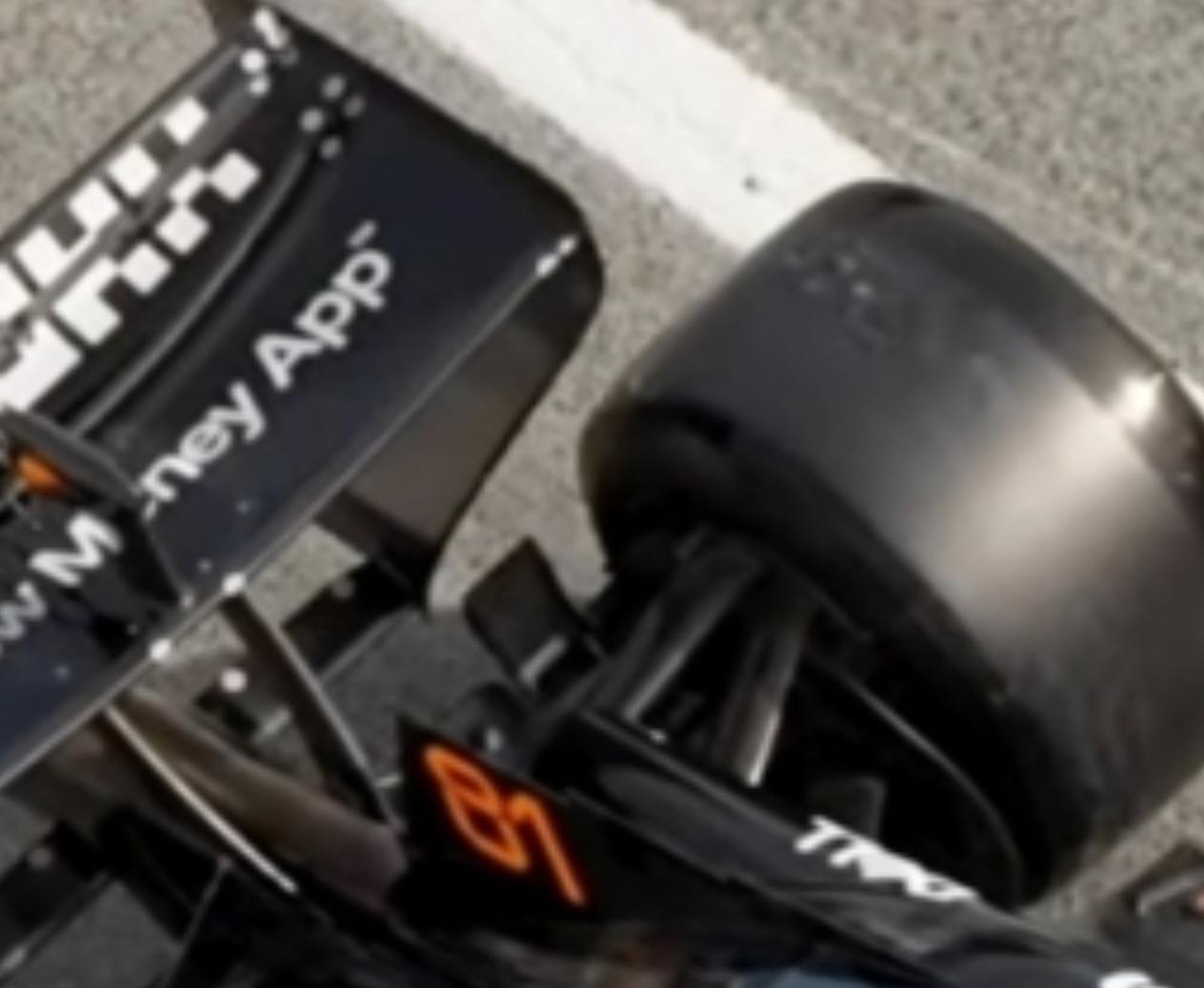
By the way, do you think they can get any meaningful beam-wing like interaction from that bottom rear wing element? It’s certainly angled aggresively, but then again I am sure most teams would be trying to do something similar with whatever the allowance is in the regulation.
Developer of F1InsightsHub