2026 Aerodynamic & Chassis Regulations

Here are our CFD links and discussions about aerodynamics, suspension, driver safety and tyres. Please stick to F1 on this forum.
vorticism
vorticism
415
Joined: 01 Mar 2022, 20:20
Location: YooEssay

Re: 2026 Aerodynamic & Chassis Regulations

Post

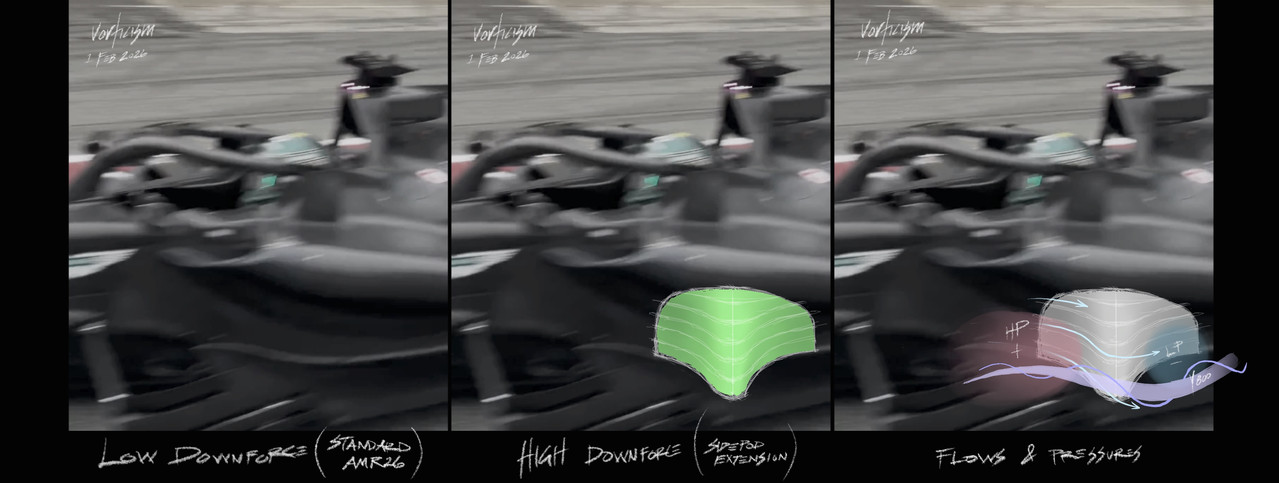
One more guess at what we’ll see this year now that I’ve seen most of the cars: track specific sidepods. AMR may have been, with the AMR26, testing what could be their low drag spec in Barcelona--their floating sidepod which has little outwash. It would be relatively easy to add modified lower sections beneath their floating sidepod to transform it into an outwashing sidepod to work the side wings (high drag, high downforce spec). I've illustrated the idea. Such a flair or extension of the lower sidepod could take a variety of forms, some with a longer trailing surface, f.e., or various fore-aft locating of the crest/apex, various widths and camber angles, etc. Perhaps that was their intention with such a clear area beneath their sidepod. Unhindered by componentry, they could place flares or extensions in the bodywork wherever they want as they develop the concept.

As for RBR, they may have been, with their RB22, testing what is their true sidepod that they intend to use regardless of track, or it could have been their high DF spec. Depending on how components are placed in their sidepods, one could imagine how an undercut could be added to the RB22 to convert it into a lower-drag spec. Which might explain the disparity between the two concepts. RBR brought their high DF spec, while AMR brought their low DF spec.

The polar-opposite disparity between those two concepts puzzled me. Could one team be getting it so wrong? Or is there something else at play?

With this formula's side wings, you have to consider how much downforce they can create independently and how they can be optimized. That’s why I’ve been pushing the blunt/bluff sidepod concept the past couple months. Previous formulas’ bargeboards did not produce much, if any, DF directly, but these do.

Image
🏴󠁧󠁢󠁥󠁮󠁧󠁿

johnnycesup
johnnycesup
2
Joined: 13 Sep 2024, 11:31

Re: 2026 Aerodynamic & Chassis Regulations

Post

vorticism wrote:
01 Feb 2026, 21:43
One more guess at what we’ll see this year now that I’ve seen most of the cars: track specific sidepods. AMR may have been, with the AMR26, testing what could be their low drag spec in Barcelona--their floating sidepod which has little outwash. It would be relatively easy to add modified lower sections beneath their floating sidepod to transform it into an outwashing sidepod to work the side wings (high drag, high downforce spec). I've illustrated the idea. Such a flair or extension of the lower sidepod could take a variety of forms, some with a longer trailing surface, f.e., or various fore-aft locating of the crest/apex, various widths and camber angles, etc. Perhaps that was their intention with such a clear area beneath their sidepod. Unhindered by componentry, they could place flares or extensions in the bodywork wherever they want as they develop the concept.

As for RBR, they may have been, with their RB22, testing what is their true sidepod that they intend to use regardless of track, or it could have been their high DF spec. Depending on how components are placed in their sidepods, one could imagine how an undercut could be added to the RB22 to convert it into a lower-drag spec. Which might explain the disparity between the two concepts. RBR brought their high DF spec, while AMR brought their low DF spec.

The polar-opposite disparity between those two concepts puzzled me. Could one team be getting it so wrong? Or is there something else at play?

With this formula's side wings, you have to consider how much downforce they can create independently and how they can be optimized. That’s why I’ve been pushing the blunt/bluff sidepod concept the past couple months. Previous formulas’ bargeboards did not produce much, if any, DF directly, but these do.

https://i.postimg.cc/NjTQcTPN/sidepodfl ... ticism.jpg
Instead of a vortex, wouldn't that sharp of an angle induce instant separation, and the creation of a massive pocket of low quality air in the most important part of the car?

vorticism
vorticism
415
Joined: 01 Mar 2022, 20:20
Location: YooEssay

Re: 2026 Aerodynamic & Chassis Regulations

Post

johnnycesup wrote:
01 Feb 2026, 23:20
Instead of a vortex, wouldn't that sharp of an angle induce instant separation, and the creation of a massive pocket of low quality air in the most important part of the car?
The vortex is off of the floor board in the foreground of the pic. Yes to separation. Although as stated the trailing surface could take a variety of forms.
🏴󠁧󠁢󠁥󠁮󠁧󠁿

User avatar
AR3-GP
464
Joined: 06 Jul 2021, 01:22

Re: 2026 Aerodynamic & Chassis Regulations

Post

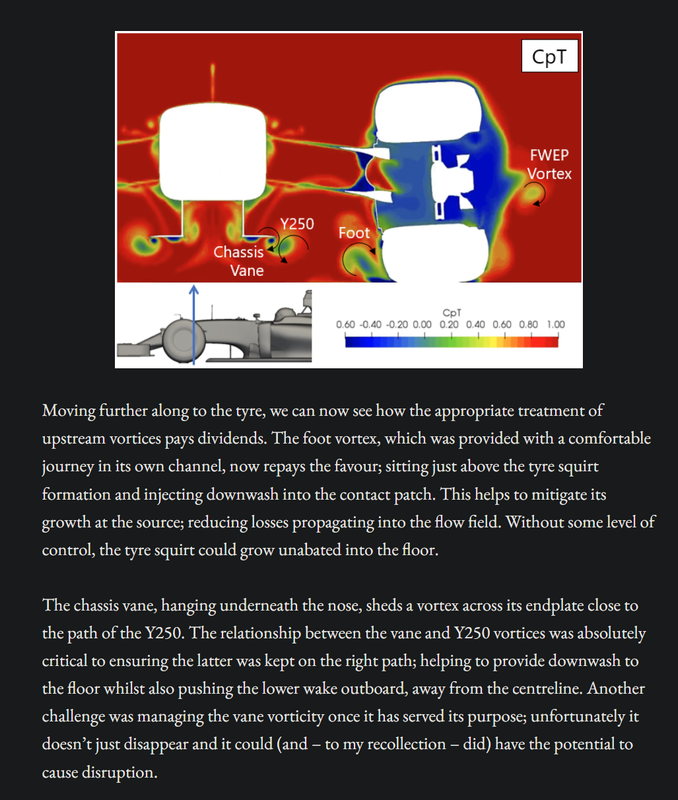
This SF16-H CFD gives some clues about front wing design possibilities in 2026
https://tameaero.wordpress.com/2023/08/ ... -h-part-i/
(1) Dive plane on the endplate can generate a vortex that helps to draw the tire wake outboard. Mclaren is the only one of the top 4 using it.
(2) Foot plate (all) and underwing strakes (Mercedes) can act as VGs that try and suppress the growth of the front tire squirt.

Image
Image


AR3-GP wrote:
08 Feb 2026, 16:27
Image
Beware of T-Rex