
- Login or Register
No account yet? Sign up
Reports suggest about 350km/h at Barcelona.
A road car struggles to hit 220mph with 500bhp in ideal conditions, no way a relatively high drag car like an F1 car (even with active aero deployed) can do it with only 500bhp. We are talking a cd of ~0.34 v a cd of ~0.7 which is a low end estimate for the 2026 car with aero deployed. Or am I missing something?
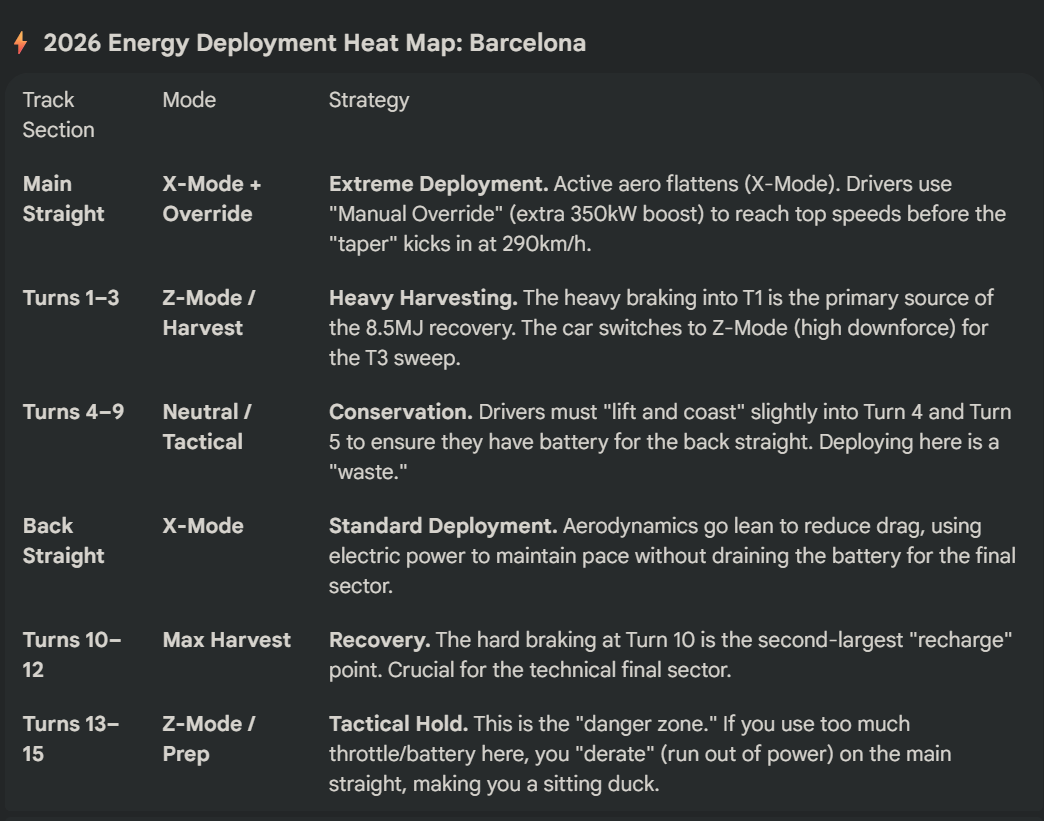
Man, this is so ---. "T1 is the primary source of the 8.5 MJ recovery" then? Are they going to spend 15 seconds braking for T1? GTFOAR3-GP wrote: ↑05 Feb 2026, 23:28I asked Gemini (AI) what the best way to use energy around Barcelona would be.
https://i.postimg.cc/Nf24wGnw/image.png
Road cars have a lot of frontal area, this balances the difference in coefficients somewhat.ChrisM40 wrote: ↑06 Feb 2026, 00:35
A road car struggles to hit 220mph with 500bhp in ideal conditions, no way a relatively high drag car like an F1 car (even with active aero deployed) can do it with only 500bhp. We are talking a cd of ~0.34 v a cd of ~0.7 which is a low end estimate for the 2026 car with aero deployed. Or am I missing something?
Not that much, and indycars are 900bhp now and are much lower drag than F1 cars, even with active aero. 0.7 is being generous, its more like 0.85 in reality. The cars lose speed when they run out of electrical power now, and that’s with 800bhp and DRS.johnnycesup wrote: ↑06 Feb 2026, 00:43Road cars have a lot of frontal area, this balances the difference in coefficients somewhat.ChrisM40 wrote: ↑06 Feb 2026, 00:35
A road car struggles to hit 220mph with 500bhp in ideal conditions, no way a relatively high drag car like an F1 car (even with active aero deployed) can do it with only 500bhp. We are talking a cd of ~0.34 v a cd of ~0.7 which is a low end estimate for the 2026 car with aero deployed. Or am I missing something?
Indycars can get to 390 kph (242 mph) at Indianapolis from a 700hp engine, seems possible that an F1 car can get to 345 with a 540 hp or so engine.
They don't run 900hp in the speedways, even with the boost increase for qualifying it's 700hp at best
Toto Wolff mentioned that 400kph would be possible with full power, I assume this means if they would be allowed to keep deploying at 350kW without restriction. If we assume 400kph to be the terminal velocity at 750kW, we get a terminal velocity of ~324kph with a 400kW engine. If the terminal velocity is only 360kph with the full 750kW, we get ~292kph with the engine alone.ChrisM40 wrote: ↑06 Feb 2026, 00:50Not that much, and indycars are 900bhp now and are much lower drag than F1 cars, even with active aero. 0.7 is being generous, its more like 0.85 in reality. The cars lose speed when they run out of electrical power now, and that’s with 800bhp and DRS.johnnycesup wrote: ↑06 Feb 2026, 00:43Road cars have a lot of frontal area, this balances the difference in coefficients somewhat.ChrisM40 wrote: ↑06 Feb 2026, 00:35
A road car struggles to hit 220mph with 500bhp in ideal conditions, no way a relatively high drag car like an F1 car (even with active aero deployed) can do it with only 500bhp. We are talking a cd of ~0.34 v a cd of ~0.7 which is a low end estimate for the 2026 car with aero deployed. Or am I missing something?
Indycars can get to 390 kph (242 mph) at Indianapolis from a 700hp engine, seems possible that an F1 car can get to 345 with a 540 hp or so engine.
Exactly, and I think that’s at Mexico with less air pressure. Ive seen somewhere the max possible to be as low as 186mph/300kph with engine alone.karana wrote: ↑06 Feb 2026, 01:22Toto Wolff mentioned that 400kph would be possible with full power, I assume this means if they would be allowed to keep deploying at 350kW without restriction. If we assume 400kph to be the terminal velocity at 750kW, we get a terminal velocity of ~324kph with a 400kW engine. If the terminal velocity is only 360kph with the full 750kW, we get ~292kph with the engine alone.ChrisM40 wrote: ↑06 Feb 2026, 00:50Not that much, and indycars are 900bhp now and are much lower drag than F1 cars, even with active aero. 0.7 is being generous, its more like 0.85 in reality. The cars lose speed when they run out of electrical power now, and that’s with 800bhp and DRS.johnnycesup wrote: ↑06 Feb 2026, 00:43
Road cars have a lot of frontal area, this balances the difference in coefficients somewhat.
Indycars can get to 390 kph (242 mph) at Indianapolis from a 700hp engine, seems possible that an F1 car can get to 345 with a 540 hp or so engine.
What are you talking about? He asked question about the out lap for qualifying. You're response doesn't seem at all related.dialtone wrote: ↑05 Feb 2026, 20:57Because the battery is 50% of your power. Max speed at the end of a straight is just a few seconds in a lap, cornering and acceleration is a lot more time in the lap and good traction gets you fast faster.mzso wrote:No reason. They can easily charge the battery with K during the outlap.ScottB wrote: ↑05 Feb 2026, 11:39Given the cars are going to be generally 'energy starved' will that change qualifying, in that previously, cars went as slow as they could on the outlap, to save the tyres, but presumably doing that sort of thing now, won't be enough to fully charge the battery? Will they have to push harder on the outlap to do that, which could impact favoured tyre choice even?
The problem is during the qualifying lap. Apparently for maximum lap-time they need to lift and coast.
You always want battery out of corners so you optimize for that, not top speed at the end of straights.
The coordinates suggest that the forward 260mm of the diffuser sidewall can be open. After that RS-Sidewall must be obscured. How far the hole can cut into the roof, I’m not sure yet.Emag wrote: ↑05 Feb 2026, 22:37I know this is illustrating the sidepod so it was probably not on your mind when you made it, but I wonder how big is the diffuser sidewall hole on this car? In some angles it looks like they don't even have a diffuser sidewall !?vorticism wrote: ↑05 Feb 2026, 21:46I think what they're doing with the sidepod is creating greater continuity between the underside of the nose and the floor. The drawing is not to scale, but it illustrates how the sidepod overhang can increase the width of the transition between the nose and the floor ramp (red triangle) if treated as a continuous surface. Won't know for sure until there are further photos.
https://i.postimg.cc/kg08FxJL/RB22floor ... ticism.jpg
viewtopic.php?p=1322315#p1322315
That's by choice and just a silly gimmick. Coasting is more efficient that regen braking, Regen should be tied to the brake pedal, or controlled separately.

In total the old 22-25 f1 cars had over 1000hp and not 800hp unless you are only counting the ICE and even then that was more like 850-900hp. From what I can see the 2026 indycar engines with hybrid are only going to be hitting 800hp combined with the electric part.