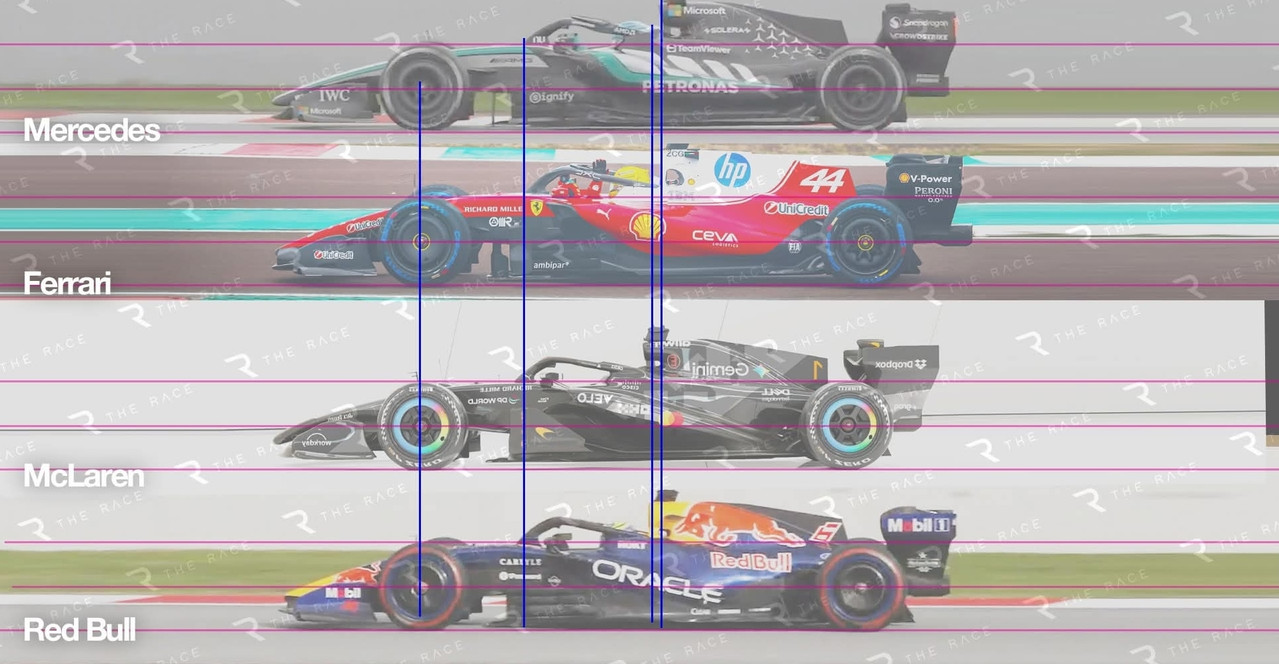
would love to see overhead shots of other cars.

I would assume that there are some really interesting advantages to be gained from opening the front wing, even if the wing itself doesn't reduce drag by much. The downstream effects of an open wing could be huge, and I'm sure several teams have found clever ways to reduce drag with it open.AR3-GP wrote: ↑02 Feb 2026, 17:16James Allison says that the drag is virtually unchanged when the front flaps drop down. According to him, the active front flap is primarily used to maintain the aero balance when the rear wing opens. If this applies to all teams, then the differences in mobile flap choice could reflect the amount of balance shift that is required when the rear wing opens. However the caveat is applying this conclusion of Mercedes to cars with different aero philosophy.


I'm genuinely surprised the FIA is allowing these downward-rotating designs for the front and rear wings. Part of the reason for DRS regulations forcing an rotating upwards flap was as a fail-safe - if the actuator fails the DRS was meant to close, resorting downforce and preventing a huge crash at the end of the straight.
This is what has been bugging me as well. While Alpine solution seems like good, if there is a failure of the "spring" it will stay open.MIKEY_! wrote: ↑07 Feb 2026, 00:39I'm genuinely surprised the FIA is allowing these downward-rotating designs for the front and rear wings. Part of the reason for DRS regulations forcing an rotating upwards flap was as a fail-safe - if the actuator fails the DRS was meant to close, resorting downforce and preventing a huge crash at the end of the straight.
Are this year's downward-rotating designs achieving fail-safety another way, or are we just waiting for a rear actuator to fail and cause a spectacular crash?
They probably have a strong spring or something that keeps the wing up if the actuator fails. If the actuator gets stuck so the wing is open anyway I'm sure they will get black flagged.MIKEY_! wrote: ↑07 Feb 2026, 00:39I'm genuinely surprised the FIA is allowing these downward-rotating designs for the front and rear wings. Part of the reason for DRS regulations forcing an rotating upwards flap was as a fail-safe - if the actuator fails the DRS was meant to close, resorting downforce and preventing a huge crash at the end of the straight.
Are this year's downward-rotating designs achieving fail-safety another way, or are we just waiting for a rear actuator to fail and cause a spectacular crash?
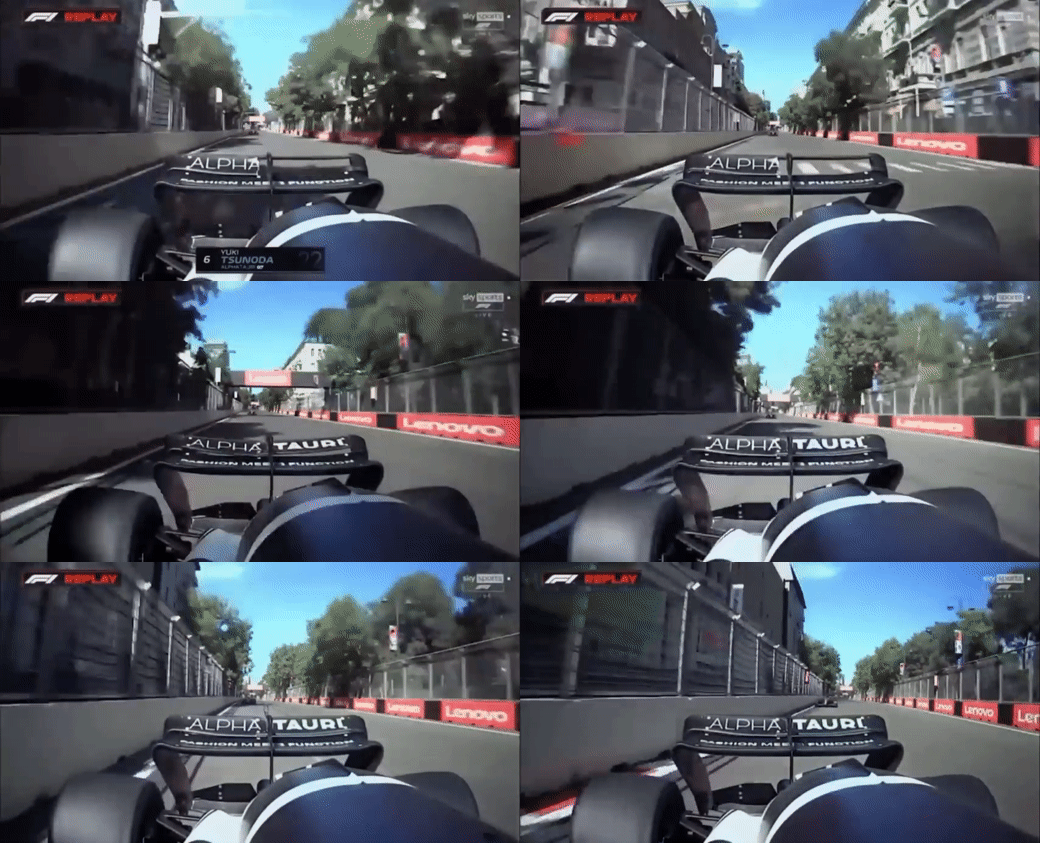
A spring seems plausible, although it's still less safe than an aerodynamic fail-safe. Tsunoda's Baku rear wing flap failure must be unlikely to occur again, but if it occured on the 2026 Alpine the consequences would be nasty.FNTC wrote: ↑07 Feb 2026, 15:38They probably have a strong spring or something that keeps the wing up if the actuator fails. If the actuator gets stuck so the wing is open anyway I'm sure they will get black flagged.MIKEY_! wrote: ↑07 Feb 2026, 00:39I'm genuinely surprised the FIA is allowing these downward-rotating designs for the front and rear wings. Part of the reason for DRS regulations forcing an rotating upwards flap was as a fail-safe - if the actuator fails the DRS was meant to close, resorting downforce and preventing a huge crash at the end of the straight.
Are this year's downward-rotating designs achieving fail-safety another way, or are we just waiting for a rear actuator to fail and cause a spectacular crash?

Do you think it's raised? I think it's the opposite. RB have a low mainplane and a low nose. The others have high nose and lifted mainplane at the tips.

We dont even know whether these wings are v1.0 or just placeholder v0.5 versions (because Barcelona test wasn't about aero). To me, the McLaren one is the only one that looks 'detailed enough' to be a v1.0 wing. And since we are on the topic, the rear wing of the AMR looks 'far more complex' than all other vanilla rear wings from other teams. I am sure we will see the 'real v1.0 cars' in Melbourne.
I think what he meant by 'raised center section' is the ground clearance of the mainplane underneath the nose w.r.t the road. In that respect, RBR nose isn't a 'low nose'.

A lot of the talk is that the Mercedes (and Aston) nose solution allows a shorter, higher nose and therefore more air underneath. I’m not sure I really see that based on these pics. Vs the Red Bull, yes, but the Ferrari and McLaren have longer pillars and I’m not actually sure there is less airflow going under the nose than the Mercedes tbh.