
- Login or Register
No account yet? Sign up




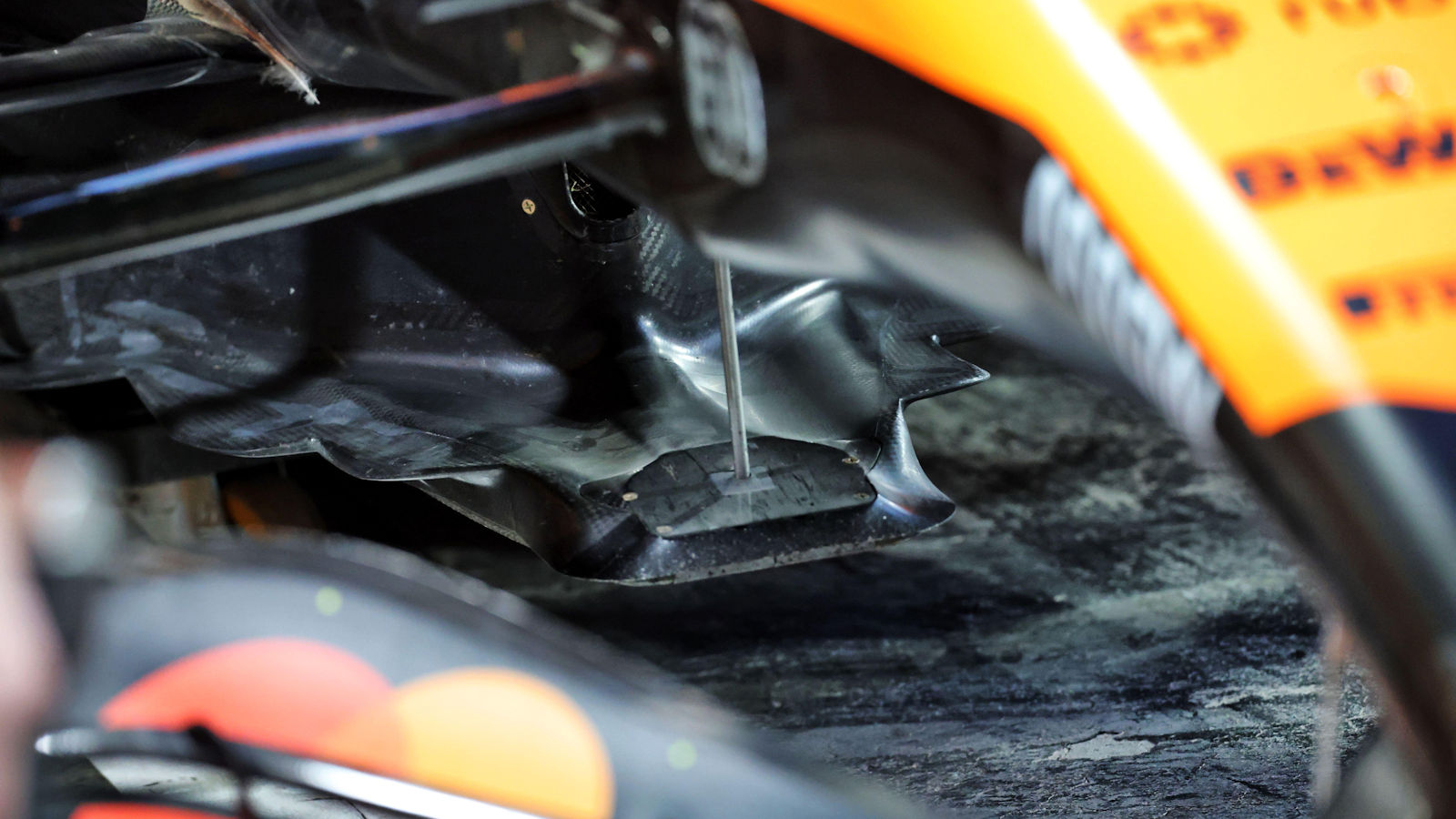
One of the theories last year for why McLaren had such good rear tire temperature control was that they were diverting some of the internal air-flow through the suspension shrouds into the brake assembly. I wonder if this is what that would look like?
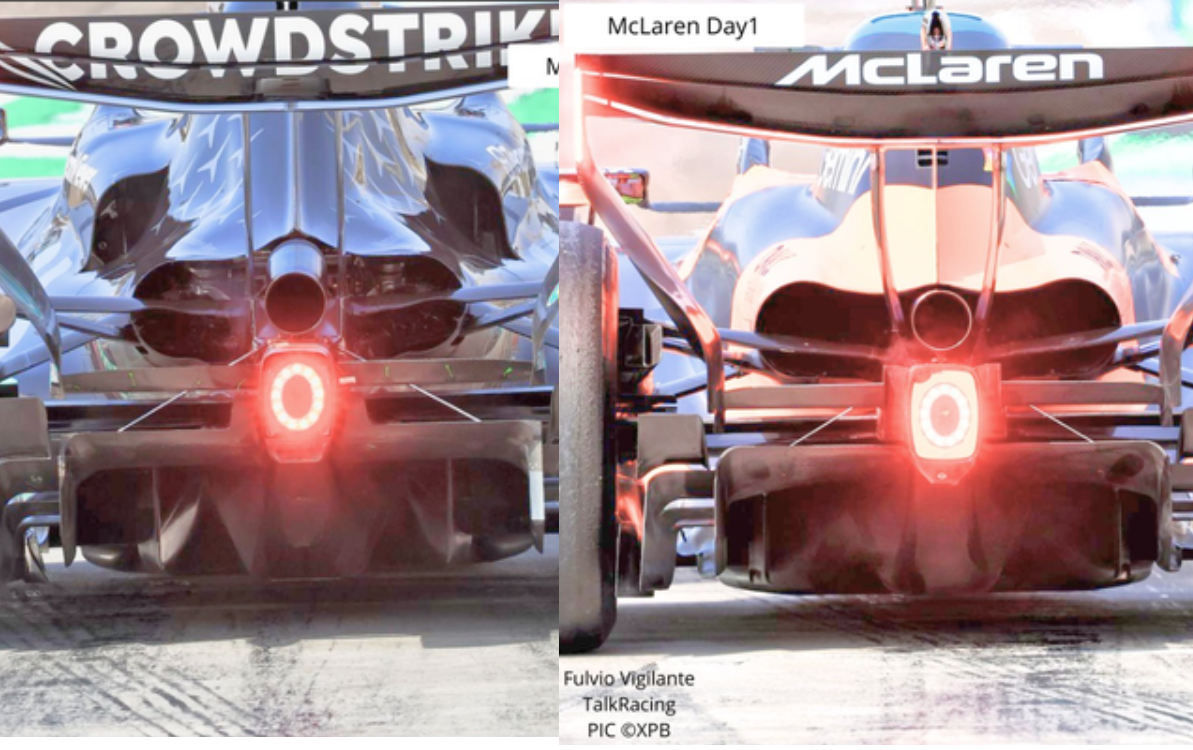
That's a bit of a biased assessment.... McLaren's rear heat exhaust is definitely larger (less flattering angle on the Merc image), their engine cover (center line) is not quiet as shrink-wrapped as the factory team's, the later also uses some sidepod volume to deliberately keep the wheel wake out longer, although it is true that Mercedes had to open up their car more for the Bahrain test.AR3-GP wrote: ↑15 Feb 2026, 21:07In my opinion, one of the reasons that Mclaren has such an efficient cooling system is because they have focused a lot on isolating the cooling airflows from the engine bay. This way the air flowing through the ducts doesn't lose energy due to passing over rough surfaces and blockage like the engine, suspension components, wiring harnesses, and the exhaust.
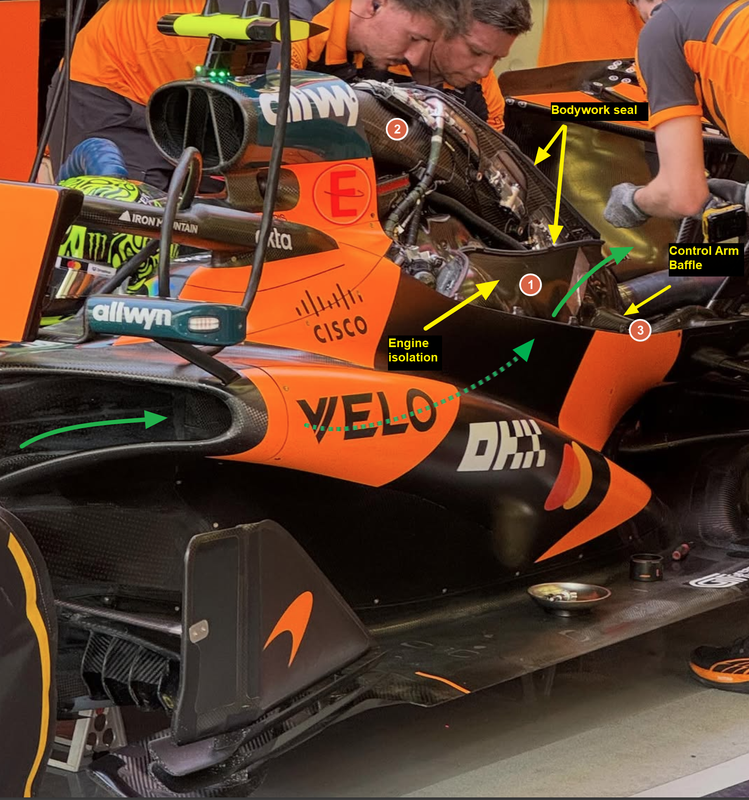
In this picture, you can see the inner baffling (1) which isolates the sidepod radiator flows from the engine bay as it moves to the rear and out the back. You can also see a well-designed roll hoop duct (2) which allows the air to enter, pass through the radiator, and then remain contained inside of a channel that is bounded above by the engine cover, and sealed on the sides/below by the grommeting on the outer edge of the radiator. There's even an aero shroud inside the engine cover just to isolate the suspension arm (3) that is crossing into the cooling channel. This is how you get an extremely efficient cooling system that doesn't need much openings to pass a large mass flow of air.
https://i.postimg.cc/3wY4R43m/image.png
Mclaren has a Mercedes engine and has the exact same cooling requirements as the factory Mercedes team. Yet Mclaren can run smaller ducts. Why? Mclaren's well isolated internal duct system is more efficient. Therefore, they don't need large openings. In the following picture, you can see the suspension bell housings of the Mercedes looking into the engine bay from the back. The cooling air has to go through and over that mess before it comes out of the engine cover at the back. This creates a lot of flow energy losses. That means you don't get the same efficiency from the cooling system and have to run larger openings.
https://i.postimg.cc/cJhhhthR/image.png

Mclaren have fully isolated the engine bay from the cooling channels. You can't see anything inside from the back of the car. It makes their cooling system more efficient. That's why they run the least amount of openings of any team.HungarianRacer wrote: ↑16 Feb 2026, 01:58That's a bit of a biased assessment.... McLaren's rear heat exhaust is definitely larger (less flattering angle on the Merc image), their engine cover (center line) is not quiet as shrink-wrapped as the factory team's, the later also uses some sidepod volume to deliberately keep the wheel wake out longer, although it is true that Mercedes had to open up their car more for the Bahrain test.AR3-GP wrote: ↑15 Feb 2026, 21:07In my opinion, one of the reasons that Mclaren has such an efficient cooling system is because they have focused a lot on isolating the cooling airflows from the engine bay. This way the air flowing through the ducts doesn't lose energy due to passing over rough surfaces and blockage like the engine, suspension components, wiring harnesses, and the exhaust.
In this picture, you can see the inner baffling (1) which isolates the sidepod radiator flows from the engine bay as it moves to the rear and out the back. You can also see a well-designed roll hoop duct (2) which allows the air to enter, pass through the radiator, and then remain contained inside of a channel that is bounded above by the engine cover, and sealed on the sides/below by the grommeting on the outer edge of the radiator. There's even an aero shroud inside the engine cover just to isolate the suspension arm (3) that is crossing into the cooling channel. This is how you get an extremely efficient cooling system that doesn't need much openings to pass a large mass flow of air.
https://i.postimg.cc/3wY4R43m/image.png
Mclaren has a Mercedes engine and has the exact same cooling requirements as the factory Mercedes team. Yet Mclaren can run smaller ducts. Why? Mclaren's well isolated internal duct system is more efficient. Therefore, they don't need large openings. In the following picture, you can see the suspension bell housings of the Mercedes looking into the engine bay from the back. The cooling air has to go through and over that mess before it comes out of the engine cover at the back. This creates a lot of flow energy losses. That means you don't get the same efficiency from the cooling system and have to run larger openings.
https://i.postimg.cc/cJhhhthR/image.png
https://i.postimg.cc/T3gd1FvB/ezgif-com ... ker(9).gif
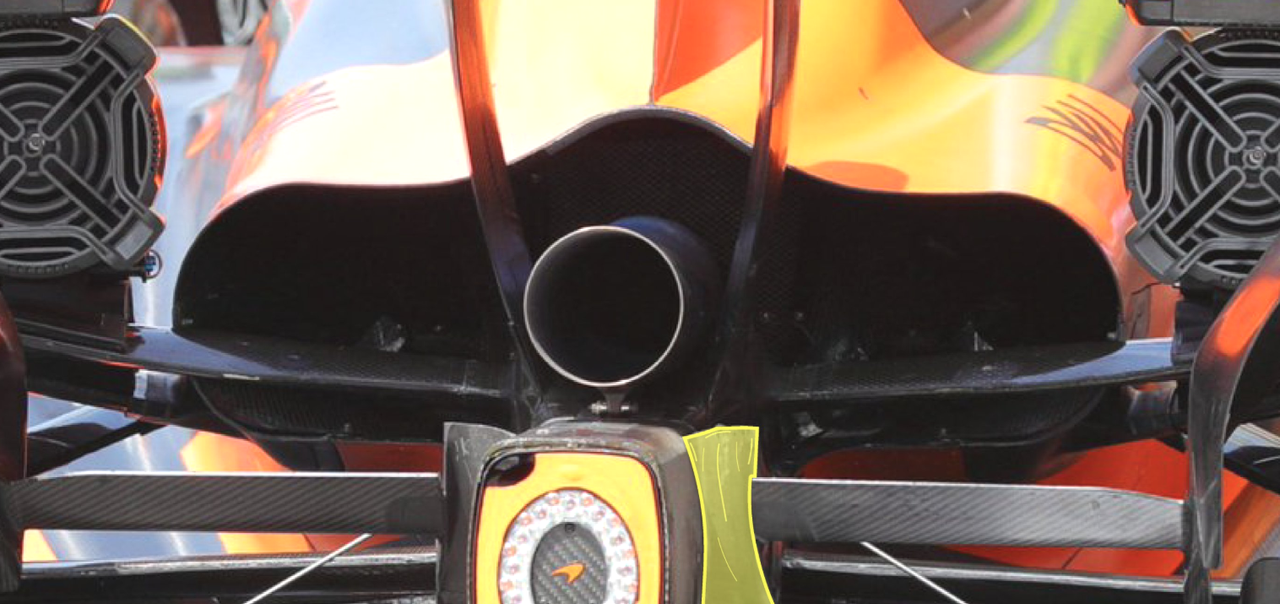
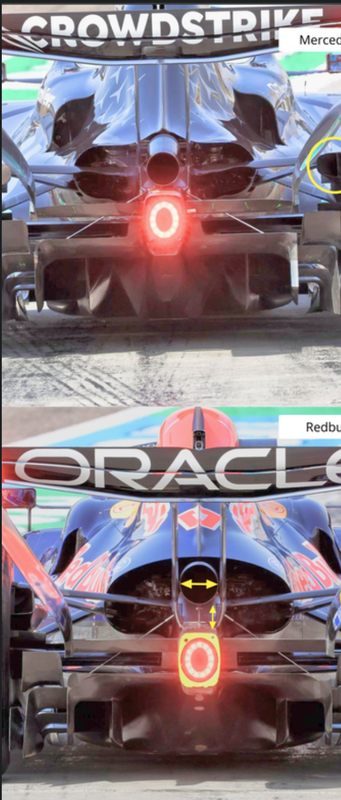



Most teams used to do like Mclaren but it seems like some ditched those big streamlined internal aero shrouds.AR3-GP wrote: ↑15 Feb 2026, 21:07In my opinion, one of the reasons that Mclaren has such an efficient cooling system is because they have focused a lot on isolating the cooling airflows from the engine bay. This way the air flowing through the ducts doesn't lose energy due to passing over rough surfaces and blockage like the engine, suspension components, wiring harnesses, and the exhaust.
In this picture, you can see the inner baffling (1) which isolates the sidepod radiator flows from the engine bay as it moves to the rear and out the back. You can also see a well-designed roll hoop duct (2) which allows the air to enter, pass through the radiator, and then remain contained inside of a channel that is bounded above by the engine cover, and sealed on the sides/below by the grommeting on the outer edge of the radiator. There's even an aero shroud inside the engine cover just to isolate the suspension arm (3) that is crossing into the cooling channel. This is how you get an extremely efficient cooling system that doesn't need much openings to pass a large mass flow of air.
https://i.postimg.cc/3wY4R43m/image.png
Mclaren has a Mercedes engine and has the exact same cooling requirements as the factory Mercedes team. Yet Mclaren can run smaller ducts. Why? Mclaren's well isolated internal duct system is more efficient. Therefore, they don't need large openings. In the following picture, you can see the suspension bell housings of the Mercedes looking into the engine bay from the back. The cooling air has to go through and over that mess before it comes out of the engine cover at the back. This creates a lot of flow energy losses. That means you don't get the same efficiency from the cooling system and have to run larger openings.
https://i.postimg.cc/cJhhhthR/image.png