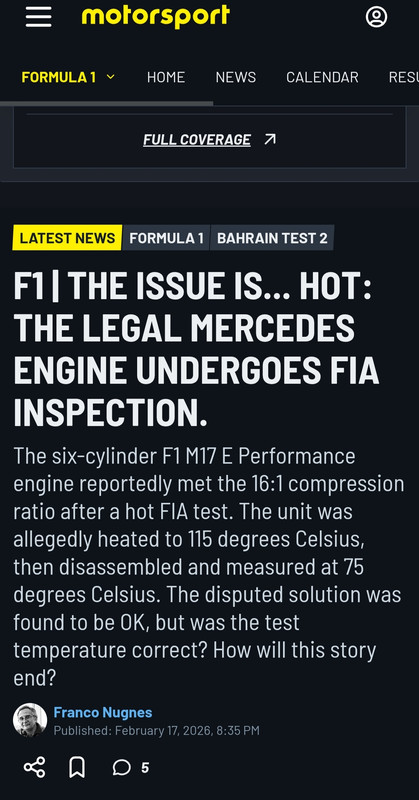
Post here all non technical related topics about Formula One. This includes race results, discussions, testing analysis etc. TV coverage and other personal questions should be in Off topic chat.
This is very unlikely given the amount of chatter and smoke present, but I would *love* the truth to be that there was no special secret compression ratio trick, but something else -- and in fact Mercedes came to the same conclusion as Red Bull awhile back which is that "yeah we tried and this doesn't work". And the fear around the test change isn't that it will render their engines illegal, but that it will reveal their engines weren't special at all, drawing attention to something else that they're doing.
This is very unlikely given the amount of chatter and smoke present, but I would *love* the truth to be that there was no special secret compression ratio trick, but something else -- and in fact Mercedes came to the same conclusion as Red Bull awhile back which is that "yeah we tried and this doesn't work". And the fear around the test change isn't that it will render their engines illegal, but that it will reveal their engines weren't special at all, drawing attention to something else that they're doing.
If it is a "sub-chamber linked by small hole(s)" then it's a brilliant interpretation of the rules. Amuses me. Meets the wording of the rules while creating new freedoms. Potentially satisfies the geometric compression ratio at all times and temperatures (yes) while providing more advantageous pressure seen by the fuel.
A big question is what is the test and what does it entail. If it can pass a CAD inspection but not a working test then it's not clever, too ban-able. If it can pass the test and meet the unpublished definitions of "cylinder" and "geometric compression ratio" then it is clever. Furthermore if it has a plausible function (f.e. as a shock absorber, wymc a hammer arrestor protecting against catastrophic pressure spikes) of some sort, it would defend its existence. Think also in terms of acoustics, shock wave dynamics, latency of pressure distributions, trade-offs of a lowered a:f ratio vs. raised charge pressure, etc. A void even with a not-so-small, test-passable connection will exhibit filling latency which would provide the fueled air with higher pressure while the geometric compression ratio remains unchanged at 16:1, at all times, at all temperatures.
The TJI chambers and their small holes were either already tested before--or ignored, depending on the test parameters. Is an assumption that the previous 18:1 was demanded but never tested? If TJI chambers can pass this test, what is the limit for orifice sizes in terms of passing the test.
If a sub-chamber is formed in part by the permitted spark plug sleeve, it would be relatively easy to implement all of this. Holes in the sleeve linked to an annular void that encompasses it, formed against the head. More speculatively (i.e. too easily ban-able): Differential thermal expansion of a steel sleeve and an aluminium head could result in eclipsing of the holes--hence the rule change to a hot test? But this is too on the nose. Too obvious of an intent. There needs to be a true function.
There are multiple concepts which can satisfy the tenets of the rumors. One or more of them could be correct. Or none. Although it seems like a lot of chatter for it to be none.
There is no scenario where a device that only exists to allow an engine to pass the test will ever be judged legal. Its a cheat that allows an illegal engine to pass and race and there are precedents that have deemed components like this illegal in the past.
There is no scenario where a device that only exists to allow an engine to pass the test will ever be judged legal. Its a cheat that allows an illegal engine to pass and race and there are precedents that have deemed components like this illegal in the past.
there is a specific word for this: it would be a defeat device
Just change the wording and include "at all times" or have teams sign an affidavit. Doing this circus with the testing is just inviting teams to work around them. Mercedes knows their compression ratio is above. Toto Wolff admitted it already so any test that they are rumored to have passed simply means that the test is inadequate.
Mercedes is not here to make a point that their engine is compliant. They just want it to pass the test even though they admitted that it is designed to operate outside of the limit. Saying that they passed a test just means they have made a mockery of your system.
Hysterical because even NASCAR is running near 140* C coolant temp (average) and and 140* C oil (sump) with localized temps in excess of 180* C. All for aero reasons (less cooling, better aero). F1 is about the same or a bit more. Piston crown temperatures will be in excess of 300* C, the exhaust valve and TJI unit will be higher.
That said, for the two dozen time, 1-1.5mm of clearance vanishes in most engines. This is just normal stuff.
Just reinforces what many of us have asked: how can they accurately measure the geometric dimensions at operating temperature?
That's rather puzzling. The article strongly confirm the 2nd chamber hypothesis. But if true, that automatically vanish any hot measurement...the geometric static cr of that thing will always be 16 no matter the temperature...only running the dynamic cr will be higher...some nonsense going on here
Just reinforces what many of us have asked: how can they accurately measure the geometric dimensions at operating temperature?
That's rather puzzling. The article strongly confirm the 2nd chamber hypothesis. But if true, that automatically vanish any hot measurement...the geometric static cr of that thing will always be 16 no matter the temperature...only running the dynamic cr will be higher...some nonsense going on here
I think that's a joke screenshot, as no such article is appearing for me on the main motorsport.com website.