Post here all non technical related topics about Formula One. This includes race results, discussions, testing analysis etc. TV coverage and other personal questions should be in Off topic chat.
Just curious, wouldn't going from 16:1 to 15.2:1 more than a five percent change in the compression ratio. That seems completely unreal to me to just happen from thermal expansion.
It doesn't require much. It is just a 0.299mm difference in the expansion of the head compared to the piston to drop the compression ratio down from 16 to 15.2.
edit: update to reflect the correct connecting rod length
Not really… There are several reasons why Mercedes even if they pass the CR Ratio at “Operating Temperature” may not agree to the test or change in the rules and the reason is simple, it extends the amount of time the “distraction” is in place.
“IF” Mercedes has a trick that allows them to increase the CR ratio while the engine is in operation (or under certain conditions) and one of those isn’t necessarily “temperature”… They will want that advantage / method to be in place for as long as possible and having everyone distracted with a temperature related benefit works for them, as long as everyone is full focused on it, their real trick is probably safe.
Finally, this is all “Theater”, from Mercedes posture in the matter, to the other Teams doing the same thing… Everyone wants the attention on someone else, while trying to keep eyes away from what they are doing in the grey areas.
I don't know about anything that you have written here, but I do know what Toto Wolff said, and the message is clear. If the vote is approved, the engine will change.
Wolff told reporters the pre-season favourites would accept the rule change but questioned the way it had been brought about.
"Either we stay with the regulations like we are or the e-vote goes ahead on Friday with the proposal that came from the FIA. Both are OK for us," he said.
"We said all along that this looks like a storm in a teacup.
"It doesn't change anything for us, whether we stay like this or whether we change the new regulations. We also want to be good citizens in the sport."
Wolff said he could understand the concern if the performance numbers being put around were close to the truth.
"If you have four other PUs (power units) that are putting immense pressure on the FIA at a certain stage, what choice do we have than not to play?," he asked.
Ferrari, Audi, Red Bull and Honda are the other power unit providers, with all facing a big challenge this season as Formula One starts a new engine era.
"You've developed a component to the regulations and that's been confirmed and then everybody else gangs up and says it's illegal. The regulators are being put under pressure. Is that how it should go?," said Wolff.
"Philosophically I disagree. But that's what has happened the last 50 years in Formula One and this time we were on the receiving end. I guess the next time maybe we will be ganging up against somebody else because we believe it's not right."
As has been pointed out to you previously, you may want to work on your reading comprehension and posting for the sake of posting, and then take note of what I and Stu said.
I think AR3-GP is by far one of the most valuable users here and I also think respect is due between everyone, on the internet as well.
As has been pointed out to you previously, you may want to work on your reading comprehension and posting for the sake of posting, and then take note of what I and Stu said.
Did you ever respond to this quote during your usual self-promotion?
A former power unit technical boss has explained to The Race that typically an engine with a 16:1 compression ratio when cold would drop to around 15.2-15.2:1 in operation because although the con rod expands, the block expands more.
As has been pointed out to you previously, you may want to work on your reading comprehension and posting for the sake of posting, and then take note of what I and Stu said.
Did you ever respond to this quote during your usual self-promotion?
A former power unit technical boss has explained to The Race that typically an engine with a 16:1 compression ratio when cold would drop to around 15.2-15.2:1 in operation because although the con rod expands, the block expands more.
Never seen that with aluminum blocks with steel rods we run (which F1 uses) because anything less than 1mm ambient piston to head clearance results in the piston hitting the head.
As has been pointed out to you previously, you may want to work on your reading comprehension and posting for the sake of posting, and then take note of what I and Stu said.
Did you ever respond to this quote during your usual self-promotion?
A former power unit technical boss has explained to The Race that typically an engine with a 16:1 compression ratio when cold would drop to around 15.2-15.2:1 in operation because although the con rod expands, the block expands more.
Never seen that with aluminum blocks with steel rods we run (which F1 uses) because anything less than 1mm ambient piston to head clearance results in the piston hitting the head.
So explain that one…
Steel expands about half as much as aluminium, and the block will be in direct contact with the combustion reaction and should be hotter than the rod. The cylinder is about 5,5 cm deep, the rod is around double that. If the temperature difference is sufficiently big, is it impossible that the block expands more than the rod?
Did you ever respond to this quote during your usual self-promotion?
Never seen that with aluminum blocks with steel rods we run (which F1 uses) because anything less than 1mm ambient piston to head clearance results in the piston hitting the head.
So explain that one…
Steel expands about half as much as aluminium, and the block will be in direct contact with the combustion reaction and should be hotter than the rod. The cylinder is about 5,5 cm deep, the rod is around double that. If the temperature difference is sufficiently big, is it impossible that the block expands more than the rod?
F1 dictates the materials used. Every engine I’ve been around, including ones with aluminum blocks and heads, the piston to head gap always closes, not grows bigger. Heat is only one part of the equation… rods stretch, pistons rock, piston pins deflect, cranks deflect, etc. All elements deflect in varying amounts, all parts are heated differently, and typically the contact occurs on the exhaust stroke or in off throttle portions when cylinder pressure is much less above the piston at TDC
Pretending like the mod was writing on your behalf... Your standards of posting drop further. Some tips for our “you idiots better take rod stretch super seriously” guy:
-telling memespace that you have experience does not affect memespace
-shouting at memespace does not affect memespace
-calling memespace an idiot doesn’t affect memespace
Material deformation from linear & angular accelerative forces, and heat, and compression & tension, can all be accounted for during the curation of the design dimensions of an engine. Rod stretch and crank warp can be taken into account while also being aware of thermal expansion, and dozens of other factors. An ICE could be designed to either raise or reduce its CR across a specified temperature range, based upon predictions of physical properties.
Inching towards optimal head clearance via iterative head gasket installations may or may not be even be used in this application, and even if it is (or something similar sans use of traditional head gaskets), it would not alter what had happened upstream during the engine design process. There would have been a targeted operational CR which must be achieved within a described physical domain, inclusive of rod stretch, and all of the material and geometry choices would have been made to achieve that CR. Any shimming of the head would still be occuring within the context of thermal expansion, and within the context of the effects of the various speculative mechanisms of action that have been discussed in this and other threads.
As the mod actually said: we can both discuss what we do know and what we do not know, while remaining rational and logical. Demanding to be the final word on something is ridiculous within the context of anonymous internet discussion.
What fascinates me it’s that they design and build the engines to very prescriptive regulations with broadly similar materials; but the finite details within the design can have a large effect on the behaviour of the ICE geometry with the application of multiple forms of heat in different locations (not to mention the variations in each manufacturer’s fluid specifications).
You have:
Engine block (structural), made from a specified alloy of Aluminium, this contains a (specified) steel crankshaft of very limited stroke variation across manufacturers, this end is capped off by an aluminium sump -AFAIK (time was these were magnesium), which also forms the lower crank bearing mounts. Temperatures in this area are largely controlled by oil.
Cylinder heads (structural), made from either (specified) Aluminium Alloy or (specified) Iron Alloy, these house the valves, cams, etc and are connected through the engine block by high-strength steel studs. Temperatures in this area are largely controlled by water.
Between these two major components we have the con-rods & pistons, con-rods can be either (specified) alloy steels or (specified) titanium alloys, pistons can be either (specified) alloy steel or (specified) aluminium alloy, the largest forces and temperatures are seen by the piston, temperature of which is large controlled by oil.
Between this is the combustion chamber, it’s surfaces are composed of (potentially) five/six different materials and withstand the largest heat gradient within the engine, cooling is controlled by both water & oil.
Yes, aluminium expands more than steel or iron, but what about when you constrain the aluminium items with steel studs and cannot have any combustion exit the chamber in a way that is not desired.
Now run that assembly regularly to 12,000rpm on a frequent basis for two hours every other week and then have it cool back to ambient (where it is not seized!!) and do that for multiple weekends without being allowed to open it and ‘check’ the internals.
Now add a ‘trick’ that will not negatively effect any of that (whilst still being in a position to win races).
Oh and your intake air (entering the combustion chamber) is at 4.8bar and needs to operate anywhere between 10 degrees C and 50 degrees C ambient.
Even with a room full of engineering experts ‘just’ turning up with an engine that will meet the competitive operational criteria (to not embarrass the manufacturer) is a remarkable achievement.
Perspective - Understanding that sometimes the truths we cling to depend greatly on our own point of view.
I don't know about anything that you have written here, but I do know what Toto Wolff said, and the message is clear. If the vote is approved, the engine will change.
As has been pointed out to you previously, you may want to work on your reading comprehension and posting for the sake of posting, and then take note of what I and Stu said.
I think AR3-GP is by far one of the most valuable users here and I also think respect is due between everyone, on the internet as well.
Does that change the fact that the quote they shared blatantly does NOT include Toto saying what they say it does??
Whatever their reputation, it doesn't change facts.
"From success, you learn absolutely nothing. From failure and setbacks, conclusions can be drawn." - Niki Lauda
Never seen that with aluminum blocks with steel rods we run (which F1 uses) because anything less than 1mm ambient piston to head clearance results in the piston hitting the head.
So explain that one…
Steel expands about half as much as aluminium, and the block will be in direct contact with the combustion reaction and should be hotter than the rod. The cylinder is about 5,5 cm deep, the rod is around double that. If the temperature difference is sufficiently big, is it impossible that the block expands more than the rod?
F1 dictates the materials used. Every engine I’ve been around, including ones with aluminum blocks and heads, the piston to head gap always closes, not grows bigger. Heat is only one part of the equation… rods stretch, pistons rock, piston pins deflect, cranks deflect, etc. All elements deflect in varying amounts, all parts are heated differently, and typically the contact occurs on the exhaust stroke or in off throttle portions when cylinder pressure is much less above the piston at TDC
I think we need you to repeat it another 10-15 times.
Tell me, how can you design the engine to run if, according to how you write, these pistons are basically non deterministic and no way to design them to meet any design criteria besides “engine doesn’t explode”.
I have an been avid reader of this forum but have probably only posted twice in the last 10 years.
Something has been irking me about the arguments surrounding compression ratio and the conditions in which they must meet the 16:1 requirements.
One of the most fundamental requirements of the engine regs is the engine capacity of 1.6L. In the dumbest sense, the compression ratio is simply a before and after volume comparison. As such the following questions have been floating around my head, which I'm sure people here would have answers to:
- what conditions are the 1.6L capacity measured?
- Must this 1.6L limit be maintained at all times during normal operating conditions?
- How is this policed?
I would assume that volumetric components of the compression ratio is fundamentally liked to the engine capacity and as such the the 16 and the 1 component of the compression ration must be measured/maintained in accordance with the 1.6L capacity limit?
Assuming the regulations detail the testing and condition requirements for the 1.6L capacity, would these not simply apply to the volumetric changes that define the compression ratio.
How can the 1.6L be so well controlled, measured and policed throughout the combustion cycled and variable operating conditions but the compression ratio not be? Could they just write the rules and do away with the 1.6L and compression ratio, and just nominate a "before and after" volume requirement.
If teams are bending the rules with compression ratios, are they not also doing the same with engine capacity?
I'm a civil engineer by trade so I'm not particularly adept with things that move lol, and I know enough about internal combustion engines to know I don't know anything (but not yet a dunning Kruger amount). However, I have found in my career that it can help a lot to have someone who knows next to nothing about the technical details (but with an experienced engineering background) ask stupid questions lol.
To all the engine experts on here, I apologies for this stupid question, but I would love it if someone could reply.
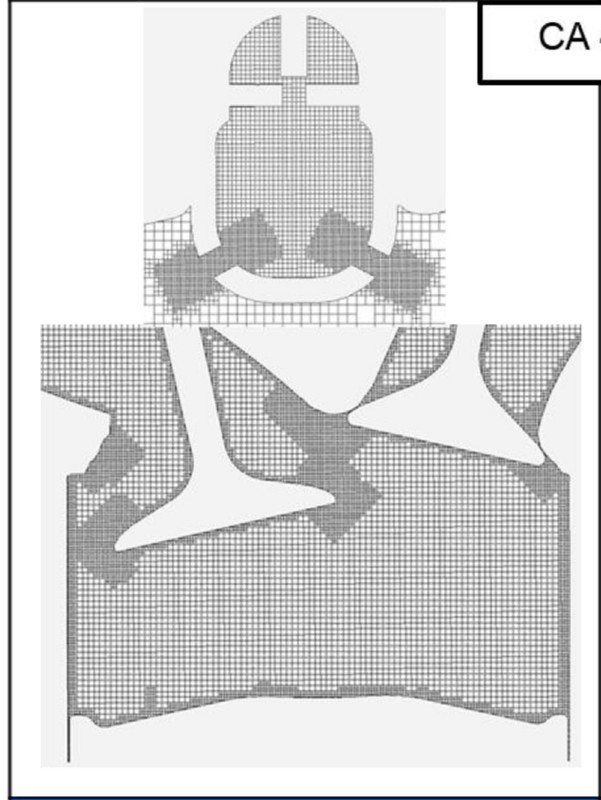
Plan view of a TJI 4 valve, pent roof engine from Ilmor Brixworth
(See chamber shape here, typical design)
We know:
Bore: 80mm
Connecting Rod Length: 119.5-120.5mm
Stroke: 53mm
If someone has some time, they can get volume from the above. Piston will be sysmetrical as seen in photos. Chamber will be typical of a 4 valve pentroof chamber, so you’ll have to extrude to to the extent of a 80mm bore.
Once you have these dimmensions, you can easily plug and play with clearance volumes and see the real effect on changes in compression.
Well. If anyone else ran a split battery they would have had to put the sensor. Certainly without the sensor it would be possible to circumvent the rules. Not that they dis but still needed to put the sensor
autodoctor911 wrote:Well. If anyone else ran a split battery they would have had to put the sensor. Certainly without the sensor it would be possible to circumvent the rules. Not that they dis but still needed to put the sensor
So by this reasoning, if anyone has designed an engine different than the rest, then they need a different measurement of CR to be considered compliant. This measurement in the rules isn’t intended to be the one used for special engines.