

via Zander Arcari

From a schematic drawing from Craig Scarborough (if I am not mistaken) there are brackets to make sure that the gas do not bypass the wing laterally, forcing them upwards.MtthsMlw wrote: ↑25 Feb 2026, 21:32Seems like the vertical plate is directly connected to the exhaust pipe. Haven't seen this detail yet.
https://pbs.twimg.com/media/HCBPuGXXkAA ... &name=orig
via Zander Arcari

Is there any pic (with similar closeness to object) from 'the other side' a.k.a looking at the 'exhaust hitting' side of the plate ? curious to see the curvature in the middlematteosc wrote: ↑25 Feb 2026, 21:48From a schematic drawing from Craig Scarborough (if I am not mistaken) there are brackets to make sure that the gas do not bypass the wing laterally, forcing them upwards.MtthsMlw wrote: ↑25 Feb 2026, 21:32Seems like the vertical plate is directly connected to the exhaust pipe. Haven't seen this detail yet.
https://pbs.twimg.com/media/HCBPuGXXkAA ... &name=orig
via Zander Arcari
it exist, and its in these forum, im sure I have seen it, and the exhaust is not as close as these image appears to be.venkyhere wrote: ↑25 Feb 2026, 21:55Is there any pic (with similar closeness to object) from 'the other side' a.k.a looking at the 'exhaust hitting' side of the plate ? curious to see the curvature in the middlematteosc wrote: ↑25 Feb 2026, 21:48From a schematic drawing from Craig Scarborough (if I am not mistaken) there are brackets to make sure that the gas do not bypass the wing laterally, forcing them upwards.MtthsMlw wrote: ↑25 Feb 2026, 21:32Seems like the vertical plate is directly connected to the exhaust pipe. Haven't seen this detail yet.
https://pbs.twimg.com/media/HCBPuGXXkAA ... &name=orig
via Zander Arcari

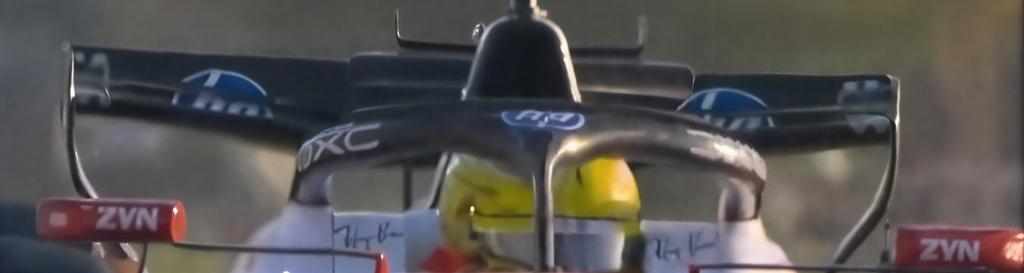


If the wing rotated the other way it would clip through the other plane. The pivot point is further back so that when it rotates the upper plane is moved backwards somewhat - I presume to interact with the exhaust plume.atanatizante wrote: ↑25 Feb 2026, 23:121. I wonder why the former DRS wing had to rotate 270 degrees forward when it would have been much easier to rotate it backward by only 90 degrees. This way, not only would the movement have been much faster, but it would also have avoided the braking/parachute phase.
2. Why didn’t they use the old central actuator on the main plane, configuring it to push the former DRS wing upward so that it could rotate backward by only 90 degrees?
3. Why didn’t they design a system that moves both the main plane and the former DRS wing together as a single unit? Could the movement be either a forward 270-degree rotation or a rearward rotation of only 90 degrees?
https://twitter.com/ScarbsTech/status/2 ... 5373726131venkyhere wrote: ↑25 Feb 2026, 21:55Is there any pic (with similar closeness to object) from 'the other side' a.k.a looking at the 'exhaust hitting' side of the plate ? curious to see the curvature in the middlematteosc wrote: ↑25 Feb 2026, 21:48From a schematic drawing from Craig Scarborough (if I am not mistaken) there are brackets to make sure that the gas do not bypass the wing laterally, forcing them upwards.MtthsMlw wrote: ↑25 Feb 2026, 21:32Seems like the vertical plate is directly connected to the exhaust pipe. Haven't seen this detail yet.
https://pbs.twimg.com/media/HCBPuGXXkAA ... &name=orig
via Zander Arcari

Because they've a, relatively, whole warehouse full of CFD capabilities to test their own theories, then a manufacturing capability in carbon layup to produce the best iteration, then a real wind tunnel to run that model, covered in sensors and strain gauges to measure the effectiveness.atanatizante wrote: ↑25 Feb 2026, 23:121. I wonder why the former DRS wing had to rotate 270 degrees forward when it would have been much easier to rotate it backward by only 90 degrees. This way, not only would the movement have been much faster, but it would also have avoided the braking/parachute phase.
2. Why didn’t they use the old central actuator on the main plane, configuring it to push the former DRS wing upward so that it could rotate backward by only 90 degrees?
3. Why didn’t they design a system that moves both the main plane and the former DRS wing together as a single unit? Could the movement be either a forward 270-degree rotation or a rearward rotation of only 90 degrees?

Thanks, so it's actually a semicircular 'cup' right where the bottom half of the exhaust hits the 'wall'. Nice, this would mean that they are creating a cup-shaped high static pressure region where the bottom half of the exhaust exits, thus encouraging the entire exhaust to shoot at double speed (like using our thumb to cover half of the garden hose orifice, to make it shoot out water at higher speed).aberracus wrote: ↑25 Feb 2026, 23:39https://twitter.com/ScarbsTech/status/2 ... 5373726131
https://pbs.twimg.com/media/HBc9dbuWoAE ... name=small
Scarb got it !
And the Flipping Rear Wing works in tandem with this system accelerating the car forward, as Kyle the F1 Aerodynamist have speculated, lets hope Ferrari has the new rear wing ready for Australia.venkyhere wrote: ↑26 Feb 2026, 00:47Thanks, so it's actually a semicircular 'cup' right where the bottom half of the exhaust hits the 'wall'. Nice, this would mean that they are creating a cup-shaped high static pressure region where the bottom half of the exhaust exits, thus encouraging the entire exhaust to shoot at double speed (like using our thumb to cover half of the garden hose orifice, to make it shoot out water at higher speed).aberracus wrote: ↑25 Feb 2026, 23:39https://twitter.com/ScarbsTech/status/2 ... 5373726131
https://pbs.twimg.com/media/HBc9dbuWoAE ... name=small
Scarb got it !
This high speed exhaust is going to 'see' an 'inverted waterfall' like air shooting up from the diffuser in the bottom, and will 'join the party' to together exit (while also pulling more 'inverted waterfall' air) and pass just beneath the rear wing, diagonally rising up. This will make the rear wing work even better. So it's a 'triple whammy' effect.
I wouldn't be surprised if the SF-26 is the car that has the best tyre wear on rear-limited tracks for the entire year.
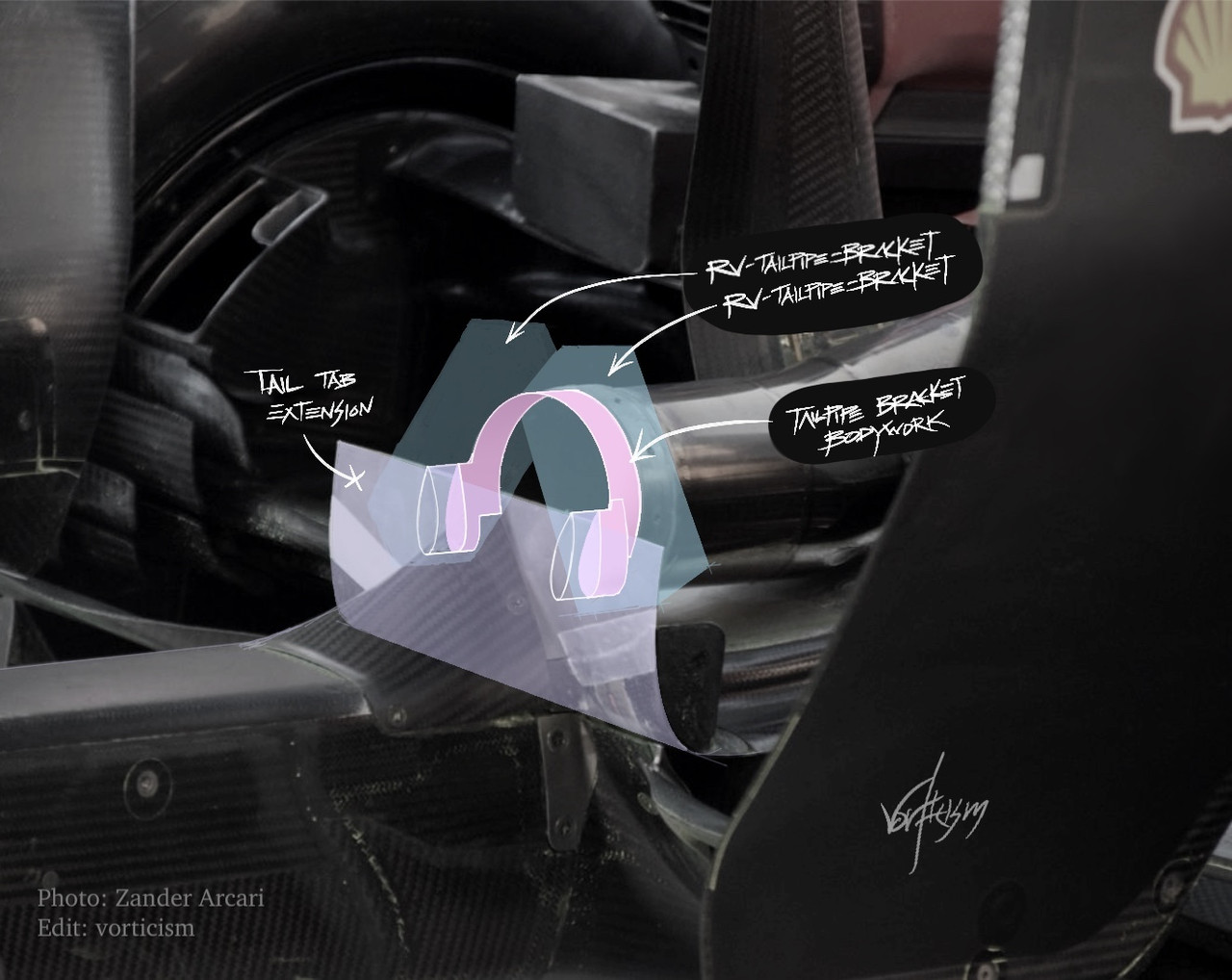
Going through the regs... The extension of the tailpipe is actually their interpretation of the single permitted Tailpipe-Bracket. It's U-shaped with two airfoil-shaped feet that connect to the panel extension of the Tail bodywork. Very clever reading of the rules. Blown bodywork has been prevented since 2012, so we'll see how long the FIA lets this last.MtthsMlw wrote: ↑25 Feb 2026, 21:32Seems like the vertical plate is directly connected to the exhaust pipe. Haven't seen this detail yet.
https://pbs.twimg.com/media/HCBPuGXXkAA ... &name=orig
via Zander Arcari
Also, if you rotate it 90 degrees "forward" you go against air resistance and it requires much more power.Farnborough wrote: ↑26 Feb 2026, 00:29Because they've a, relatively, whole warehouse full of CFD capabilities to test their own theories, then a manufacturing capability in carbon layup to produce the best iteration, then a real wind tunnel to run that model, covered in sensors and strain gauges to measure the effectiveness.atanatizante wrote: ↑25 Feb 2026, 23:121. I wonder why the former DRS wing had to rotate 270 degrees forward when it would have been much easier to rotate it backward by only 90 degrees. This way, not only would the movement have been much faster, but it would also have avoided the braking/parachute phase.
2. Why didn’t they use the old central actuator on the main plane, configuring it to push the former DRS wing upward so that it could rotate backward by only 90 degrees?
3. Why didn’t they design a system that moves both the main plane and the former DRS wing together as a single unit? Could the movement be either a forward 270-degree rotation or a rearward rotation of only 90 degrees?
Guess you must have similar at immediate disposal to develop your own theory and questions

A night race should reveal all.MtthsMlw wrote: ↑25 Feb 2026, 21:32Seems like the vertical plate is directly connected to the exhaust pipe. Haven't seen this detail yet.
https://pbs.twimg.com/media/HCBPuGXXkAA ... &name=orig
via Zander Arcari