Since the longbow applies forces at the upright, then its vibrational modes are resolved by the pushrod/damper system.

- Login or Register
No account yet? Sign up
Since the longbow applies forces at the upright, then its vibrational modes are resolved by the pushrod/damper system.
Sort of. What RBR developed across six years or more may or may not be a wishbone, may just be a single spar that spans the 1,5m between the front uprights. The keel suspensions of 90s/00s provided a single central anchoring point, not a constrained span of a spar--this would impose different cantilever properties. You could say that those wishbones were continuous but not always monolithic because some (all?) of them had a metal flexure center, which was a common (and still is) type of alternative to a rose joint. If you go back far enough you'll find transverse springs and live/solid axles on grand prix cars i.e. other types of transversely continuous suspension members.Andi76 wrote: ↑27 Feb 2026, 00:30Just by the way - such contious whisbones were used first by by Rory Byrne on the Ferrari F2001 in 2001. It was called "one-piece" or "monolithic"-wishbone back in these days. And it indeed acted like a kind of leaf spring. Ferrari used them untill 2007 (actually they stopped using it with the F2007) and Renault and Minardi copied it in 2002 and used it untill 2004.vorticism wrote: ↑23 Feb 2026, 00:42Yes, it may act somewhat as a leaf spring, although the addition may be trivial. I had taken to calling it the longbow when I first became aware of it on the RB18, owing to it being almost the same dimensions thereof, then found it in photos of earlier RBR cars. In this specific application the unique feature seems to be that the arm anchor/pivot-point can be placed ahead of the bulkhead, inside the nosecone. It also would not trace a perfectly circular at its outboard end, being a bending beam, although, again, this might be trivial and consequential.Farnborough wrote: ↑22 Feb 2026, 21:53
Good clear image of that component, as mentioned its been in other team designs recently too.
Possibly correct to assume that it is a spring component that is supplemented by the torsion bar used to produce a homogeneous "total" spring contribution in support.
The damping can't of course be achieved (well not to any great degree) and must be placed within pushrod internal destination within bellcrank area.
Who else is using it this year?

That was not what I intended with the Q. Let me ask with more words :
Yes, some had flexures at the attachment points, but most were indeed monolitic. But basically, it's the same idea, adapted to the respective requirements.vorticism wrote: ↑27 Feb 2026, 17:29Sort of. What RBR developed across six years or more may or may not be a wishbone, may just be a single spar that spans the 1,5m between the front uprights. The keel suspensions of 90s/00s provided a single central anchoring point, not a constrained span of a spar--this would impose different cantilever properties. You could say that those wishbones were continuous but not always monolithic because some (all?) of them had a metal flexure center, which was a common (and still is) type of alternative to a rose joint. If you go back far enough you'll find transverse springs and live/solid axles on grand prix cars i.e. other types of transversely continuous suspension members.Andi76 wrote: ↑27 Feb 2026, 00:30Just by the way - such contious whisbones were used first by by Rory Byrne on the Ferrari F2001 in 2001. It was called "one-piece" or "monolithic"-wishbone back in these days. And it indeed acted like a kind of leaf spring. Ferrari used them untill 2007 (actually they stopped using it with the F2007) and Renault and Minardi copied it in 2002 and used it untill 2004.vorticism wrote: ↑23 Feb 2026, 00:42
Yes, it may act somewhat as a leaf spring, although the addition may be trivial. I had taken to calling it the longbow when I first became aware of it on the RB18, owing to it being almost the same dimensions thereof, then found it in photos of earlier RBR cars. In this specific application the unique feature seems to be that the arm anchor/pivot-point can be placed ahead of the bulkhead, inside the nosecone. It also would not trace a perfectly circular at its outboard end, being a bending beam, although, again, this might be trivial and consequential.
Who else is using it this year?
To the extent that the longbow has any appreciable spring rate, it may also provide some anti-roll effect. A bar twice constrained centrally will see one end raise when the other end is raised, while the center would deflect downward.
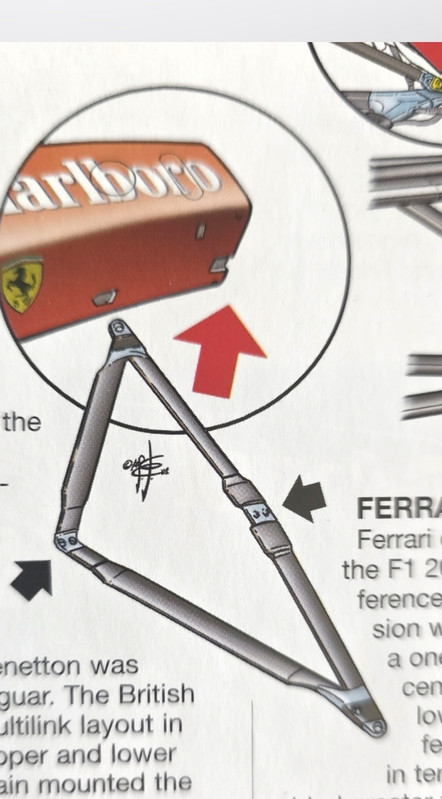
I doubt it. I don’t think teams were experimenting much with carbon fiber springs at that time (late 90s, early 00s), wasn’t exactly the state of the art at the time. Piola’s illustration there depicts the center and outer ends in light blue, by which he means metal, which is to say, it’s not monolithic. If you can find any photos please post them. If your standard is simply that continuousness=insignificant then, as I said, you’ll find grand prix cars much earlier than the F2001 that had continuous suspension members. It wouldn’t stop there. For thousands of years wagons were constructed in this way.Andi76 wrote: ↑28 Feb 2026, 15:02Yes, some had flexures at the attachment points, but most were indeed monolitic. But basically, it's the same idea, adapted to the respective requirements.
https://postimg.cc/ygxnKnKC
Mclaren, AMR, Mercedes, RBR.vorticism wrote: ↑23 Feb 2026, 00:42Yes, it may act somewhat as a leaf spring, although the addition may be trivial. I had taken to calling it the longbow when I first became aware of it on the RB18, owing to it being almost the same dimensions thereof, then found it in photos of earlier RBR cars. In this specific application the unique feature seems to be that the arm anchor/pivot-point can be placed ahead of the bulkhead, inside the nosecone. It also would not trace a perfectly circular at its outboard end, being a bending beam, although, again, this might be trivial and consequential.
Who else is using it this year?

The context seems to suggest the "structure the battery is attached to" refers to the front of the ICE, but is it possible Honda is referring to the chassis instead of (or as well as) the ICE? Late integration of the chassis and PU could have meant such a problem was not picked up until it was too late to resolve before testing. Pure speculation on my part.Honda observed abnormal vibrations that caused damage to the battery, although it is not sure whether the battery system itself is the initial problem. What Honda can see is the battery pack is being shaken because the structure it is attached to is vibrating more severely than expected.
Honda is investigating a combination of factors that likely caused these vibrations to emerge and running virtual track testing at its Sakura base with a chassis, engine and gearbox combined, but is yet to pinpoint the root cause.
"If we could identify a single cause, it would be easier to fix, but because multiple linked factors generate the vibration, we don't know whether fixing just one will solve it," said Takeishi.
Together with Aston Martin, Honda is assessing what countermeasures can be implemented on both the car and engine side - including what can be done before the season opener in Australia next weekend.
Aston Martin is willing to modify components on its car if necessary. Controlling the vibrations is critical for the engine's chances of running reliably in the early races of the season, which includes Honda's home grand prix in Japan at the end of March.
After managing the start of the season with interim measures, Honda will look to change reliability-related parts where possible within the cost cap.


Interestingly, honda ran into exactly the same problem with red bull in 2021MIKEY_! wrote: ↑01 Mar 2026, 03:10I know some here talk down The Race's technical reporting, but this was interesting:
The context seems to suggest the "structure the battery is attached to" refers to the front of the ICE, but is it possible Honda is referring to the chassis instead of (or as well as) the ICE? Late integration of the chassis and PU could have meant such a problem was not picked up until it was too late to resolve before testing. Pure speculation on my part.Honda observed abnormal vibrations that caused damage to the battery, although it is not sure whether the battery system itself is the initial problem. What Honda can see is the battery pack is being shaken because the structure it is attached to is vibrating more severely than expected.
Honda is investigating a combination of factors that likely caused these vibrations to emerge and running virtual track testing at its Sakura base with a chassis, engine and gearbox combined, but is yet to pinpoint the root cause.
"If we could identify a single cause, it would be easier to fix, but because multiple linked factors generate the vibration, we don't know whether fixing just one will solve it," said Takeishi.
Together with Aston Martin, Honda is assessing what countermeasures can be implemented on both the car and engine side - including what can be done before the season opener in Australia next weekend.
Aston Martin is willing to modify components on its car if necessary. Controlling the vibrations is critical for the engine's chances of running reliably in the early races of the season, which includes Honda's home grand prix in Japan at the end of March.
After managing the start of the season with interim measures, Honda will look to change reliability-related parts where possible within the cost cap.
https://www.the-race.com/formula-1/hond ... dentified/

I recall at the time, the short-term fix was simply dialing back the power mode of the ICE a bit, which they did mid-GP in Bahrain. It was believed that their 'ultra-fast combustion' technique was giving them some warning signs so they played it safe, without losing too much performance.organic wrote: ↑01 Mar 2026, 12:11
Interestingly, honda ran into exactly the same problem with red bull in 2021
https://www.formu1a.uno/le-vibrazioni-d ... -red-bull/
I had always heard it was ES related..Rasoose wrote: ↑02 Mar 2026, 03:45I recall at the time, the short-term fix was simply dialing back the power mode of the ICE a bit, which they did mid-GP in Bahrain. It was believed that their 'ultra-fast combustion' technique was giving them some warning signs so they played it safe, without losing too much performance.organic wrote: ↑01 Mar 2026, 12:11
Interestingly, honda ran into exactly the same problem with red bull in 2021
https://www.formu1a.uno/le-vibrazioni-d ... -red-bull/
Perhaps it was simply to protect the ES/CE all along, and not the ICE. I know they went back to full power later in the season(France possibly), and they also had a battery/ES upgrade mid season (Netherlands) as well.
I assume there are some electronics in the battery, such as the invertor, if that is the case then mounting the battery to the engine fully or partially is crazy, electronics hate the high frequency vibrations that engines create.MIKEY_! wrote: ↑01 Mar 2026, 03:10I know some here talk down The Race's technical reporting, but this was interesting:
The context seems to suggest the "structure the battery is attached to" refers to the front of the ICE, but is it possible Honda is referring to the chassis instead of (or as well as) the ICE? Late integration of the chassis and PU could have meant such a problem was not picked up until it was too late to resolve before testing. Pure speculation on my part.Honda observed abnormal vibrations that caused damage to the battery, although it is not sure whether the battery system itself is the initial problem. What Honda can see is the battery pack is being shaken because the structure it is attached to is vibrating more severely than expected.
Honda is investigating a combination of factors that likely caused these vibrations to emerge and running virtual track testing at its Sakura base with a chassis, engine and gearbox combined, but is yet to pinpoint the root cause.
"If we could identify a single cause, it would be easier to fix, but because multiple linked factors generate the vibration, we don't know whether fixing just one will solve it," said Takeishi.
Together with Aston Martin, Honda is assessing what countermeasures can be implemented on both the car and engine side - including what can be done before the season opener in Australia next weekend.
Aston Martin is willing to modify components on its car if necessary. Controlling the vibrations is critical for the engine's chances of running reliably in the early races of the season, which includes Honda's home grand prix in Japan at the end of March.
After managing the start of the season with interim measures, Honda will look to change reliability-related parts where possible within the cost cap.
https://www.the-race.com/formula-1/hond ... dentified/