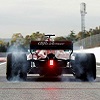
Ferrari SF-26

A place to discuss the characteristics of the cars in Formula One, both current as well as historical. Laptimes, driver worshipping and team chatter do not belong here.
User avatar
catent
0
Joined: 28 Mar 2023, 08:52
Location: Virginia, USA

Re: Ferrari SF-26

Post

AR3-GP wrote:
05 Mar 2026, 09:41
Melbourne (Photos from Albert Fabrega)


https://pbs.twimg.com/media/HCoVF7SWcAA ... name=large
That 'monkey wing' sits very close to the exhaust, which makes sense since that likely increase its effectiveness. It looks particularly well seated, too, with some nice looking design on the edges/sides to hug the round shape of the exhaustpipe.

I suspect the team tested dozens, maybe hundreds, of different distances and heights relative to the exhaust, likely down to fractions of millimeters, to find the optimal distance for the flap to sit in respect to the exhaust exit.

Cool to think about and I am excited to see the benefit it brings.

Just_a_fan
Just_a_fan
593
Joined: 31 Jan 2010, 20:37

Re: Ferrari SF-26

Post

hollus wrote:
05 Mar 2026, 09:46
While it is fun to speculate on the exhaust hitting the rear wing, is that even remotely realistic?
What is the mass flow through that exhaust? And what is the mass flow of air (at 100 and at 300 kh/h) that it encounters?
Intuitively I’d say that any thermal effects will have been largely dissipated by the time it gets that high, and that the effective angle of travel of that gas would be below 45 degrees, but I have not run the numbers.
Are we sure it is not more about “sucking” the diffuser? Any upflow there joins the upwards moving airflow behind the car instead of fighting against it.
All wild speculation, shall we start a thread for it if it is run in Melbourne? (which is now confirmed, while I was writing this post).
My gut feeling is that they are looking to use the exhaust to help drive the diffuser at low speed/high throttle locations. I don't see that this device will have much effect on the rear wing - certainly not thermally affecting the structure and likely not affecting the air flow as much as the little video posted earlier in the thread suggests.

Looking at the way the support is sculptured behind the "monkey dam", it is shaped to be less hinderance to air flowing upwards from around the rear crash structure. If one just wanted to support the monkey dam without worrying about airflow, a couple of simple buttress pieces would do it and with less mass / construction resource. That the bracket is shaped the way it is suggests it's trying not to obstruct airflow.

I wonder if it's the interaction of the exhaust flow and the structure to the side of the bracket that create vortices to help drive the diffuser centre section.

Of course, we could all be wrong and the device is actually intended to reduce the diffuser's effectiveness (and hence the floor's downforce) at high speed/high throttle locations i.e. on straights. Hear me out - if the flow actually tumbles downwards at high speed it would reduce the diffuser's effectiveness. I can see the exhaust wanting to curl downwards over the monkey dam, especially if the two sideways extensions of the dam create a suitable pair of vortices. Just a left-field thought.
If you are more fortunate than others, build a larger table not a taller fence.


Martin Keene
Martin Keene
8
Joined: 11 May 2010, 09:02

Re: Ferrari SF-26

Post

hollus wrote:
05 Mar 2026, 09:46
While it is fun to speculate on the exhaust hitting the rear wing, is that even remotely realistic?
What is the mass flow through that exhaust? And what is the mass flow of air (at 100 and at 300 kh/h) that it encounters?
Intuitively I’d say that any thermal effects will have been largely dissipated by the time it gets that high, and that the effective angle of travel of that gas would be below 45 degrees, but I have not run the numbers.
Are we sure it is not more about “sucking” the diffuser? Any upflow there joins the upwards moving airflow behind the car instead of fighting against it.
All wild speculation, shall we start a thread for it if it is run in Melbourne? (which is now confirmed, while I was writing this post).
The mass flow will be driven by engine RPM, not vehicle speed, the speed will have an impact on airbox pressure on a ram air intake on F1 car, but that pressure difference will be largely irrelevant compared to the pressure being provided by the turbocharger.

Now seeing the close up picture of the tail pipe wing, and how it effectively closes off the bottom half of the tail pipe, that must be having an impact of the pressure drop, or lack of pressure drop, in the tail pipe. That must be introducing some back pressure onto the turbocharger, given Ferrari have a smaller turbo charger, are they using that back pressure to maintain inertia in the turbocharger to reduce turbo lag?

matteosc
matteosc
31
Joined: 11 Sep 2012, 17:07

Re: Ferrari SF-26

Post

Just_a_fan wrote:
05 Mar 2026, 11:39
[...]
Of course, we could all be wrong and the device is actually intended to reduce the diffuser's effectiveness (and hence the floor's downforce) at high speed/high throttle locations i.e. on straights. Hear me out - if the flow actually tumbles downwards at high speed it would reduce the diffuser's effectiveness. I can see the exhaust wanting to curl downwards over the monkey dam, especially if the two sideways extensions of the dam create a suitable pair of vortices. Just a left-field thought.
That seems unlikey. First in high speed the mass of air increases while the exhaust gas flow stays the same, so this device will become less and less effective with speed. Secondarly, I do not see the exhaust gas curling downwards at all. If they wanted it to curl downwards, they would have gone with the opposite solution. In general, you do not want anything to do downwards in that point of the car.

What I think is accurate is that the back side of this "monkey dam" is designed to further expand the air from the diffuser, in pair with the extensions that were already there from the beginning.

User avatar
PlatinumZealot
565
Joined: 12 Jun 2008, 03:45

Re: Ferrari SF-26

Post

The diffuser and rear wing a linked. The exhaust is helping both. See the video by Kyle engineers. I don't think there needs to be aymore speculation until after we see it work for a few races and perhaps even with the rotating wing.
🖐️✌️☝️👀👌✍️🐎🏆🙏

Racing Green in 2028

Just_a_fan
Just_a_fan
593
Joined: 31 Jan 2010, 20:37

Re: Ferrari SF-26

Post

matteosc wrote:
05 Mar 2026, 12:37
Just_a_fan wrote:
05 Mar 2026, 11:39
[...]
Of course, we could all be wrong and the device is actually intended to reduce the diffuser's effectiveness (and hence the floor's downforce) at high speed/high throttle locations i.e. on straights. Hear me out - if the flow actually tumbles downwards at high speed it would reduce the diffuser's effectiveness. I can see the exhaust wanting to curl downwards over the monkey dam, especially if the two sideways extensions of the dam create a suitable pair of vortices. Just a left-field thought.
That seems unlikey. First in high speed the mass of air increases while the exhaust gas flow stays the same, so this device will become less and less effective with speed. Secondarly, I do not see the exhaust gas curling downwards at all. If they wanted it to curl downwards, they would have gone with the opposite solution. In general, you do not want anything to do downwards in that point of the car.

What I think is accurate is that the back side of this "monkey dam" is designed to further expand the air from the diffuser, in pair with the extensions that were already there from the beginning.
It was a "1% possibility" idea rather than a solid "I think this happens..." 8)

I have little doubt that the whole acts in concert with the diffuser to improve efficiency and perhaps add some verticality to the flow in this region. If you can increase the flow over the top of a diffuser, you increase its efficiency and effectiveness - it's why so much effort is given to getting air to the rear and over the diffuser, after all.
If you are more fortunate than others, build a larger table not a taller fence.

wuzak
wuzak
527
Joined: 30 Aug 2011, 03:26

Re: Ferrari SF-26

Post

I see that the standard wing and activator are on the car for Melbourne.

I think Vasseur said that the macarena wasn't ready yet, and wouldn't be for a while.

Will it be a case of horse for course? For instance, would the macarena wing be less stable than the standard wing for active aero zones where there are curves, such as T6-T9 at Melbourne?

matteosc
matteosc
31
Joined: 11 Sep 2012, 17:07

Re: Ferrari SF-26

Post

wuzak wrote:
05 Mar 2026, 19:13
I see that the standard wing and activator are on the car for Melbourne.

I think Vasseur said that the macarena wasn't ready yet, and wouldn't be for a while.

Will it be a case of horse for course? For instance, would the macarena wing be less stable than the standard wing for active aero zones where there are curves, such as T6-T9 at Melbourne?
I think it is mainly because it is not ready. I think the issue is currently the opening and closing time (and reliability).

Luscion
Luscion
129
Joined: 13 Feb 2023, 01:37

Re: Ferrari SF-26

Post

wuzak wrote:
05 Mar 2026, 19:13
I see that the standard wing and activator are on the car for Melbourne.

I think Vasseur said that the macarena wasn't ready yet, and wouldn't be for a while.

Will it be a case of horse for course? For instance, would the macarena wing be less stable than the standard wing for active aero zones where there are curves, such as T6-T9 at Melbourne?
Apparently theres a more advanced/reliable version in the works, aim is to bring it to Canada but if things go well it could be brought as soon as the 4th race

User avatar
porridge
2
Joined: 04 Feb 2026, 19:41

Re: Ferrari SF-26

Post

@carpentiers_f1
Image
Image

User avatar
MtthsMlw
1053
Joined: 12 Jul 2017, 18:38
Location: Germany

Re: Ferrari SF-26

Post

Image

Farnborough
Farnborough
139
Joined: 18 Mar 2023, 14:15

Re: Ferrari SF-26

Post

Did anyone see/capture CL off @ turn 1 in FP ?

There's good footage of airflow and it's ejection out the side from dust picked up from cutting grass that gives graphic display of flow structures around sidepods etc.

User avatar
hollus
Moderator
Joined: 29 Mar 2009, 01:21
Location: Copenhagen, Denmark

Re: Ferrari SF-26

Post

That is a lot more than just exhaust gas being forced upwards.
Dunning asked: Do you know, Kruger? Kruger said: Yes.

User avatar
sucof
38
Joined: 23 Nov 2012, 12:15

Re: Ferrari SF-26

Post

hollus wrote:
06 Mar 2026, 13:13
That is a lot more than just exhaust gas being forced upwards.
If you mean aiding the diffuser and rear wing then sure.
This solution clearly accelerates air going over the diffusor, and that is always important for diffusor performance.
It also accelerates air from the diffusor, again positive. And it affects the rear wing somewhat too.

It would have been fun to see the Ferrari do some hot laps with and without this solution, to know how much it adds to the performance.

User avatar
hollus
Moderator
Joined: 29 Mar 2009, 01:21
Location: Copenhagen, Denmark

Re: Ferrari SF-26

Post

I mean that all the air about 15 cm either side of the exhaust pipe, and like for 10 cm below the exhaust, is also encouraged to go upwards. The exhaust gas itself meets that “wedge wing” but all the area is trapping air in a cul-de-sac where the best way out is up, often the only way out is upwards.
Dunning asked: Do you know, Kruger? Kruger said: Yes.