

Schedule: https://www.formula1.com/en/racing/2026/china

Mercedes' Kimi Antonelli had a perfect race from pole position and was in control from start to finish to secure his first victory in Formula One. The 19 year-old was followed by George Russell who battled off the Ferraris of which Hamilton emerged on top to complete the podium.


This one is about in the middle, IIRC.
That's why I think we have to come up with a better metric than just the total braking energy. The problem is that if the braking energy is concentrated in 1 sector, then you can still end up with needing to harvest a lot on straights in other parts of the track.FittingMechanics wrote: ↑10 Mar 2026, 13:15
This one is about in the middle, IIRC.
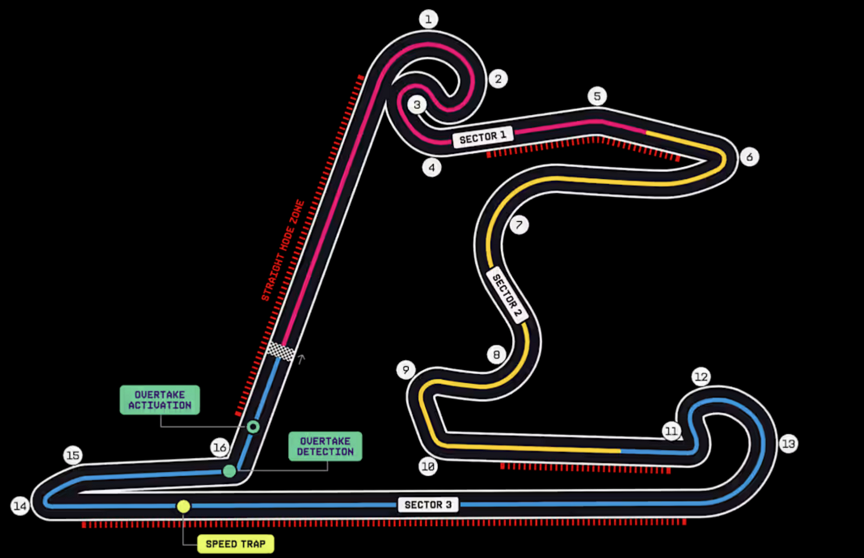
But this track has two straights one after another and that could be a problem.
Yeah, total braking energy is quite misleading. Proper metric would be to rank how much energy you can recharge by braking before each long straight, and then add weights for straight length. So a track with less energy but two straights on opposite sides of the circuit would rank better then energy rich track with two straights back to back.AR3-GP wrote: ↑10 Mar 2026, 13:27That's why I think we have to come up with a better metric than just the total braking energy. The problem is that if the braking energy is concentrated in 1 sector, then you can still end up with needing to harvest a lot on straights in other parts of the track.FittingMechanics wrote: ↑10 Mar 2026, 13:15
This one is about in the middle, IIRC.
But this track has two straights one after another and that could be a problem.
China is a good example of this. It has two straights that are back to back.
Exactly.FittingMechanics wrote: ↑10 Mar 2026, 13:31Yeah, total braking energy is quite misleading. Proper metric would be to rank how much energy you can recharge by braking before each long straight, and then add weights for straight length. So a track with less energy but two straights on opposite sides of the circuit would rank better then energy rich track with two straights back to back.AR3-GP wrote: ↑10 Mar 2026, 13:27That's why I think we have to come up with a better metric than just the total braking energy. The problem is that if the braking energy is concentrated in 1 sector, then you can still end up with needing to harvest a lot on straights in other parts of the track.FittingMechanics wrote: ↑10 Mar 2026, 13:15
This one is about in the middle, IIRC.
But this track has two straights one after another and that could be a problem.
China is a good example of this. It has two straights that are back to back.
I think Ferrari can win.

6th best out of the 24 tracks on the calendar is what I recall seeing, with Monaco being the best and Jeddah the worst. I would expect significant lift and coast and/or super clipping mostly in turn 16, and perhaps some going into the hairpin.
I'd argue that the best estimate of how energy starved tracks are is best calculated by estimating time at full throttle compared to time under braking, time slowing and time at a relatively low constant speed (to account for hairpins and tightening corners where you can partial-throttle recharge). It's the best measure of how easy it will be to harvest 9MJ. In reality the most important thing is whether you can harvest 9MJ, after that it's a matter of budgeting the recharging and deployment around the lap most efficiently.AR3-GP wrote: ↑10 Mar 2026, 13:27That's why I think we have to come up with a better metric than just the total braking energy. The problem is that if the braking energy is concentrated in 1 sector, then you can still end up with needing to harvest a lot on straights in other parts of the track.
China is a good example of this. It has two straights that are back to back.
Did you mean T14 or T16? I don't understand why they would do that in T15?bananapeel23 wrote: ↑10 Mar 2026, 13:52Turn 15 will likely be the only turn with severe lift and coast.
Oops, I meant T16, I forgot that T15 isn't just considered part of the hairpin. Fixed thatAR3-GP wrote: ↑10 Mar 2026, 14:20Did you mean T14 or T16? I don't understand why they would do that in T15?bananapeel23 wrote: ↑10 Mar 2026, 13:52Turn 15 will likely be the only turn with severe lift and coast.
The back straight is long enough that the slipstream might be enough, even though it's weak.