ispano6 wrote: ↑12 Mar 2026, 23:51
No you're not understanding. Honda said 3 years ago that the
2026 PU will have even more vibrations than the 2022-2025 power units due to the change from 120 kW to up to 350 kW.
They mention this in the article they published in 2024
https://global.honda/en/tech/motorsport ... wer_Units/
On the hardware side, large output MGU-Ks change a car’s vibration profile, so it is essential to ensure reliability to withstand the change. With the larger amounts of energy repeatedly stored in the ES and then used, development needs to focus on minimizing degradation of performance. With elimination of the MGU-H, highly efficient and effective energy management systems must also be developed when relying on the MGU-K alone.
In late January
“The specifications for the 2026 season are essentially fixed, and our current focus is on improving reliability ahead of homologation. However, there are many things you can only learn by installing the PU in a car and actually running it. That’s why winter testing—mounting it in a real car or one that’s very close to race conditions and confirming that everything operates properly—is an extremely important task, and that’s the stage we’re at now.”
Honda wanted the PU in the car ASAP, but the chassis was delayed. Had the car been ready in time to be on a track for even filming shakedown prior to Barcelona, some counter-measures could have been prepared before homologation. It is what it is.
there are 3 main parts to the PU. The ICE, the MGU-K and the Battery. And only the ICE and MGU-K cause vibration.
Back in 2021, Honda mentioned vibration on ICE was a concern due to higher compression ratio of 18:1, however this is now less of an issue because CR has been reduced to 16:1.
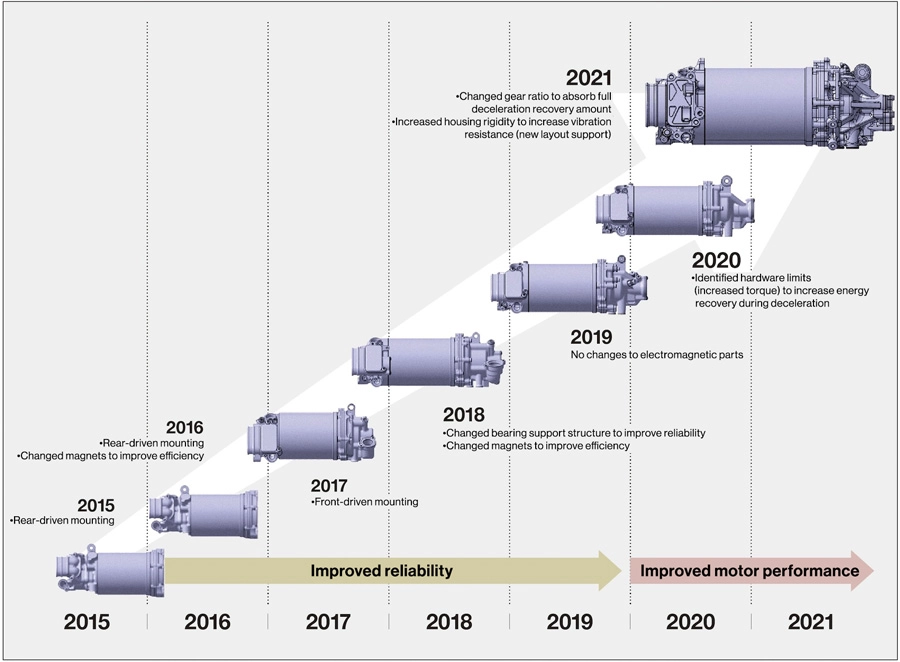
In 2021, Honda also mentioned about the vibration of MGU-K, which is why they increase the rigidity of the housing. With 2026 regulation, I would suppose the MGU-K will be bigger, which mean more vibration than before.
AMR is the only team that is running such deep undercut which require relocation of MGU-K to other part of the engine. For this reason, AMR may be the only team that has got its MGU-K place inside the monocoque right next to the battery.
AMR reported that the vibration is affecting both battery and the ICE, so I assume the main source of the vibration problem has to come from MGU-K, not the ICE because ICE vibration doesnt affect the battery and battery doesnt vibrate on its own.
As for why Honda place its MGU-K next to the battery? I can only guess this is to enable AMR to have the deep undercut, which no other team are doing at the moment.
So is this Honda's fault? Yes and No
Yes, because they didnt anticipate or detected the vibration will be an issue when they were doing test at the factory. Perhaps due to the lack of chassis to run the test.
No, because the idea to relocate the MGU-K has to come from AMR, while no other team on the grid are doing the same, perhaps they were aware of the challenges.
AN is known for pushing the boundary and for this case, he may have gone a little too far and too late for the team to find a solution to fix the problem (if it can be fix at all). I suppose Honda must be going flat out on simulation test in the factory right now, and if they cant find a solution, then its likely they will have to relocate the MGU-K to the side of the engine, and AMR will have to redesign the chassis and suspension layout.