- Login or Register
No account yet? Sign up

Just a reminder to everyone. These are external aerodynamic parts. Doesn't mean internal aerodynamic components haven't been changed or that weight reduction hasn't taken place.SilviuAgo wrote: ↑13 Mar 2026, 09:19MCL40 in Shanghai (McLaren F1 sources)
https://pbs.twimg.com/media/HDQzKBEWUAA ... name=large
https://pbs.twimg.com/media/HDQxkeuWQAA ... name=large
https://pbs.twimg.com/media/HDSEBHlaIAA ... name=large
I think we are all aware about that, and all this "updates" presented by teams are linked with aero parts (FW, RW, sidepods, floor)/suspension etc.trinidefender wrote: ↑13 Mar 2026, 19:55Just a reminder to everyone. These are external aerodynamic parts. Doesn't mean internal aerodynamic components haven't been changed or that weight reduction hasn't taken place.SilviuAgo wrote: ↑13 Mar 2026, 09:19MCL40 in Shanghai (McLaren F1 sources)
https://pbs.twimg.com/media/HDQzKBEWUAA ... name=large
https://pbs.twimg.com/media/HDQxkeuWQAA ... name=large
https://pbs.twimg.com/media/HDSEBHlaIAA ... name=large


you mean in-depth 'no look' ?SilviuAgo wrote: ↑15 Mar 2026, 11:52In-depth look at MCL40 upper part of front suspension architecture
https://pbs.twimg.com/media/HDbwxS2W0AE ... name=large
Source:F1tv
Imo is actually more relevant now in 2026 than it would have been last year. With the introduction of Active Aerodynamics, the front suspension's role has changed.venkyhere wrote: ↑15 Mar 2026, 12:35you mean in-depth 'no look' ?SilviuAgo wrote: ↑15 Mar 2026, 11:52In-depth look at MCL40 upper part of front suspension architecture
https://pbs.twimg.com/media/HDbwxS2W0AE ... name=large
Source:F1tv
we are seeing nothing meaningful
My post was not about the 'importance' of front suspension design.SilviuAgo wrote: ↑15 Mar 2026, 12:48Imo is actually more relevant now in 2026 than it would have been last year. With the introduction of Active Aerodynamics, the front suspension's role has changed.venkyhere wrote: ↑15 Mar 2026, 12:35you mean in-depth 'no look' ?SilviuAgo wrote: ↑15 Mar 2026, 11:52In-depth look at MCL40 upper part of front suspension architecture
https://pbs.twimg.com/media/HDbwxS2W0AE ... name=large
Source:F1tv
we are seeing nothing meaningful
1. Mechanical Balance for Active Aero: Because the front and rear wings now shift positions to reduce drag on straights, the mechanical 'platform' provided by this suspension must be incredibly precise to handle the sudden shifts in aero-balance. We saw even in China Lando's FW touching track at the end of straight line and producing some sparks.
2.Narrower 2026 Chassis: You can see how McLaren has packaged the upper wishbones to suit the narrower 2026 chassis width. This mounting height is key to managing the wake around the new, smaller front wheels and directing it toward the revised sidepod inlets.
3.Flow Redirection: In 2026, the goal is to manage the "outwash" differently since the floor isn't doing all the part from ground effect era.
So sorry for not having a better picture, but is all I got from the live stream.
venkyhere wrote: ↑15 Mar 2026, 14:38I don't think that the 'Longbow' wishbone design has any anti-roll bar function: bump on one side has no effect on the other side, as the movement is accommodated by the flexure joints.SilviuAgo wrote: ↑15 Mar 2026, 12:48...Many have a 'longbow' forming the forward arm of the upper wishbones on either side (ie a physical connection, that acts as anti roll bar whilst still having enough 'flex' at either end, to allow up-down movement of one side without affecting other side too much).
The main advantage is consistency of suspension geometry left-to-right: any slight variation in the machining of the chassis mounting points can potentially vary the distance between the outboard axes of the left and right wishbones and affect your camber. By having the wishbones connected, this distance is set in stone (carbon). Furthermore, the connecting piece adds stiffness against compressive side loads, again keeping the geometry more consistent, and there may also be a slight weight saving of laying up a spanning wishbone over engineering a thick mounting point for separate cantilevered flexure joints.
I'm not sure that "weight" is the primary reason that Mclaren went for a shorter car. It would only be a side effect. The words about weight in this tweet are not from anyone at Mclaren.
This is actually taken from a Rob Marshall interview.
The tweet doesn't source the specific quote, so I forgot reading about this. However considering that Mercedes and Ferrari have no issue, I'm not convinced that there was no way to make a longer car. Mclaren have other reasons.

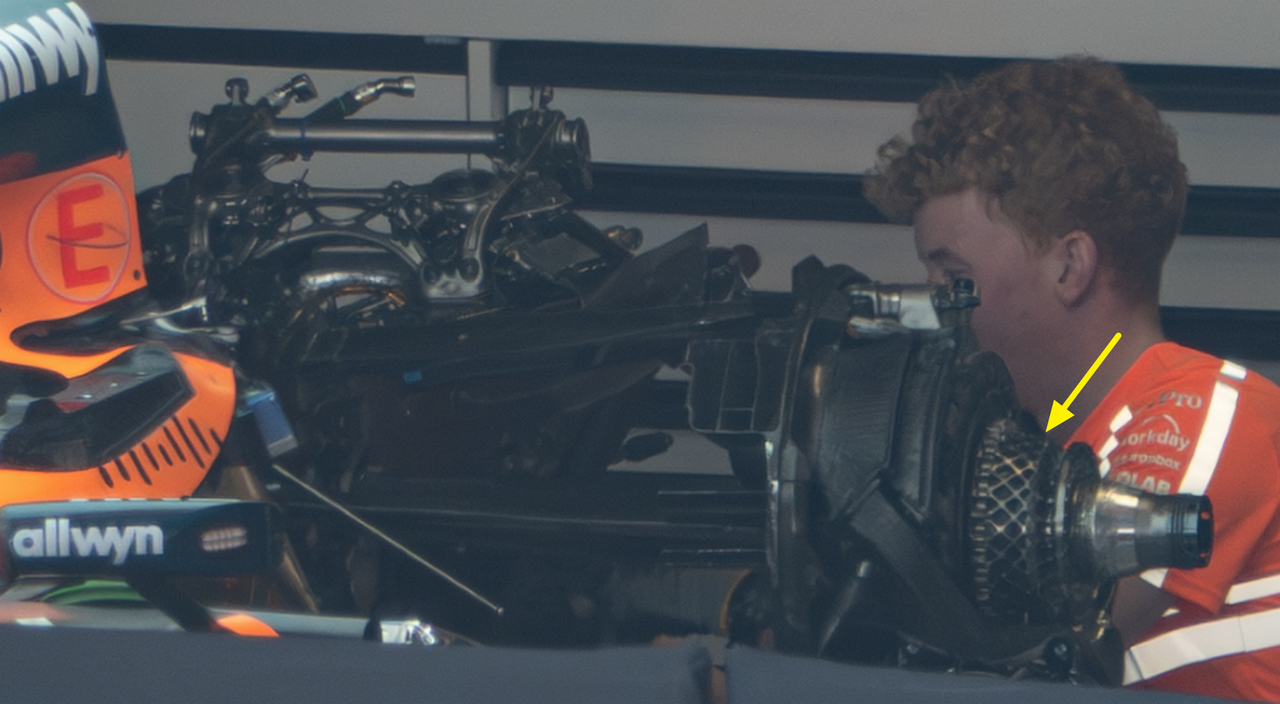

Those teeth slightly more inboard of your arrow is where the disc splines onto the hub.AR3-GP wrote: ↑25 Mar 2026, 14:39@n_mode_log
I don't think I've seen this before:
https://i.postimg.cc/50ckKZ9N/image.png
Is that where the rear brake rotor sits?
https://pbs.twimg.com/media/HDNF3b-XgAA ... name=large