No guarantee that other teams spotted it.

- Login or Register
No account yet? Sign up

As far as I understand, there are no rules stating that the closing speed must be linear, nor that it must be the same in every corner; there is only the 400ms limit (which, to the naked eye, seems to be exceeded).
Never the less, if it takes longer then 0.4 of a second from point A to point B, fully open to fully closed, it can't be legally run in a race or qualifying.
Were the other cars driving in a vacuum? Like it was said, weird that no team protested, but they might have not spotted it.

Normally eight arms (effectively two wishbone each side) plus pushrod, plus halfshaft fairing, non load bearing.vorticism wrote: ↑23 Mar 2026, 13:30The driveshaft has its own dedicated fairing. Six suspension arms. Seven discrete aero elements. The driveshaft fairing must be heavier, stronger than the others, since it wouldn't be able to contact the driveshaft along that half meter span. It couldn't be a simple thin skin like the others.
"Under all operating conditions" is definitely stipulated in the aero rules, but I don't have time to look it up right now.Martin Keene wrote: ↑23 Mar 2026, 15:16The 400ms is an interesting rule, because is that 400ms when the car is stationary or when running, because surely as the aero load builds on the wing during the closing process, the wing will likely slowdown. Very, very fractionally slow down, but when there is a rule measure in ms, details matter.
There is nothing in the rules that mentions whether it is stationary or at speed, so therefore, it must apply in both conditions.
I've got the following arrangement:- the main diagonal link (foremost on car, furthest from camera) as pushrod, and going through the orifice on engine cover to top of torsion bar location.Lasssept wrote: ↑21 Mar 2026, 23:48https://pbs.twimg.com/media/HD9RoiSXEAA ... name=large
Xavier Gàzquez
It is compliant under ambient temperatureMartin Keene wrote: ↑23 Mar 2026, 15:16The 400ms is an interesting rule, because is that 400ms when the car is stationary or when running, because surely as the aero load builds on the wing during the closing process, the wing will likely slowdown. Very, very fractionally slow down, but when there is a rule measure in ms, details matter.
There is nothing in the rules that mentions whether it is stationary or at speed, so therefore, it must apply in both conditions.

It's definitely more than 0.4s and I doubt it's a "gas leak" . The timing of the 1st stop of the front wing is the same as the time it takes to close the rear wing. Here's a video:
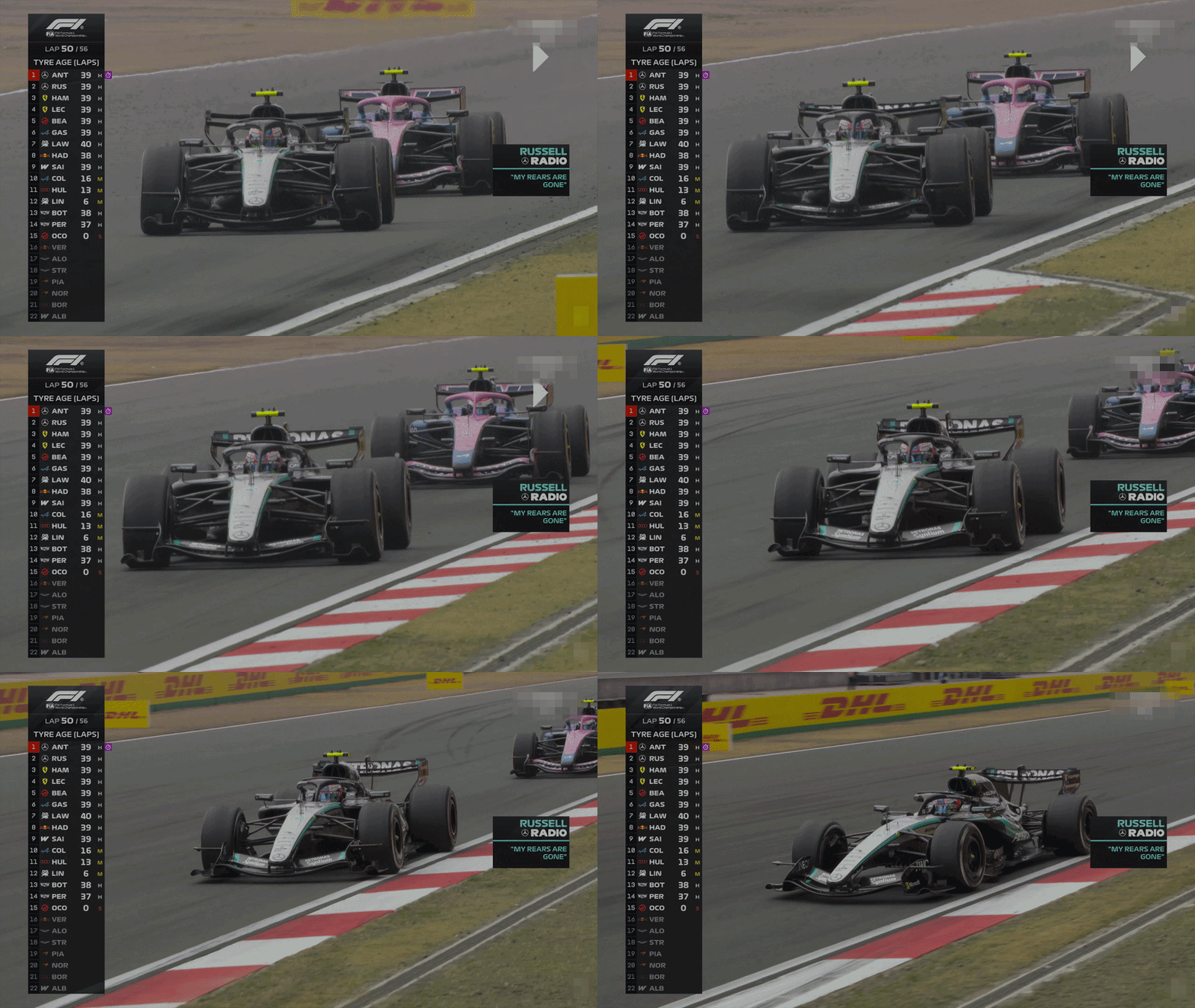
https://www.planetf1.com/news/lewis-ham ... uch%20more!A source from a rival team indicated to PlanetF1.com that it is commonplace for teams to delay the activation and deactivation of straight-line mode between the front and rear of the car.
However, this usually sees the front wing close later than the rear wing in order to reduce the potential for bottoming and skid wear.
The source added that this critical balance limitation definitely increases the risk of instability in combined braking events.