George Russell claimed his first Formula One sprint race win at the 2026 Chinese Grand Prix, maintaining his perfect start to the season after a closely fought contest that highlighted both Mercedes’ strengths and the evolving competitive order under the 2026 regulations.
This forum contains threads to discuss teams themselves. Anything not technical about the cars, including restructuring, performances etc belongs here.
Not sure how it relates to the discussion about Hamilton potentially being down on power, but I noticed Leclerc looked rapid through the hairpin and 'Spoon' all race long (generally, and compared to Hamilton, and to a lesser extent Russell).
He had that patented aggressive front-end driving style, really pitching the nose in on entry and shortening the corner. I would have halfway expected this might cost him recharge/deployment, but perhaps that wasn't the case (or he was able to find it back elsewhere).
Hamilton didn't seem to have enough front wing for the race. he asked for two more clicks on the front wing during his stop. In the second stint he was complaining that the car wouldn't turn, and had lots of understeer. From the onboards it was very noticeable at the hairpin.
Are we in a situation again similar to last year where Charles can go more extreme with the setup since these are rear limited cars? or is it just a wrong setup issue?
Hamilton didn't seem to have enough front wing for the race. he asked for two more clicks on the front wing during his stop. In the second stint he was complaining that the car wouldn't turn, and had lots of understeer. From the onboards it was very noticeable at the hairpin.
Are we in a situation again similar to last year where Charles can go more extreme with the setup since these are rear limited cars? or is it just a wrong setup issue?
I don't think anyone outside of the trackside engineering staff would know that with complete authority. With that being said, The car looked to have a boat load of understeer, specialty in the hairpin.
This conversation reminds me of what Leclerc said after the race, that sometimes from the cockpit it's extremely difficult to tell whether something is a battery issue or not. At the start of the race he felt like he was low on power and he kept asking if he had an issue and Ferrari said no, right up until the pit stop. They had the same exchange multiple times, Lec was getting very frustrated. The unpredictability of the deployment software probably makes matters worse, where sometimes it may not be a "glitch" but rather a "feature" (but still a negative for the driver)
Hopefully the software is something they really focus on in April - both Ferrari and the FIA as it's causing a lot of frustration and confusion
This conversation reminds me of what Leclerc said after the race, that sometimes from the cockpit it's extremely difficult to tell whether something is a battery issue or not. At the start of the race he felt like he was low on power and he kept asking if he had an issue and Ferrari said no, right up until the pit stop. They had the same exchange multiple times, Lec was getting very frustrated. The unpredictability of the deployment software probably makes matters worse, where sometimes it may not be a "glitch" but rather a "feature" (but still a negative for the driver)
Hopefully the software is something they really focus on in April - both Ferrari and the FIA as it's causing a lot of frustration and confusion
It's a compounding issue as well. If you have a set-up issue, damage, an in proper fuel load, or just racing hard wheel to wheel, it all has an impact.
If have to change you line, how you accelerate, or how you brake, it will change how much you can harvest & deploy.
"Lewis didn’t have any engine issues during the race, but his hard tyres degraded more significantly than Charles’, which led to higher energy consumption due to wheel spin. This also accelerated tyre wear.
Coming out of corners, a driver with a good set-up gains a significant advantage in energy deployment over the lap. This can represent a 1–2% energy saving with every acceleration. It also depends on tyre condition and driving style.
In Hamilton’s case, for example, Carlo Santi asked him at one point to reduce acceleration by 15% coming out of corners, to slow down in order to have more overall energy and improve lap times. The data shows that Leclerc had more speed by slowing down in a way that Vasseur describes as ‘counter-intuitive’".
These cars pose some really “interesting” challenges for the drivers.
I thought it was an April Fool’s joke, but it turns out it’s true...
It just shows what an outstanding driver Leclerc is...
“He drives a car with a lot of oversteer, and somehow he manages to slide the rear end without causing tyre degradation. When I try to slide the rear of the car in a similar way, the tyre wear is massive”
"Lewis didn’t have any engine issues during the race, but his hard tyres degraded more significantly than Charles’, which led to higher energy consumption due to wheel spin. This also accelerated tyre wear.
Coming out of corners, a driver with a good set-up gains a significant advantage in energy deployment over the lap. This can represent a 1–2% energy saving with every acceleration. It also depends on tyre condition and driving style.
In Hamilton’s case, for example, Carlo Santi asked him at one point to reduce acceleration by 15% coming out of corners, to slow down in order to have more overall energy and improve lap times. The data shows that Leclerc had more speed by slowing down in a way that Vasseur describes as ‘counter-intuitive’".
These cars pose some really “interesting” challenges for the drivers.
I thought it was an April Fool’s joke, but it turns out it’s true...
It just shows what an outstanding driver Leclerc is...
“He drives a car with a lot of oversteer, and somehow he manages to slide the rear end without causing tyre degradation. When I try to slide the rear of the car in a similar way, the tyre wear is massive”
That was with the old cars I think Hamilton has a much better grasp on the current gen machine
This conversation reminds me of what Leclerc said after the race, that sometimes from the cockpit it's extremely difficult to tell whether something is a battery issue or not. At the start of the race he felt like he was low on power and he kept asking if he had an issue and Ferrari said no, right up until the pit stop. They had the same exchange multiple times, Lec was getting very frustrated. The unpredictability of the deployment software probably makes matters worse, where sometimes it may not be a "glitch" but rather a "feature" (but still a negative for the driver)
Hopefully the software is something they really focus on in April - both Ferrari and the FIA as it's causing a lot of frustration and confusion
It is still the "discovery phase" of these regulations so definitely drivers, race engineers, designers, regulators are definitely learning as they go along.
All of the drivers will converge on this weird way of driving very soon.
Not sure how it relates to the discussion about Hamilton potentially being down on power, but I noticed Leclerc looked rapid through the hairpin and 'Spoon' all race long (generally, and compared to Hamilton, and to a lesser extent Russell).
He had that patented aggressive front-end driving style, really pitching the nose in on entry and shortening the corner. I would have halfway expected this might cost him recharge/deployment, but perhaps that wasn't the case (or he was able to find it back elsewhere).
Hamilton didn't seem to have enough front wing for the race. he asked for two more clicks on the front wing during his stop. In the second stint he was complaining that the car wouldn't turn, and had lots of understeer. From the onboards it was very noticeable at the hairpin.
Are we in a situation again similar to last year where Charles can go more extreme with the setup since these are rear limited cars? or is it just a wrong setup issue?
Suzuka is front limited. Lots of understeer from ragging on the front tyres in the high speed. Drivers will ask for more wing. The cars don't seem to be rear limited at all in terms of going around a corner. They are very sesnitive to battery charging!
"Lewis didn’t have any engine issues during the race, but his hard tyres degraded more significantly than Charles’, which led to higher energy consumption due to wheel spin. This also accelerated tyre wear.
Coming out of corners, a driver with a good set-up gains a significant advantage in energy deployment over the lap. This can represent a 1–2% energy saving with every acceleration. It also depends on tyre condition and driving style.
In Hamilton’s case, for example, Carlo Santi asked him at one point to reduce acceleration by 15% coming out of corners, to slow down in order to have more overall energy and improve lap times. The data shows that Leclerc had more speed by slowing down in a way that Vasseur describes as ‘counter-intuitive’".
These cars pose some really “interesting” challenges for the drivers.
I thought it was an April Fool’s joke, but it turns out it’s true...
It just shows what an outstanding driver Leclerc is...
“He drives a car with a lot of oversteer, and somehow he manages to slide the rear end without causing tyre degradation. When I try to slide the rear of the car in a similar way, the tyre wear is massive”
In China ham seemed to have loads of over steer and it made him faster. I believe these new cars have solved the problem quoted.
These cars pose some really “interesting” challenges for the drivers.
I thought it was an April Fool’s joke, but it turns out it’s true...
It just shows what an outstanding driver Leclerc is...
“He drives a car with a lot of oversteer, and somehow he manages to slide the rear end without causing tyre degradation. When I try to slide the rear of the car in a similar way, the tyre wear is massive”
In China ham seemed to have loads of over steer and it made him faster. I believe these new cars have solved the problem quoted.
That his driving style, late braking deep into corners. It makes the corners really short so oversteer sort of enables this a little bit. It won't really slow him down much in the way the understeer would. Seems to be the same for Leclerc as well. It's a good thing for Ferrari to have two drivers with similar styles.
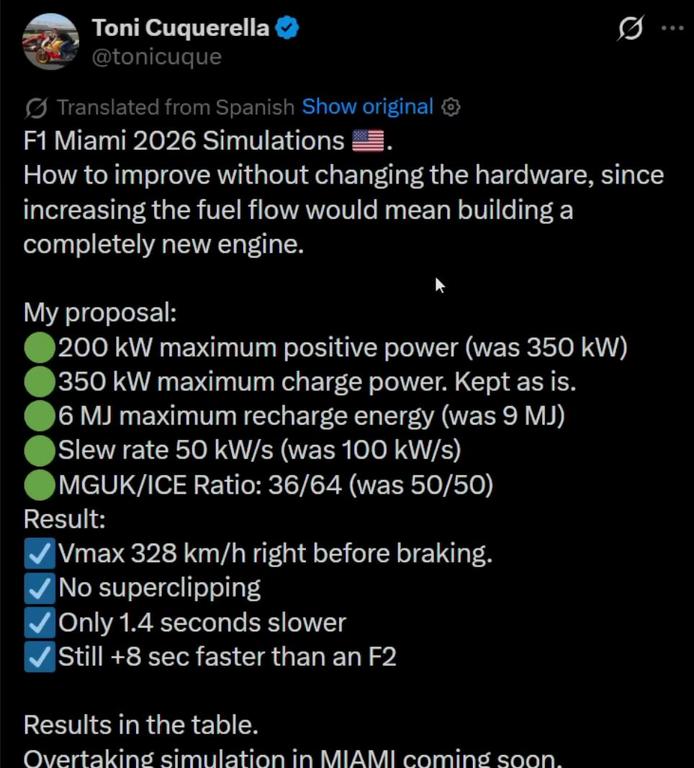
I don’t know if this is the right thread to post, or if it was posted elsewhere, this post from X by former F1 engineer Toni Cuquerella regarding his proposal to modify the sporting regulations concerning the electric part …
I thought it was an April Fool’s joke, but it turns out it’s true...
It just shows what an outstanding driver Leclerc is...
“He drives a car with a lot of oversteer, and somehow he manages to slide the rear end without causing tyre degradation. When I try to slide the rear of the car in a similar way, the tyre wear is massive”
In China ham seemed to have loads of over steer and it made him faster. I believe these new cars have solved the problem quoted.
That his driving style, late braking deep into corners. It makes the corners really short so oversteer sort of enables this a little bit. It won't really slow him down much in the way the understeer would. Seems to be the same for Leclerc as well. It's a good thing for Ferrari to have two drivers with similar styles.
Leclerc and Verstappen are considered short corner drivers, is Hamilton as well?
I don’t know if this is the right thread to post, or if it was posted elsewhere, this post from X by former F1 engineer Toni Cuquerella regarding his proposal to modify the sporting regulations concerning the electric part …
The important text, though I encourage clicking the article as Giuliana provided some great illustrations:
The gap to Mercedes is clearly dictated by a difference in power unit performance. The delta would be around 20bhp, as previously reported - and, from what has been learned, this leaves the Italian team fairly confident of being allowed an upgrade under the Additional Development and Upgrade Opportunities (ADUO) system.
The F1 Commission will meet on April 9 to discuss the current regulations, as well as to set the final deadline for establishing the power unit performance ranking for ADUO, which had the Miami race as its deadline. Without the Bahrain and Saudi Arabian races, this deadline could be postponed to Monaco - but in Maranello at least there is a preference towards maintaining the current deadline.
(...)
The choice to use the fast Italian track was made immediately after Australia - and as far as we know, other teams are also considering holding one of the two permitted filming day sessions at Monza.
Ferrari has set April 22 as the date - which, weather permitting, will allow testing of most of the updates that will later be brought to Miami.
This is not the ideal scenario for the Maranello team, which had planned to split part of the developments across the two canceled races in Sakhir and Jeddah, bringing the main components to Bahrain.
(...)
A revised floor - intended for Bahrain - is the main upgrade for increasing aerodynamic downforce. It will be fitted to the SF-26 that will run the 200km at Monza on April 22.
Some parts on the car will concern additional aerodynamic changes and weight reduction, while in Miami there will also be components related to cooling management.
In Miami we will also see again the two halo wings that popped up in China practice and were removed because they did not comply with a detail relating to the material used, which must be the same as the halo structure.
The test in China confirmed what the team feared - namely that the specification used (of the wing) in Bahrain testing cannot yet be used in races because it does not provide sufficient rear stability under combined braking conditions (with a non-straight steering angle).
Ferrari should still keep the option open regarding which of the rear wing specifications to use from time to time, the classic version (seen in the first three races) or the Macarena version. For now, this dilemma mainly exists on circuits such as Monte Carlo, where the traditional flap-opening specification might be preferred.
"Lewis didn’t have any engine issues during the race, but his hard tyres degraded more significantly than Charles’, which led to higher energy consumption due to wheel spin. This also accelerated tyre wear.
Coming out of corners, a driver with a good set-up gains a significant advantage in energy deployment over the lap. This can represent a 1–2% energy saving with every acceleration. It also depends on tyre condition and driving style.
In Hamilton’s case, for example, Carlo Santi asked him at one point to reduce acceleration by 15% coming out of corners, to slow down in order to have more overall energy and improve lap times. The data shows that Leclerc had more speed by slowing down in a way that Vasseur describes as ‘counter-intuitive’".
This has been misunderstood somewhat. Charles isn't going slower out of the corners, just using the throttle slightly less at first to prevent wheel spin.
This means his battery deployment isn't being wasted during the spinning phase, however short. He's not getting more power than Hamilton, nor is he going slower in order to be faster later.