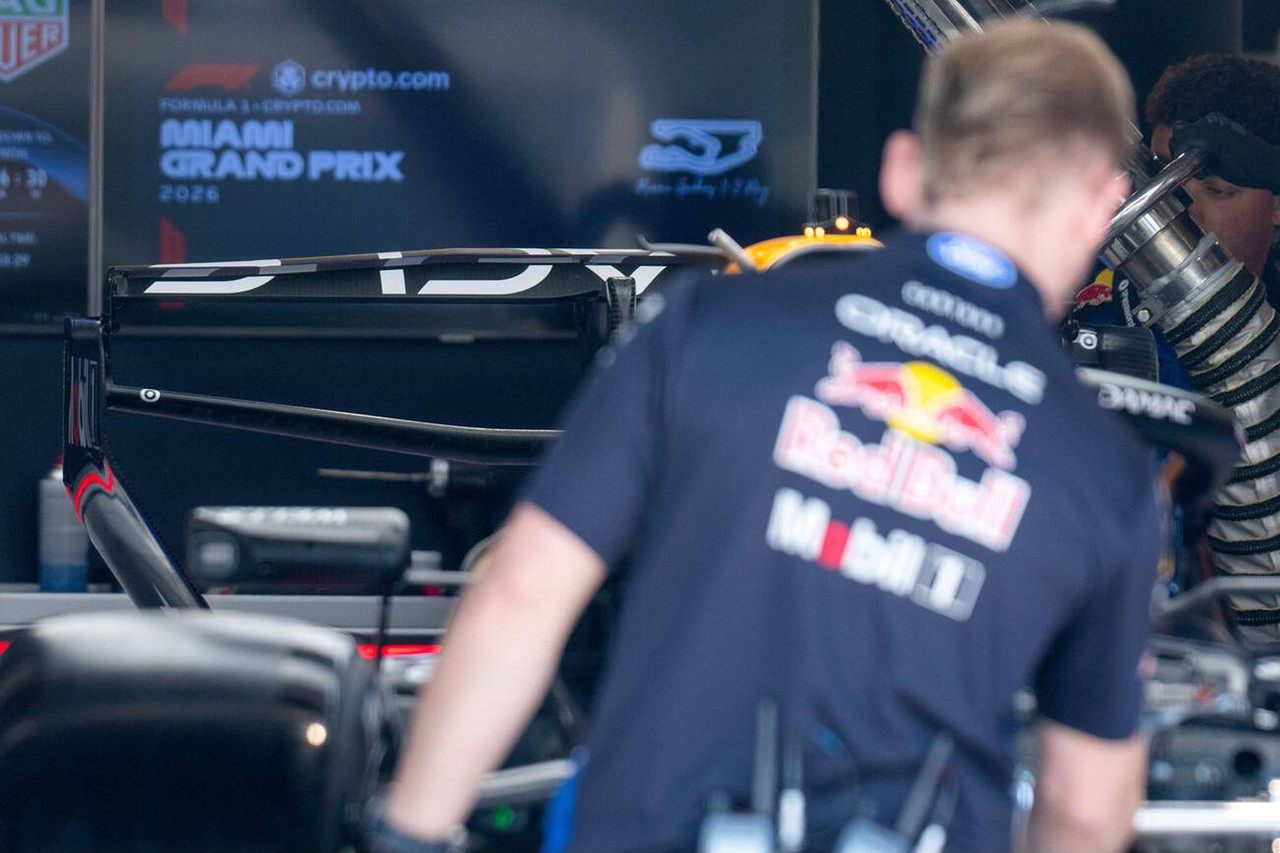
Owen.C93 wrote: ↑01 May 2026, 13:14
Looks like it gets quite sharp as the sidepod reaches the floor, forming a strake.
I would have thought that would violate the minimum radius rules, but maybe it’s relaxed lower down.
Could you be more specific? I'm not seeing what you are referring to.
Paa wrote: ↑01 May 2026, 01:45
It is an honest question. As a layman I would think only the cross section of the wing (opened and closed) and the profile matter. Is the gap between the top and bottom matters much as long as the profile shape and cross section area is the same?
Any two aero surfaces running roughly parallel to each other will create a volume of high-pressure air flow between them, and that pressure will increase the closer the two surfaces are, which induces drag. However, there will be a point of diminishing returns beyond which increasing the gap will provide less drag benefit.
It's impossible for us to tell where that point is relative to the Red Bull and Ferrari wings, without access to CFD. However, one possible hint is in Ferrari's design. Their wing pivots around the middle of the flap, and because of how their actuator functions there is no obvious reason why that pivot point can't be higher up, which would increase the gap. So maybe the slot gap when opened is as big as it needs to be.
It's also possible that Red Bull's decision to mount their flap on swing arms (which increases the opened slot gap) is done purely because that is the geometry needed for the whole mechanism to function, rather than chasing a bigger slot gap.