Aston Martin AMR26

A place to discuss the characteristics of the cars in Formula One, both current as well as historical. Laptimes, driver worshipping and team chatter do not belong here.
User avatar
SiLo
144
Joined: 25 Jul 2010, 19:09

Re: Aston Martin AMR26

Post

GhostF1 wrote:
02 Apr 2026, 05:52
https://ibb.co/wZq7RYJQ

Good wheelbase comparisons but also, drastic differences in the engine cover shape based on packaging underneath (purple line). The Aston is extremely compact. How quickly the line falls from the intake entry and remains really shallow.
The packaging on the McLaren is a masterpiece considering how much shorter the car is as well.
Felipe Baby!

Farnborough
Farnborough
151
Joined: 18 Mar 2023, 14:15

Re: Aston Martin AMR26

Post

SiLo wrote:
02 Apr 2026, 10:56
GhostF1 wrote:
02 Apr 2026, 05:52
https://ibb.co/wZq7RYJQ

Good wheelbase comparisons but also, drastic differences in the engine cover shape based on packaging underneath (purple line). The Aston is extremely compact. How quickly the line falls from the intake entry and remains really shallow.
The packaging on the McLaren is a masterpiece considering how much shorter the car is as well.
I feel the layout if this AMR is the most extreme, and big departure from previous team design, as you'd expect from new team direction.
We just can't see where its landed currently, from obvious compromise in place. But no doubt about it, this is quite a radical interpretation and with significant development potential I expect.

I'm not in the game of "prediction" as is often given, just that technically this one really stands out in design and within very tight regulation that come with this era.
They've much work to do, but hidden in plain sight currently is quite a step in design approach.

User avatar
SiLo
144
Joined: 25 Jul 2010, 19:09

Re: Aston Martin AMR26

Post

Farnborough wrote:
02 Apr 2026, 11:05
SiLo wrote:
02 Apr 2026, 10:56
GhostF1 wrote:
02 Apr 2026, 05:52
https://ibb.co/wZq7RYJQ

Good wheelbase comparisons but also, drastic differences in the engine cover shape based on packaging underneath (purple line). The Aston is extremely compact. How quickly the line falls from the intake entry and remains really shallow.
The packaging on the McLaren is a masterpiece considering how much shorter the car is as well.
I feel the layout if this AMR is the most extreme, and big departure from previous team design, as you'd expect from new team direction.
We just can't see where its landed currently, from obvious compromise in place. But no doubt about it, this is quite a radical interpretation and with significant development potential I expect.

I'm not in the game of "prediction" as is often given, just that technically this one really stands out in design and within very tight regulation that come with this era.
They've much work to do, but hidden in plain sight currently is quite a step in design approach.
I guess that's a direction you can go. And you have two options:

1. Conservative, start from a solid baseline and improve it incrementally.
2. Extreme, start from your most outlandish position and reign it in incrementally.

Both options will converge at some point, it's just which one is best initially. Maybe Aston think they have some tricks in their design choices, but right now we just can't see them.
Felipe Baby!

Farnborough
Farnborough
151
Joined: 18 Mar 2023, 14:15

Re: Aston Martin AMR26

Post

SiLo wrote:
02 Apr 2026, 12:27
Farnborough wrote:
02 Apr 2026, 11:05
SiLo wrote:
02 Apr 2026, 10:56


The packaging on the McLaren is a masterpiece considering how much shorter the car is as well.
I feel the layout if this AMR is the most extreme, and big departure from previous team design, as you'd expect from new team direction.
We just can't see where its landed currently, from obvious compromise in place. But no doubt about it, this is quite a radical interpretation and with significant development potential I expect.

I'm not in the game of "prediction" as is often given, just that technically this one really stands out in design and within very tight regulation that come with this era.
They've much work to do, but hidden in plain sight currently is quite a step in design approach.
I guess that's a direction you can go. And you have two options:

1. Conservative, start from a solid baseline and improve it incrementally.
2. Extreme, start from your most outlandish position and reign it in incrementally.

Both options will converge at some point, it's just which one is best initially. Maybe Aston think they have some tricks in their design choices, but right now we just can't see them.
What about the particularly small form for midships layout, the very adventurous, and obvious, rear suspension mounting and geometry ? I don't believe this car is being looked at with clarity on here, just bland statement based in current performance.

Conservative=evolution, when they had nothing of substance to evolve.

They've won nothing recently.

Extreme, I'd not call it that. But a clean sheet design, yes. This is what the 2022 RB was, it jumped the rest of them in concept.

This AMR26 the same for intent, there's literally no point in starting from a conservative outlook. That's just simply more of the same.

User avatar
diffuser
259
Joined: 07 Sep 2012, 13:55
Location: Montreal

Re: Aston Martin AMR26

Post

Farnborough wrote:
02 Apr 2026, 14:03
SiLo wrote:
02 Apr 2026, 12:27
Farnborough wrote:
02 Apr 2026, 11:05


I feel the layout if this AMR is the most extreme, and big departure from previous team design, as you'd expect from new team direction.
We just can't see where its landed currently, from obvious compromise in place. But no doubt about it, this is quite a radical interpretation and with significant development potential I expect.

I'm not in the game of "prediction" as is often given, just that technically this one really stands out in design and within very tight regulation that come with this era.
They've much work to do, but hidden in plain sight currently is quite a step in design approach.
I guess that's a direction you can go. And you have two options:

1. Conservative, start from a solid baseline and improve it incrementally.
2. Extreme, start from your most outlandish position and reign it in incrementally.

Both options will converge at some point, it's just which one is best initially. Maybe Aston think they have some tricks in their design choices, but right now we just can't see them.
What about the particularly small form for midships layout, the very adventurous, and obvious, rear suspension mounting and geometry ? I don't believe this car is being looked at with clarity on here, just bland statement based in current performance.

Conservative=evolution, when they had nothing of substance to evolve.

They've won nothing recently.

Extreme, I'd not call it that. But a clean sheet design, yes. This is what the 2022 RB was, it jumped the rest of them in concept.

This AMR26 the same for intent, there's literally no point in starting from a conservative outlook. That's just simply more of the same.
It's gotten really trendy to get on here and repeat "sound bites" from any era in F1 and apply it to this year's car's problems when the underlying data is likely completely different. Terms like B-Spec, Redesign keep getting thrown around.

Krack said they'll have an upgrade for Miami. The big improvement will come when they turn up the wick on the PU. From the onboards, they were testing overpass button and it wasn't always working. So that falls under testing PU systems still. They are still able to collect aero data in the state the car was in but hard to know your suspension limitations when your not pushing more than 75%. From the onboards, Alonso looked like he was on a Sunday drive in the race. Half expected him to start whistling.

User avatar
ispano6
164
Joined: 09 Mar 2017, 23:56
Location: my playseat

Re: Aston Martin AMR26

Post

An interesting analysis on https://www.as-web.jp/f1/1310337

Aston Martin's sharp front suspension is a failure! ? Deciphering the latest F1 mechanics

The June issue of "auto sport" released on Tuesday, April 28 features a special look at the mechanics of the new generation of F1 cars. There is a lot of content, such as the actual state of energy management revealed at the Japanese Grand Prix and the intuition of each 26 models and aero by aerodynamic developers who have experience in turning wind tunnels under the current regulations, but from among them, we will first decipher Aston Martin's radical front suspension.

■ Steering rack position is low efficiency at the rear end of the tire
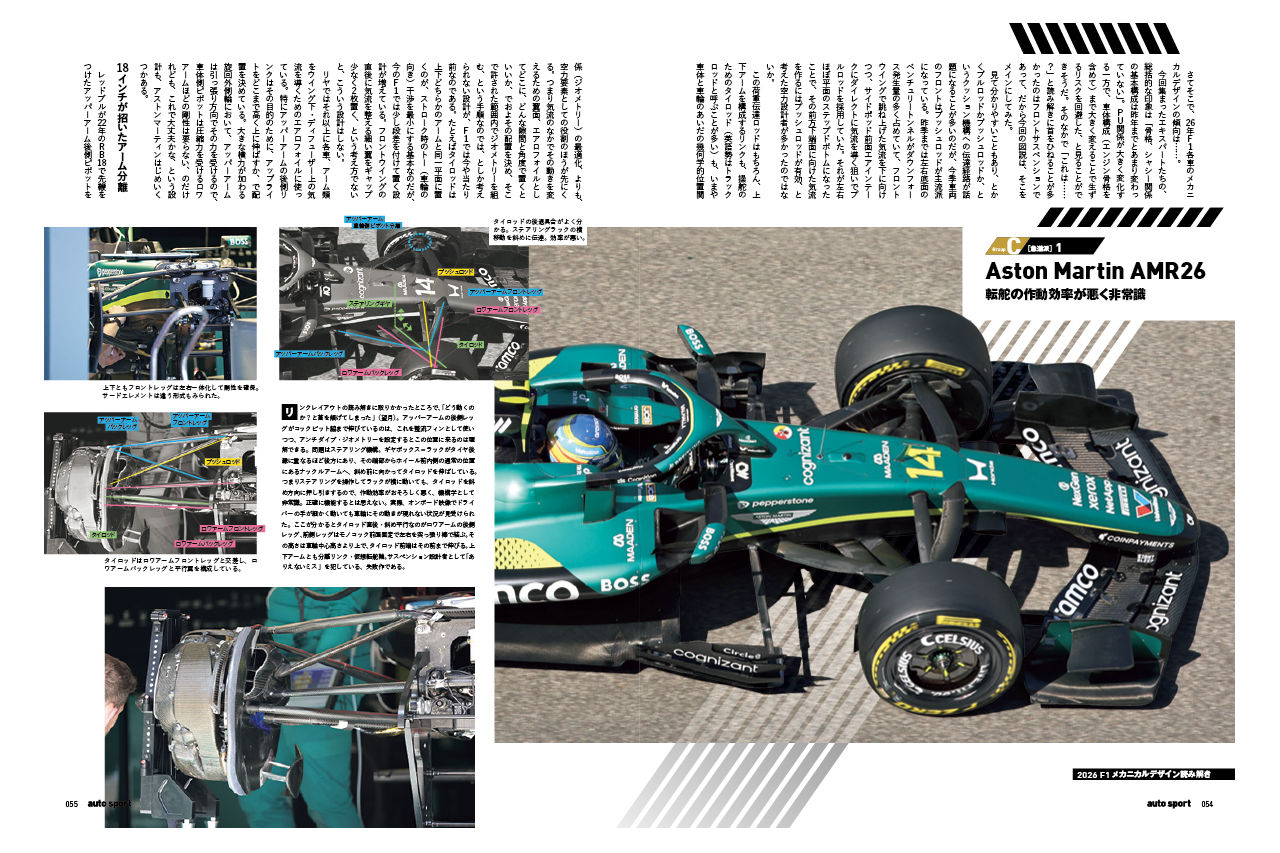
When I started reading the link layout, I tilted my head and asked, "How will it move?" (Mochizuki *Participating member of the book reading and decoding project). It is understandable that the rear leg of the upper arm extends to the side of the cockpit, and it comes to this position when you set the anti-dive geometry while using it as a commutator fin.

The problem is the steering mechanism. The gearbox = rack is located behind the tire trailing edge, and the tie rod is extended diagonally forward from its end to the knuckle arm in the normal position inside the front of the wheel. In other words, even if the rack moves sideways by operating the steering, the tie rod is pushed and pulled in an oblique direction, so the operating efficiency is terribly poor, and it is insane as a mechanic. I don't think it works exactly.

In fact, in the on-board video, even if the driver's hand moves slightly, the movement does not appear on the wheels. If you understand this, the rear leg of the lower arm is diagonally parallel right after the tie rod, and the front leg is fixed on the front of the monocoque and tied the left and right sides with a stick. Its height is above the center height of the wheel, and the front end of the tie rod extends to the front. Both the upper and lower arms are separated links and virtual rotating steering shafts. As a suspension designer, he is making "impossible mistakes" and is a failure (Takehiko Ryokaku).

The layout is novel and aggressive. However, there seems to be a problem with the operation
It is a little difficult to read only the text, but you can understand the content of the point by combining photos and composition explanation diagrams. As a premise, due to the change in regulations, the floor has changed from Venturi to a stepped bottom, and it has become mandatory to install a "floorboard" like a bargeboard in the opposite direction, and it is difficult to take air into the floor from the side of the vehicle, so you want to take air into the floor as much as possible from the front of the vehicle.
Image

For this reason, I would like to make full use of the front suspension arms as commutator blades. Many teams have changed the suspension type from pull rod to push rod in order to secure flow path and rectification. As you know, Aston Martin has Adrian Newey joining. It is not difficult to imagine that the suspension design instructions were given with aero as a top priority.

The rear leg of the upper arm is long and extends backward, which looks very aggressive and cool to the eyes. If you pay attention to the lower side, the tie rod extends to the front of the wheel along the rear leg on the lower side, and these two ...... Rather, the two wings form a wing. This is also very cool, but considering the operation of the steering wheel, it can even be said that it is a mechanical defect.

If the lever ratio is created on the tie rod, it will expand the input from the road surface, and the steering vibration is also caused by this! ? When I fantasized about it, Mr. Ryokaku rejected the hypothesis, saying, "That's not the case."

■The cleanup master is McLaren. Multi-link is popular
McLaren is smartly finding solutions to the proposition of balancing aerodynamic requirements and kinetic dynamics. It turned out that the wheel side attachment point of the tie rod is very unique for a formula in this project.

The "separation link/virtual steering axis" in the quoted text is a form in which the upper and lower arms of the double wishbone are further divided into a total of 3 or 4 upper and lower arms, and other teams are also incorporated, and if it is a mass-produced car, it is called a multi-link. Although the wheels are now 18 inches and the inner diameter of the wheels has been expanded, it has become difficult to secure the ideal mounting point on the wheel side as a geometry, and it seemed to be popular as a countermeasure.
I don't have access to this F1 Tech weekly content but curious if it has similar observations.
https://www.formula1.com/en/latest/arti ... imIuakPt0u