https://www.linkedin.com/posts/dominik- ... paign=copy
CFD sim of RB wing by Dominik Balasko. Tap the link to watch his simulation...
Red Bull's Macarena Wing — Compromise or Genuine Gain?

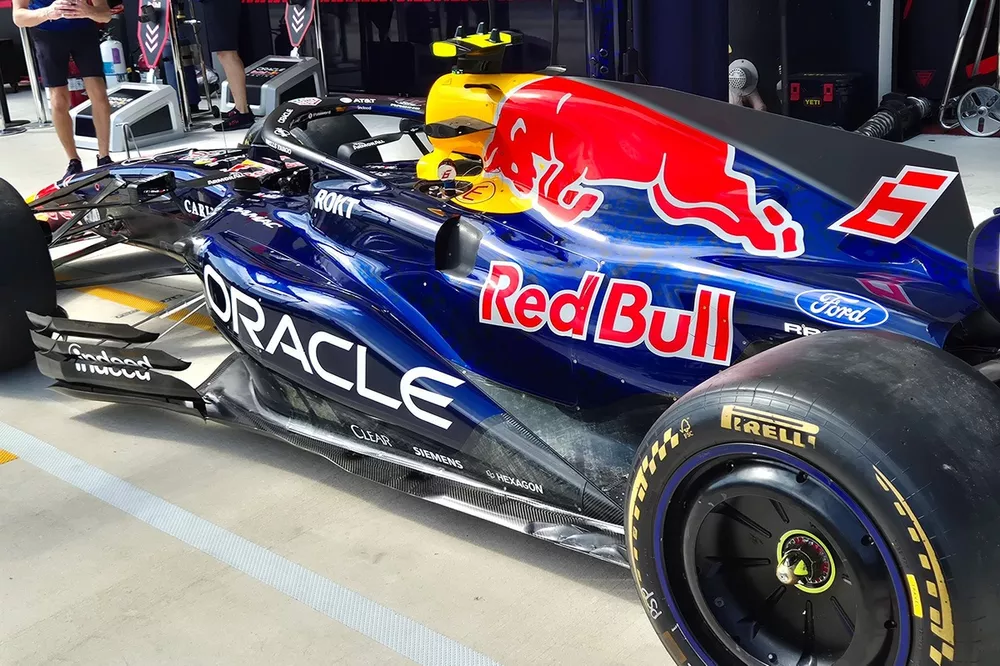
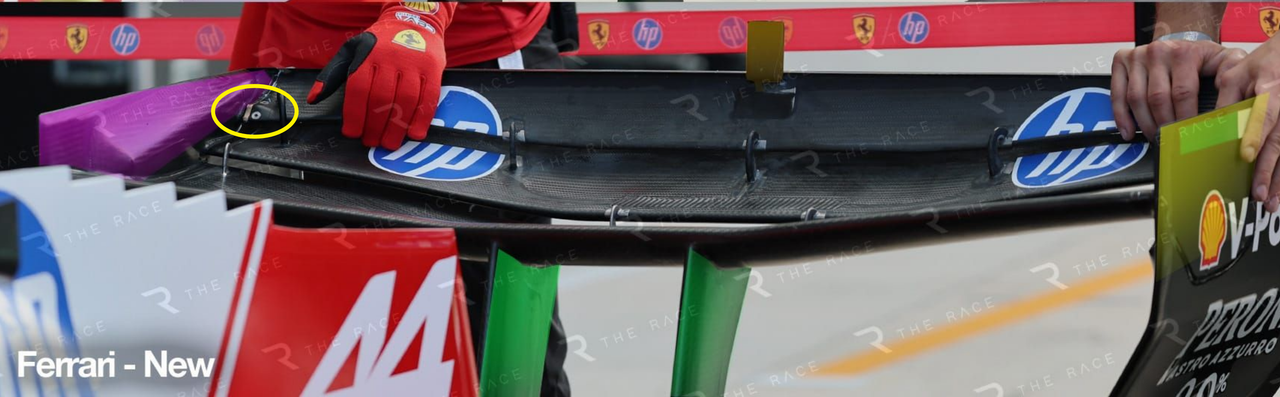
Red Bull debuted their Macarena-style flipping rear wing in Miami — and the architecture tells a different story to Ferrari's. What they share: Both deploy trailing-edge-first. The goal: exploit the deployed position aerodynamically, not just reduce drag. Where Ferrari extracts more: Ferrari's endplate actuation places the flap rearward into the diffuser upwash at full deployment. The flap curves that upwash into a forward-inclined lift vector — an active aero gain, not just camber-change drag relief. Red Bull's centred actuation keeps the flap forward of that corridor. The gain is drag reduction, not lift generation. Where Red Bull has the advantage: Ferrari acts from one endplate only. That's a massive torsional load across the full flap span — asymmetric, structurally demanding, and a real weight penalty. Red Bull's central mount is symmetric, lighter, and allows significantly faster opening and closing. The aero behavior on closing reflects that too. Ferrari's flap only re-enters the slot gap suction region late in the closing stroke — delayed reattachment, wide hysteresis loop, slow downforce recovery. Red Bull's closing sequence tells a different story: • Slot gap suction re-established from the start of the stroke • Partial attachment present early → lift builds linearly through the return • Smooth, predictable downforce recovery with no step-change in loading In practice: more consistent aero loading on corner entry, directly influencing trail-braking margin and rear stability under rotation. My take? Red Bull probably won't match Ferrari's peak straight-line delta. But a lighter, faster actuation system combined with linear lift build-up through the closing stroke means more consistent performance lap-to-lap — and in a race environment, that's often the more valuable commodity. Not a compromise. A deliberate trade-off — peak gain for aerodynamic consistency. Full simulation breakdown below — DRS hysteresis study in STAR-CCM+, flow visualization included. Credit for the geometry goes to Emil Qvist
I learn from the mistakes of people who take my advice...

 Red Bull debuted their Macarena-style flipping rear wing in Miami — and the architecture tells a different story to Ferrari's. What they share: Both deploy trailing-edge-first. The goal: exploit the deployed position aerodynamically, not just reduce drag. Where Ferrari extracts more: Ferrari's endplate actuation places the flap rearward into the diffuser upwash at full deployment. The flap curves that upwash into a forward-inclined lift vector — an active aero gain, not just camber-change drag relief. Red Bull's centred actuation keeps the flap forward of that corridor. The gain is drag reduction, not lift generation. Where Red Bull has the advantage: Ferrari acts from one endplate only. That's a massive torsional load across the full flap span — asymmetric, structurally demanding, and a real weight penalty. Red Bull's central mount is symmetric, lighter, and allows significantly faster opening and closing. The aero behavior on closing reflects that too. Ferrari's flap only re-enters the slot gap suction region late in the closing stroke — delayed reattachment, wide hysteresis loop, slow downforce recovery. Red Bull's closing sequence tells a different story: • Slot gap suction re-established from the start of the stroke • Partial attachment present early → lift builds linearly through the return • Smooth, predictable downforce recovery with no step-change in loading In practice: more consistent aero loading on corner entry, directly influencing trail-braking margin and rear stability under rotation. My take? Red Bull probably won't match Ferrari's peak straight-line delta. But a lighter, faster actuation system combined with linear lift build-up through the closing stroke means more consistent performance lap-to-lap — and in a race environment, that's often the more valuable commodity. Not a compromise. A deliberate trade-off — peak gain for aerodynamic consistency. Full simulation breakdown below — DRS hysteresis study in STAR-CCM+, flow visualization included. Credit for the geometry goes to Emil Qvist