Analysis of Hungary upgrades (tks to formulatecnica.it for drawings):
In recent races, McLaren had under-optimized the car's setup and, in terms of development, was a step behind its rivals. The so-called "development rate," or the frequency of development, was a weak point for the English manufacturer , for very clear reasons.
Since June 30, the ATR (Aerodynamics Test Regulations) rankings, which govern aerodynamic testing, have been updated based on the current status of the constructors' standings. Until then, having won the 2025 world championship, McLaren was the team most penalized by this rule. Everything has changed with the unlocking of additional hours in the wind tunnel and a surplus of testable geometries.
 Front view of the bottom with the old wheel corner of the McLaren MCL40
The Woking team has worked hard to implement these changes as quickly as possible. The speed with which the entire process is carried out and their cost are crucial in the Circus. Today, we can confirm that these updates were initially planned for the second half of the championship, tentatively for the Dutch Grand Prix in Zandvoort after the summer break.
But in the United Kingdom, the reigning world champion team worked extremely hard to bring forward its work plan and, surprisingly, introduce the new features as early as the Hungarian Grand Prix. Most of these updates directly affect the car's performance, while the remainder served to better adapt the cooling to the demands of this track.
McLaren: new floor to stabilize rear downforce
Among these updates, two were fundamental. First, let's talk about the floor (illustration below). Specifically, the Woking engineers lengthened the external vertical appendage that slides longitudinally along the floor.
 Comparison between the old and new McLaren MCL40 floorpan
Furthermore, a vertical but internal fin is added, an appendage that effectively "cages" the three slots in the bottom, the latter modified in shape . The bottom, moreover, is excavated with the clear objective of clearly dividing the portion responsible for turbulence control from the adjacent area. A meticulous work, in short.
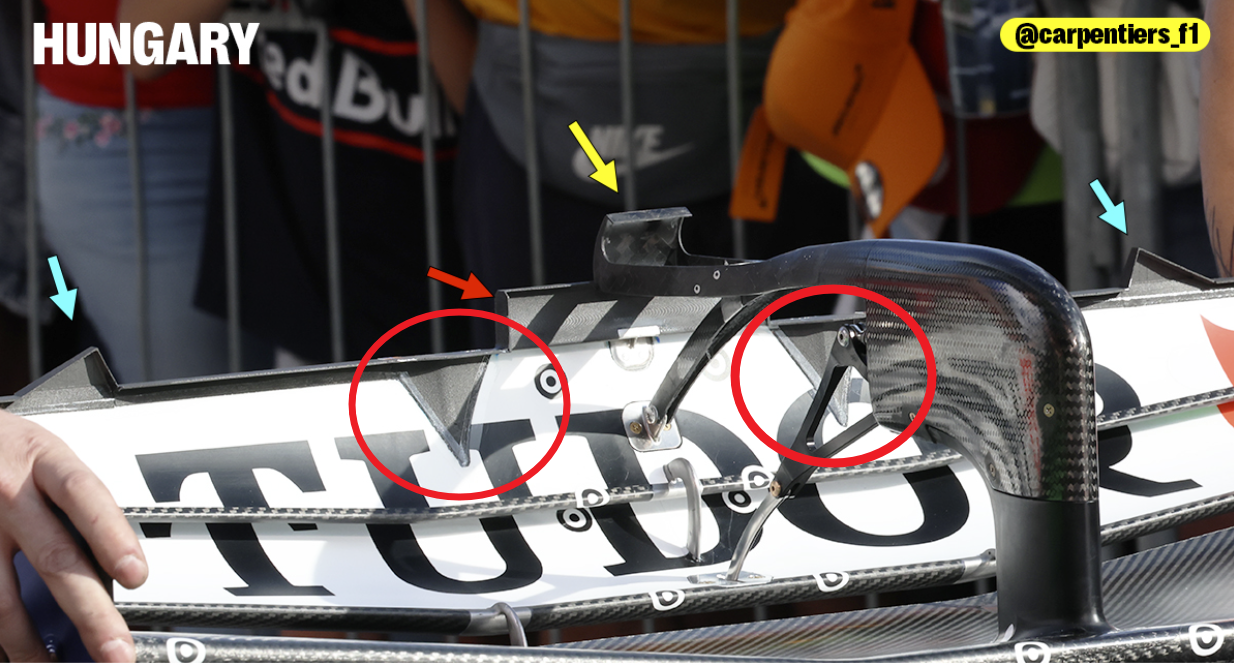
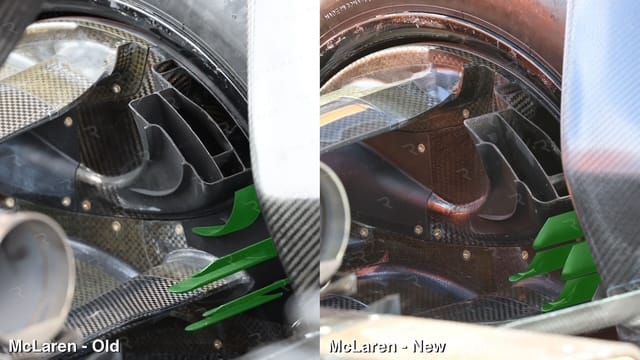
The second crucial modification is at the rear. We're talking about all those appendages anchored to the rear brake intake, which have the task of smoothing out the turbulence flowing sideways to the diffuser and which, normally, would be sucked up by the low pressure generated in the underbody. For this reason, fins are used to attenuate the vortices, making them less harmful to the underbody-diffuser assembly.
From the illustration, we can confirm several corrections. Although we're talking about details in the overall aerodynamic context of the car, these elements make a marked difference . The curved appendage (white arrow at the top) has been split into multiple profiles. This solution significantly increases flow stability in various conditions, significantly reducing the risk of detachment.
 Comparison between the two versions of wheel corner on the McLaren MCL40
As a result, it was possible to increase the incidence of the lower appendage group , thus being able to vary the pressure field on the sides of the extractor to improve control and attenuate the turbulence flowing close to the tire. Again, we're talking about a truly meticulous job to add performance to the MCL40.
These modifications, in addition to increasing local downforce, have generated stable downforce across a wider range of driving conditions . Each individual aerodynamic element depends on the conditions of the flow that hits it. The latter varies based on the positioning of the car, considering that when cornering, the car exhibits a combination of roll and yaw.
 Front view of the bottom with the new wheel corner of the McLaren MCL40
Each aerodynamic component mounted on the car generates a certain amount of downforce depending on the incoming flow conditions. The car steers and leans, and the flow varies in direction and intensity . The aerodynamic map summarizes the relationship between downforce and the car's characteristic angles. It's a tool that teams use to achieve absolute precision.
 The McLaren MCL40's two main updates for the Hungarian Grand Prix
Updates and an expanded aerodynamic map aren't enough to explain McLaren's F1 triumph in Hungary. As Lando Norris himself revealed, it was also the wind that made the difference compared to rivals like Ferrari , taming the MCL40's chronic rear-end problems. A subtle factor that favored the Woking team, and not a little
Norris: The wind changed McLaren's weekend
“ I didn't expect to be so strong in qualifying, but the wind changed from Friday to Saturday, and Saturday's wind really suited our car much better, ” McLaren's reigning world champion revealed, adding: “We know that in certain types of wind we struggle a lot. This is something we need to work on inside the car.”




 Merc
Merc