From Gemini AI:
Here is the breakdown of how engine changes work in 2026:
1. The General Rule (Freeze): Once the engine is homologated, changes are typically forbidden except for those necessary for reliability, safety, or cost-saving, which must be approved by the FIA.
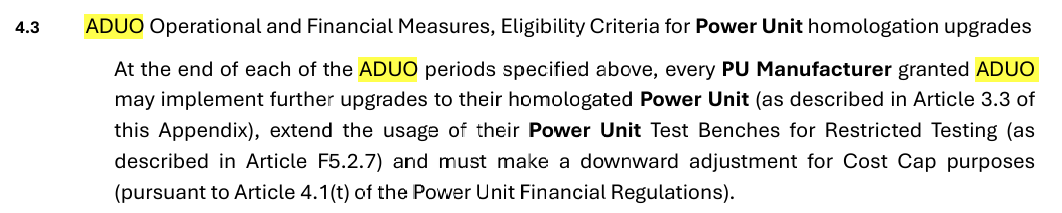
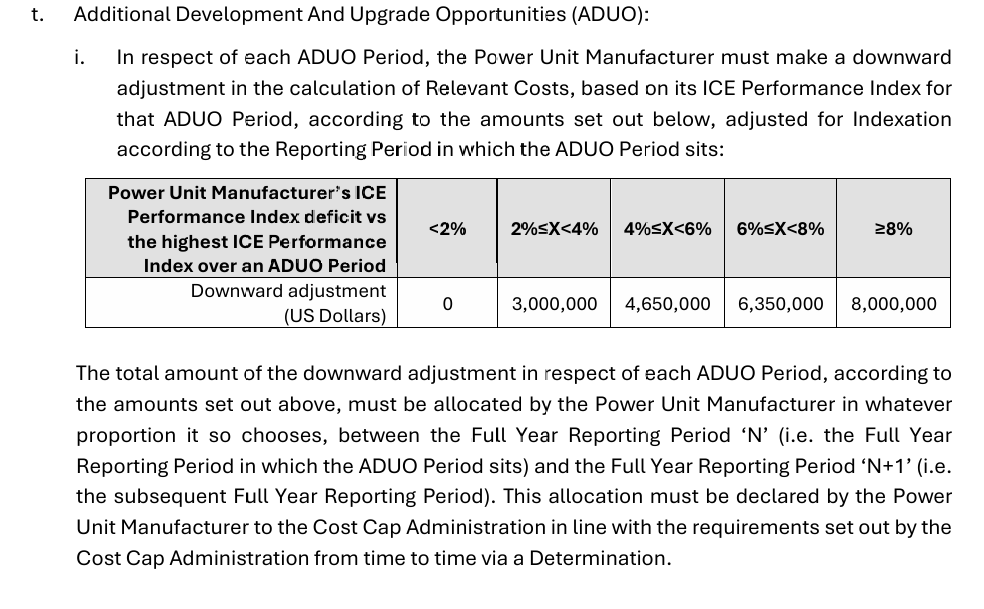
2. The 2026 Exception (ADUO): If a manufacturer is deemed to be underperforming based on performance assessments (calculated over three periods in the season: races 1–6, 7–12, and 13–18), they may be allowed to introduce upgrades.
3. Catch-up Mechanism: If a manufacturer is 2% to 4% off the best engine, they are allowed one additional upgrade in-season; if they are more than 4% off, they get two upgrades.
The performance is assessed at three specific milestones during the 24-race season:
Period 1: After Race 6 (25% mark).
Period 2: After Race 12 (50% mark).
Period 3: After Race 18 (75% mark).
Calculation Methodology
The FIA monitors each power unit's performance using standardized sensors and telemetry data to determine a "Reference Power" based on the top-performing units.
Metric: The primary calculation is based on the average Internal Combustion Engine (ICE) performance.
Gap Thresholds:
2% to 4% gap: If a manufacturer's average output is between 2% and 4% below the reference power of the top competitors, they are granted one additional development opportunity.
Over 4% gap: If the performance deficit exceeds 4%, the manufacturer is granted two additional development opportunities.
Granted Relief Measures
Manufacturers found to be lagging in these periods can receive several forms of assistance to close the gap:
Homologation Changes: Permission to modify their officially frozen (homologated) power unit design.
Test Bench Hours: Additional development time on power unit dynos.
Cost Cap Relief: Limited financial flexibility to spend on these specific performance-recovery projects without violating the strict power unit cost cap.

- Login or Register
No account yet? Sign up