
- Login or Register
No account yet? Sign up

Honda F1 project leader Yusuke Hasegawa has outlined a number of reasons why Honda has been struggling so badly in the beginning of the 2017 Formula One season. He confirmed that lots of problems were not discovered while running on the dynamo meter.

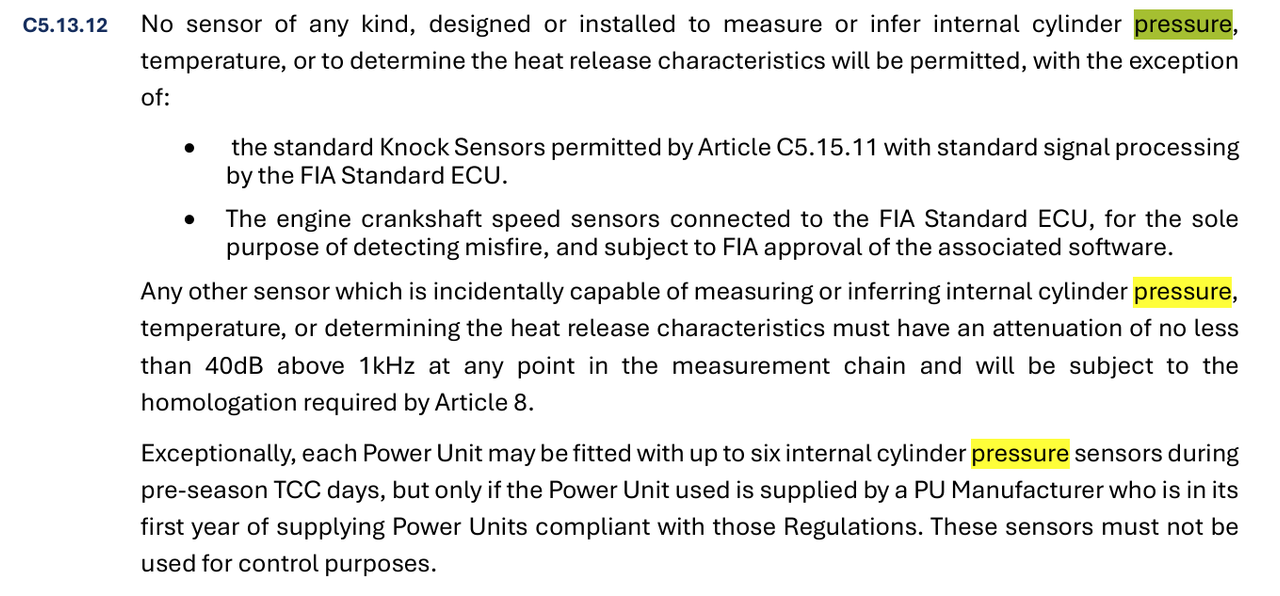
So no pressure and temperature sensors. That pretty much rules out real time monitoring as proposed before. And it's even illegal to infer these values.AR3-GP wrote: ↑26 Mar 2026, 03:34You can use pressure sensors on the test benches, but you are not allowed to have them at the track. There's an exception for new PU manufacturers during the pre-season (RB and Audi).
https://i.postimg.cc/bY9bpLdT/image.png
Could mean anything. Such as a confirmation that such sensors are used at all. Doesn't mean everyone.
Yes the new test is a waste of time. Its political theater.mzso wrote: ↑26 Mar 2026, 15:10Not that the FIA wording of "compliance with the compression ratio limit must be demonstrated not only at ambient conditions, but also at a representative operating temperature of 130°C." suggested such. I always thought that means heating it up to 130C and measure the compression ratio on a test rig.
Honestly from the first this test felt like a pretense. Temperatures go much higher than that on the cylinder walls and pistons, don't they? Surely, if a mini chamber exists it closes up near operating temperature.
No it doesn't but he could have used "some are" or "most are" but he chose to use "they are" in referencing the PU manufactures. It could be that I'm just reading too much in those words....mzso wrote: ↑26 Mar 2026, 15:10So pressure and temperature sensors. That pretty much rules out real time monitoring as proposed before. And it's even illegal to infer these values.AR3-GP wrote: ↑26 Mar 2026, 03:34You can use pressure sensors on the test benches, but you are not allowed to have them at the track. There's an exception for new PU manufacturers during the pre-season (RB and Audi).
https://i.postimg.cc/bY9bpLdT/image.png
Not that the FIA wording of "compliance with the compression ratio limit must be demonstrated not only at ambient conditions, but also at a representative operating temperature of 130°C." suggested such. I always thought that means heating it up to 130C and measure the compression ratio on a test rig.
Honestly from the first this test felt like a pretense. Temperatures go much higher than that on the cylinder walls and pistons, don't they? Surely, if a mini chamber exists it closes up near operating temperature.
Could mean anything. Such as a confirmation that such sensors are used at all. Doesn't mean everyone.
It always comes down heating what up to 130C ? If we're talking a combustion chamber, it's cold, if we're talking a crankshaft or connecting rod we're talking too hot. I thought it meant the coolant temperature.AR3-GP wrote: ↑26 Mar 2026, 15:14Yes the new test is a waste of time. Its political theater.mzso wrote: ↑26 Mar 2026, 15:10Not that the FIA wording of "compliance with the compression ratio limit must be demonstrated not only at ambient conditions, but also at a representative operating temperature of 130°C." suggested such. I always thought that means heating it up to 130C and measure the compression ratio on a test rig.
Honestly from the first this test felt like a pretense. Temperatures go much higher than that on the cylinder walls and pistons, don't they? Surely, if a mini chamber exists it closes up near operating temperature.
It is theater. Whether it's coolant or oil, you won't reproduce the quasi-equilibrium thermal distribution of a running ICE by simply circulating warm oil and coolant. It's a terrible misunderstanding of how things work.diffuser wrote: ↑26 Mar 2026, 16:05It always comes down heating what up to 130C ? If we're talking a combustion chamber, it's cold, if we're talking a crankshaft or connecting rod we're talking too hot. I thought it meant the coolant temperature.
I don't believe it's political theater. The other PU manufactures would not allow that. I believe that they just didn't know "the how" yet at the time they said that and why it'll take till June to implement it. From a manufactures point of view, changing a head gasket thickness would drop the CR. So you would need a Homolagation change.
AR3-GP wrote: ↑26 Mar 2026, 16:09It is theather. Whether it's coolant or oil, you won't reproduce the quasi-equilibrium thermal distribution of a running ICE by simply circulating warm oil and coolant. It's a terrible misunderstanding of how things work.diffuser wrote: ↑26 Mar 2026, 16:05It always comes down heating what up to 130C ? If we're talking a combustion chamber, it's cold, if we're talking a crankshaft or connecting rod we're talking too hot. I thought it meant the coolant temperature.
I don't believe it's political theater. The other PU manufactures would not allow that. I believe that they just didn't know "the how" yet at the time they said that and why it'll take till June to implement it. From a manufactures point of view, changing a head gasket thickness would drop the CR. So you would need a Homolagation change.
Coolant extracts heat from an engine due to the temperature difference between the coolant and the surrounding metallic surfaces. The heat that raises the temperature of the metal above that of the coolant comes from combustion. If there is no combustion, the test is theater.
I agree.diffuser wrote: ↑26 Mar 2026, 16:11AR3-GP wrote: ↑26 Mar 2026, 16:09It is theather. Whether it's coolant or oil, you won't reproduce the quasi-equilibrium thermal distribution of a running ICE by simply circulating warm oil and coolant. It's a terrible misunderstanding of how things work.diffuser wrote: ↑26 Mar 2026, 16:05It always comes down heating what up to 130C ? If we're talking a combustion chamber, it's cold, if we're talking a crankshaft or connecting rod we're talking too hot. I thought it meant the coolant temperature.
I don't believe it's political theater. The other PU manufactures would not allow that. I believe that they just didn't know "the how" yet at the time they said that and why it'll take till June to implement it. From a manufactures point of view, changing a head gasket thickness would drop the CR. So you would need a Homolagation change.
Coolant extracts heat from an engine due to the temperature difference between the coolant and the surrounding metallic surfaces. The heat that raises the temperature of the metal above that of the coolant comes from combustion. If there is no combustion, the test is theater.
Yeah, I think they're gonna be testing live ...
BTW that whole part in the regs about the "40db above 1khz" means they full expect pressure sensors to be in the heads anyways but the imposed sensing limit makes it useless for measuring pressure but they can still be used to measure other stuff below the limit.
 that all is OK and no advantage will continue to be had.
Yep. It's getting old seeing the same sort of posts lacking technical understanding again and again and again........because people don’t seem to be actually into technical discussion here.
By putting the whole thing in an "oven", and rotating the crankshaft to measure the difference. I would guess.
Without the necessary sensors, how? Drilling a hole in the cylinder for a probe??
Obvious, sure, but but whether it's allowed or not is much debated.Hoffman900 wrote: ↑26 Mar 2026, 18:09FYI: the manufacturers have to submit all the CAD drawings, including material, AND A reference PU that can be dissasembled to the FIA. This whole extra chamber idea is hogwash and would be blatently obvious and very clearly not allowed.
In either case the test seems to be futile.Hoffman900 wrote: ↑26 Mar 2026, 18:09A connecting rod expansing some? Sure, but it’s not going to show you at 120* C when running temps are higher and there is no forces acting on the rod.
Driving the conjecture is the secrecy around the facts. That's naive in current availability of scrutiny from anyone with interest in F1 to any real degree.mzso wrote: ↑26 Mar 2026, 20:48Obvious, sure, but but whether it's allowed or not is much debated.Hoffman900 wrote: ↑26 Mar 2026, 18:09FYI: the manufacturers have to submit all the CAD drawings, including material, AND A reference PU that can be dissasembled to the FIA. This whole extra chamber idea is hogwash and would be blatently obvious and very clearly not allowed.In either case the test seems to be futile.Hoffman900 wrote: ↑26 Mar 2026, 18:09A connecting rod expansing some? Sure, but it’s not going to show you at 120* C when running temps are higher and there is no forces acting on the rod.