Apparently they run 11100 rpm limited.

- Login or Register
No account yet? Sign up
Apparently they run 11100 rpm limited.

Isn't that the point of a works deal? To have a collaborative relationship and be able to better fit engine and chassis and integrate them together? If AMR should be expected to sit back and wait for an engine from Honda without any say in the design and Honda sit back and wait for a chassis from AMR without any say, what is the point of the works deal? Both should be able to make requests to each other and both should be able to push back when something cannot be done and both should be able to come to a well tested "compromise" solution when designing / integrating chassis and engine. That's the whole point of a works deal.Otromundo wrote: ↑13 Mar 2026, 04:16Last week or maybe the week before I saw a video of a Japanese reporter interviewing a big boss from HRC. He had a life-size model of the engine behind him where you could see that the electrical part + battery were in staggered positions. They asked him the reason. He replied that AN had asked them for the MGU-K to be as low as possible and that they had to modify the engine. That the electrical part above the MGU-K housed "electrical components" (I suspected they could be capacitors, which is something I think is important to confirm, by the way) and that the lower part housed the battery. And that AN's reason was to move the center of gravity as low as possible, something logical and also typical of AN. At no point was AN or AMR criticized.
I've been looking for it for 2 days because I didn't save its address and I would like you to see it. But there is no way. Let's see if I can find it while I wait for P1 to start.
The drivers depend on the feel of the road in the steering wheel. If you dampen it, you lose all that. Anyways, last weekend, Stroll said the vibration was down 50%.GhostF1 wrote: ↑13 Mar 2026, 05:53I suppose a question that someone I know asked me that seems so obvious, it hasn't been asked is.. "if the vibrations for the driver are THAT bad they can't even drive the car, can they not introduce a damper on the steering and seat somewhere? Most motorcycles have dampers to mitigate severe vibrations for this exact reason. At this point, if it introduces a kilo or two, so be it, I think that's the least of their concerns for the moment, but if it gets them running, great".
I personally refuse to believe there is nothing they can do to make it possible for the drivers to actually drive it for [prolonged timeframes. This sounds archaic and a dodge or an exaggerated safety plea for development time.
That staggered box Honda used last year was a separate unit, so stacking it on top of the battery now isn’t really a big deal.Otromundo wrote: ↑13 Mar 2026, 04:16Last week or maybe the week before I saw a video of a Japanese reporter interviewing a big boss from HRC. He had a life-size model of the engine behind him where you could see that the electrical part + battery were in staggered positions. They asked him the reason. He replied that AN had asked them for the MGU-K to be as low as possible and that they had to modify the engine. That the electrical part above the MGU-K housed "electrical components" (I suspected they could be capacitors, which is something I think is important to confirm, by the way) and that the lower part housed the battery. And that AN's reason was to move the center of gravity as low as possible, something logical and also typical of AN. At no point was AN or AMR criticized.
I've been looking for it for 2 days because I didn't save its address and I would like you to see it. But there is no way. Let's see if I can find it while I wait for P1 to start.
Strange cause Stroll initially declined to answer it saying “it is up to others to answer on vibrations improvement..”diffuser wrote: ↑13 Mar 2026, 11:03The drivers depend on the feel of the road in the steering wheel. If you dampen it, you lose all that. Anyways, last weekend, Stroll said the vibration was down 50%.GhostF1 wrote: ↑13 Mar 2026, 05:53I suppose a question that someone I know asked me that seems so obvious, it hasn't been asked is.. "if the vibrations for the driver are THAT bad they can't even drive the car, can they not introduce a damper on the steering and seat somewhere? Most motorcycles have dampers to mitigate severe vibrations for this exact reason. At this point, if it introduces a kilo or two, so be it, I think that's the least of their concerns for the moment, but if it gets them running, great".
I personally refuse to believe there is nothing they can do to make it possible for the drivers to actually drive it for [prolonged timeframes. This sounds archaic and a dodge or an exaggerated safety plea for development time.
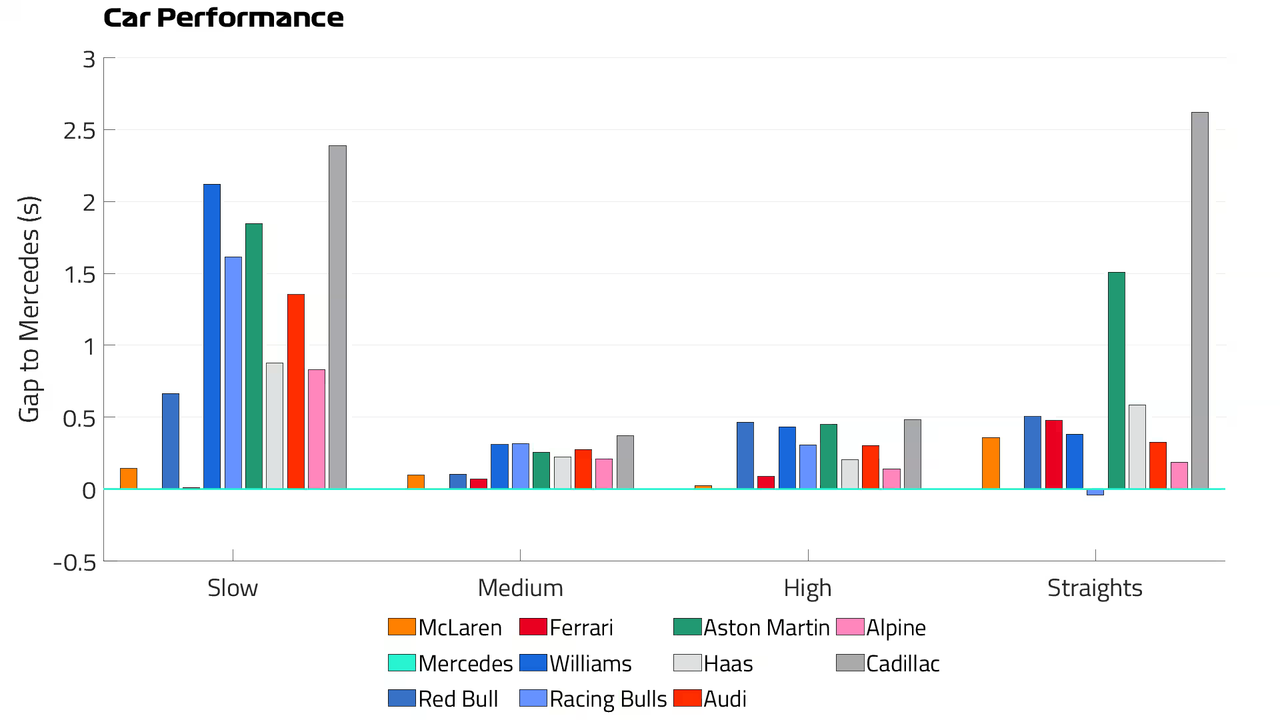
Alonso said that they've done so few laps so far that they haven't yet optimized the car and the package; this car is still far from its maximum potential.Ashwinv16 wrote: ↑13 Mar 2026, 09:17looking at the sector times i am starting to see Adrian's frustration. He really cooked with the regs. Granted the car is still not great in slow corners but it's an absolute rocket in medium speed corners(defie lty the fastest or at least 2nd fastest behind the Ferrari and handles the high speed well. Honeslty it looks like as long as Honda gives reliability with a battery and regen to match others, it wont matter if the cars down on power. The chassis will make it up. Slow corners is massive worry though with terrible understeer and even worse traction but step by step.
Maybe they can use the 2 filming session's laps to get some laps in over that period.
Potentially they can. Also Krack after Melbourne said they could have finished the race.

Well, the super-zero sizing is also another one of AN's priorities, as is normal in their profession. It wouldn't have caught my attention if the one from HRC had said it because I take it for granted. On the other hand, what did catch my attention was lowering the car's center of gravity. Something that is also normally among AN's priorities, but it caught my attention more. I haven't been able to find the video yet, I didn't save its URL and it is being very complicated.diffuser wrote: ↑13 Mar 2026, 11:45That staggered box Honda used last year was a separate unit, so stacking it on top of the battery now isn’t really a big deal.Otromundo wrote: ↑13 Mar 2026, 04:16Last week or maybe the week before I saw a video of a Japanese reporter interviewing a big boss from HRC. He had a life-size model of the engine behind him where you could see that the electrical part + battery were in staggered positions. They asked him the reason. He replied that AN had asked them for the MGU-K to be as low as possible and that they had to modify the engine. That the electrical part above the MGU-K housed "electrical components" (I suspected they could be capacitors, which is something I think is important to confirm, by the way) and that the lower part housed the battery. And that AN's reason was to move the center of gravity as low as possible, something logical and also typical of AN. At no point was AN or AMR criticized.
I've been looking for it for 2 days because I didn't save its address and I would like you to see it. But there is no way. Let's see if I can find it while I wait for P1 to start.
From what I remember reading, the change wasn’t about lowering the center of gravity—it was about keeping the car as narrow as possible. That’s probably why the AMR26 seems to have such a large undercut.
They moved the control electronics from beside the battery to on top of it. That freed up space, and they used the MGU-K transmission to reposition the MGU-K from sitting alongside the ICE to almost in front of it.
The regulations require the MGU-K to connect to the crankshaft—if I remember correctly, about 100 mm from the front of the ICE—so the MGU-K has to sit forward of that point.
That’s different from last year, when the regs had the MGU-K connected to the rear of the crankshaft and positioned alongside the ICE.
They’re using the MGU-K’s transmission to connect to the crankshaft, then connecting the MGU-K to that in a way that makes it appear as if the MGU-K is mounted almost directly in front of the ICE.
How do you presume that the K produces vibrations?CHT wrote: ↑12 Mar 2026, 10:07From the footnote, Honda mentioned the MGU-K housing rigidity was increased to improve vibration resistance and the 2021 MGU-K housing was attached to the side of the engine. Currently the MGU-K is mounted end to end to the ICE. I am guessing the MGU-K vibration on the ICE engine and gearbox is likely to be very severe.Leon Kennedy wrote: ↑12 Mar 2026, 09:17So, to put it the usual way, it's Adrian's fault. If I tell the architect of my house to make the columns diagonally, I imagine he will only make them to please me and without considering the consequences.
No guys, it doesn't work like that for me, they themselves said that there were no vibrations on the test bench. It was their mistake and they need to fix it.
https://global.honda/en/tech/motorsport ... U-H_MGU-K/
https://global.honda/en/tech/motorsport ... es/08.webp
Like for the MGU-H, the main focus of MGU-K development through to 2019 was improved reliability, which changed to improved motor performance from 2020. The bearing support structure was changed in 2018. While no problems were found at all when bench-testing motors on their own, they would break down when installed and operated in actual power unit bench tests. This was due to insufficient bearing allowable loads in terms of radial load. With the new-layout ICE introduced in 2021, combustion pressure increased and vibration became more intense. Housing rigidity was increased to improve vibration resistance.
It's pretty, but it doesn't mean it's fast as well. Maybe it's fast, maybe it isn't.Leon Kennedy wrote: ↑13 Mar 2026, 01:57For me it all depends on Honda, if they can unlock the engine without losing reliability for me they are in the top 5, I have looked carefully at the cars and none are as worked as AM. We'll see in Japan where they say they might solve the vibration problem, although I have my doubts.
And why do you assume that? Have you ever seen an electric motor? They the rotor and it's bearings as the only moving parts, which has rotary symmetry. Unless it's completely defective it's not the source of any vibration.CHT wrote: ↑13 Mar 2026, 03:16AMR is the only team that is running such deep undercut which require relocation of MGU-K to other part of the engine. For this reason, AMR may be the only team that has got its MGU-K place inside the monocoque right next to the battery.
AMR reported that the vibration is affecting both battery and the ICE, so I assume the main source of the vibration problem has to come from MGU-K, not the ICE because ICE vibration doesnt affect the battery and battery doesnt vibrate on its own.
Except that ICE has all the reciprocating parts. And having it like 0,5m further back makes little difference especially with a rigid carbon fiber chassis.CHT wrote: ↑13 Mar 2026, 04:40All F1 cars on the grid has similar ICE attachment to the chassis and there is no reason to believe the Honda ICE engine is vibrating so excessively that a battery pack sitting in the monocoque can be damage. If its ICE vibration issue, its also impossible for Honda not to notice this problem in the factory.
Having said that, its also important to note the MGU-K is also mounted to the ICE, which could also be the source of the excessive vibration as this is now mounted at a different location to other teams.