2025/2026 Hybrid Powerunit speculation

All that has to do with the power train, gearbox, clutch, fuels and lubricants, etc. Generally the mechanical side of Formula One.
Martin Keene
Martin Keene
8
Joined: 11 May 2010, 09:02

Re: 2025/2026 Hybrid Powerunit speculation

Post

mzso wrote:
05 Jan 2026, 15:11
So there are these rumors of Ferrari testing steel cylinder heads. How does this make sense? It just seems to me that it's just more weight rather high up.
And as far as I know, the minimum weight increase of 35kg is exactly the minimum weight of the now included energy storage. So no extra leeway there.
I can't get my head around the idea either, so I did some reading.

Now, this is my interpretation of the rules, and other may have a different view. But I don't see how a steel cylinder head is allowed in the rules.

What do the rules say:
5.18.8 Static components:
a. Other than inserts within them, engine crankcases including sump, cylinder heads and cylinder head cam covers must be manufactured from aluminium or iron alloys.
No composite materials or metal matrix composites are permitted either for the whole component or locally.
The rules state the head must be aluminum or iron alloy's. Steel by its definition is an alloy, an iron alloy with less than 2% carbon as defined by the World Steel Organisation, a material with more than 2% carbon is therefore iron alloy.

So the rules specifically exclude a steel alloy cylinder head. That's how I read it.

vorticism
vorticism
373
Joined: 01 Mar 2022, 20:20
Location: YooEssay

Re: 2025/2026 Hybrid Powerunit speculation

Post

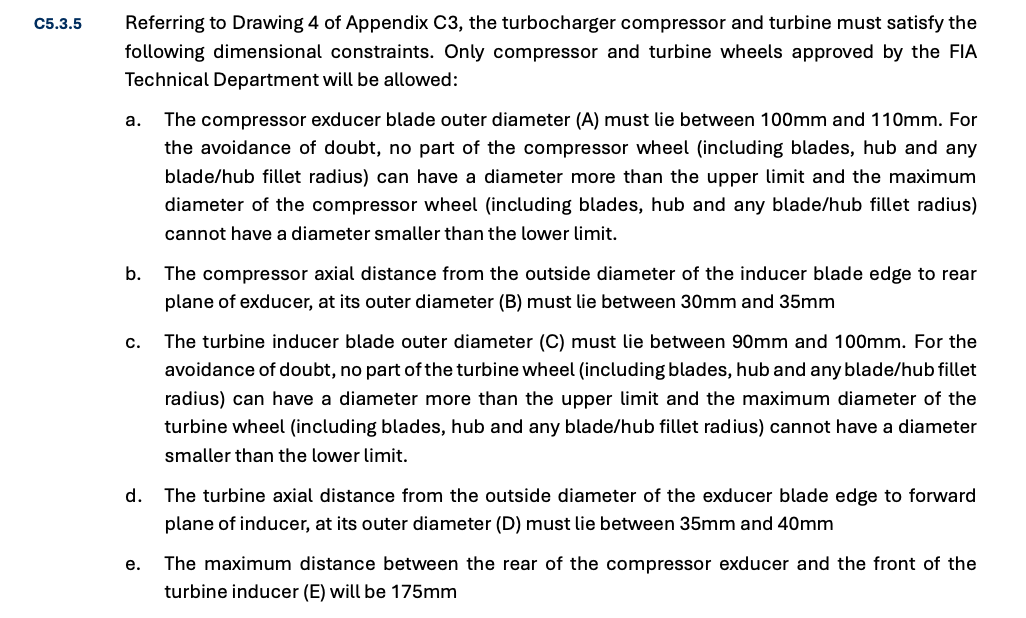
There seems to be a few surprise freedoms within the turbocharger regs:

Image

F.e. the turbine isn’t demanded to be single-sided, only the compressor is. A dual outlet turbine could provide some new options for wheel ramp profiles and oulet area (think of a double-sided compressor wheel). Also, directionality of flow is not specified, so a radial-outlfow turbine could be pursued. Is the inlet:outet area ratio of a turbocharger turbine considered to be a limiting factor in terms of geometry and packaging?

Keeping in mind the overall depth and diameter specs, and the rotational velocity limit, consider: inlet and outlet area can both be relatively greater, or I could provide up to twice the amount of outlet area relative to the inlet area, compared to a conventional design.
🏴󠁧󠁢󠁥󠁮󠁧󠁿

Hoffman900
Hoffman900
223
Joined: 13 Oct 2019, 03:02

Re: 2025/2026 Hybrid Powerunit speculation

Post

Martin Keene wrote:
05 Jan 2026, 16:40
mzso wrote:
05 Jan 2026, 15:11
So there are these rumors of Ferrari testing steel cylinder heads. How does this make sense? It just seems to me that it's just more weight rather high up.
And as far as I know, the minimum weight increase of 35kg is exactly the minimum weight of the now included energy storage. So no extra leeway there.
I can't get my head around the idea either, so I did some reading.

Now, this is my interpretation of the rules, and other may have a different view. But I don't see how a steel cylinder head is allowed in the rules.

What do the rules say:
5.18.8 Static components:
a. Other than inserts within them, engine crankcases including sump, cylinder heads and cylinder head cam covers must be manufactured from aluminium or iron alloys.
No composite materials or metal matrix composites are permitted either for the whole component or locally.
The rules state the head must be aluminum or iron alloy's. Steel by its definition is an alloy, an iron alloy with less than 2% carbon as defined by the World Steel Organisation, a material with more than 2% carbon is therefore iron alloy.

So the rules specifically exclude a steel alloy cylinder head. That's how I read it.
Europeans in my experience call iron heads “steel”

User avatar
venkyhere
31
Joined: 10 Feb 2024, 06:17

Re: 2025/2026 Hybrid Powerunit speculation

Post

wuzak wrote:
05 Jan 2026, 15:26
They'll be able to use thinner sections in some places, and there is a minimum CoG height.
Kindly educate me, how do FIA 'measure' CoG height ?

User avatar
venkyhere
31
Joined: 10 Feb 2024, 06:17

Re: 2025/2026 Hybrid Powerunit speculation

Post

vorticism wrote:
05 Jan 2026, 16:43
There seems to be a few surprise freedoms within the turbocharger regs:

https://i.postimg.cc/3N591Byg/turbo-regs.png
b & d have ensured the absence of a 'split turbo' haven't they ?
vorticism wrote:
05 Jan 2026, 16:43
F.e. the turbine isn’t demanded to be single-sided, only the compressor is. A dual outlet turbine could provide some new options for wheel ramp profiles and oulet area (think of a double-sided compressor wheel). Also, directionality of flow is not specified, so a radial-outlfow turbine could be pursued. Is the inlet:outet area ratio of a turbocharger turbine considered to be a limiting factor in terms of geometry and packaging?

Keeping in mind the overall depth and diameter specs, and the rotational velocity limit, consider: inlet and outlet area can both be relatively greater, or I could provide up to twice the amount of outlet area relative to the inlet area, compared to a conventional design.
If I perceive your Q at basic undergrad level, when is the turbine most effective ? when the compressor 'load' on the spindle can be attacked with the 'speed' of the exhaust gas molecules, rather than the 'pressure' of the exhaust gas molecules (temp = average RMS kinetic energy of N molecules, and pressure = volumetric density of the same average RMS kinetic energy of the N molecules ; from a simple viewpoint). To generate enough 'torque' to turn the turbine, how can anything other than radially attacking the blades of the turbine with the fast exhaust be optimal ? Doesn't this automatically mean an axial exit for the gases on the turbine side ?
From your Q, unable to have a mental picture of a 'radial exit' for the exhaust gases from the turbine. Kindly elaborate.

Martin Keene
Martin Keene
8
Joined: 11 May 2010, 09:02

Re: 2025/2026 Hybrid Powerunit speculation

Post

Hoffman900 wrote:
05 Jan 2026, 17:10
Martin Keene wrote:
05 Jan 2026, 16:40
mzso wrote:
05 Jan 2026, 15:11
So there are these rumors of Ferrari testing steel cylinder heads. How does this make sense? It just seems to me that it's just more weight rather high up.
And as far as I know, the minimum weight increase of 35kg is exactly the minimum weight of the now included energy storage. So no extra leeway there.
I can't get my head around the idea either, so I did some reading.

Now, this is my interpretation of the rules, and other may have a different view. But I don't see how a steel cylinder head is allowed in the rules.

What do the rules say:
5.18.8 Static components:
a. Other than inserts within them, engine crankcases including sump, cylinder heads and cylinder head cam covers must be manufactured from aluminium or iron alloys.
No composite materials or metal matrix composites are permitted either for the whole component or locally.
The rules state the head must be aluminum or iron alloy's. Steel by its definition is an alloy, an iron alloy with less than 2% carbon as defined by the World Steel Organisation, a material with more than 2% carbon is therefore iron alloy.

So the rules specifically exclude a steel alloy cylinder head. That's how I read it.
Europeans in my experience call iron heads “steel”
I am in Europe, UK specifically, and we definitely refer to iron heads as iron, not steel.

johnnycesup
johnnycesup
0
Joined: 13 Sep 2024, 11:31

Re: 2025/2026 Hybrid Powerunit speculation

Post

Martin Keene wrote:
05 Jan 2026, 16:40

The rules state the head must be aluminum or iron alloy's. Steel by its definition is an alloy, an iron alloy with less than 2% carbon as defined by the World Steel Organisation, a material with more than 2% carbon is therefore iron alloy.

So the rules specifically exclude a steel alloy cylinder head. That's how I read it.
I believe Steel falls into the "iron alloy" designation, doesn't it? I mean, "Steel by its definition is an alloy, an iron alloy with ..." makes it pretty clear.

wuzak
wuzak
518
Joined: 30 Aug 2011, 03:26

Re: 2025/2026 Hybrid Powerunit speculation

Post

johnnycesup wrote:
05 Jan 2026, 18:08
Martin Keene wrote:
05 Jan 2026, 16:40

The rules state the head must be aluminum or iron alloy's. Steel by its definition is an alloy, an iron alloy with less than 2% carbon as defined by the World Steel Organisation, a material with more than 2% carbon is therefore iron alloy.

So the rules specifically exclude a steel alloy cylinder head. That's how I read it.
I believe Steel falls into the "iron alloy" designation, doesn't it? I mean, "Steel by its definition is an alloy, an iron alloy with ..." makes it pretty clear.
Yes, steel is very much an iron alloy.

I suspect they used the term iron alloy rather than steel so they don't have to define what steel is.

User avatar
AR3-GP
399
Joined: 06 Jul 2021, 01:22

Re: 2025/2026 Hybrid Powerunit speculation

Post

venkyhere wrote:
05 Jan 2026, 17:24
wuzak wrote:
05 Jan 2026, 15:26
They'll be able to use thinner sections in some places, and there is a minimum CoG height.
Kindly educate me, how do FIA 'measure' CoG height ?
It can be extracted from the CAD. You could also do a tip-over test.
Beware of T-Rex

Tommy Cookers
Tommy Cookers
657
Joined: 17 Feb 2012, 16:55

Re: 2025/2026 Hybrid Powerunit speculation

Post

Martin Keene wrote:
05 Jan 2026, 16:40
.....I don't see how a steel cylinder head is allowed in the rules.
.....The rules state the head must be aluminum or iron alloy's. Steel by its definition is an alloy, an iron alloy with less than 2% carbon as defined by the World Steel Organisation, a material with more than 2% carbon is therefore iron alloy.
So the rules specifically exclude a steel alloy cylinder head. That's how I read it.

iron with more then 2% carbon is (by accident of history) called cast iron
steel is an alloy of iron and carbon and nothing else
alloy steel is an alloy of iron with a small amount one or more other metals but little or no carbon
alloys of iron with large amounts of other metals can be called lots of things
this is why the FIA uses the legalistic terms that it uses

because iron is made by chemically reducing iron ore with carbon (rather inexactly)
the carbon over about 2% cannot exist in combination with iron so it exists as aggregations of free carbon ie graphite
(steel as required is then made by exactly removing carbon from the CI)

CI is around 4% carbon
it melts quite readily and has high fluidity so ....
it can be sand cast .....
(moulds made like sandcastles only from sand and water - so cheap and highly frangible)
to cast steel the moulds must be bonded
Last edited by Tommy Cookers on 05 Jan 2026, 19:28, edited 3 times in total.

wuzak
wuzak
518
Joined: 30 Aug 2011, 03:26

Re: 2025/2026 Hybrid Powerunit speculation

Post

venkyhere wrote:
05 Jan 2026, 17:24
wuzak wrote:
05 Jan 2026, 15:26
They'll be able to use thinner sections in some places, and there is a minimum CoG height.
Kindly educate me, how do FIA 'measure' CoG height ?
C5.5.3 The centre of gravity of the Power Unit must be above Z=200. The parts considered are listed as “ICE” and “TC” in the “PU MASS GROUP” column of Appendix C3, with the exception of items 6 (ICE intake air system components), 20 (ICE-mounted electrical components), 29 (MGU-K Torque sensor), 30 (SCM), 41 (Powerbox), 43 (General electrical devices outside of the ESME) 44 (source of energy independent of the ES), 70 (PU air valve regulators) and 71 (PU air valve system equipment).

C5.4.5 The crankshaft centre line must lie at Y=0 and Z=90 (±0.5mm) and be parallel to the X axis. The Power Unit may only transmit torque to the Gearbox by means of a single output shaft that must be co-axial with the crankshaft. The output shaft must rotate clockwise when viewed from the front of the car.

C5.4.17 Engine (ICE) mountings may only comprise six M12 studs for connection to the Survival Cell and either four or six M12 studs for connection to the Gearbox Case. These studs may be fitted on the Survival Cell, Power Unit or Gearbox Case, their installed end must be M12 and their free end may be a different diameter. Every stud must have a tensile strength greater than 100kN.
The six mounting faces of the studs for connection to the Survival Cell must lie at [XPU, Y, Z]=[0, ±270, 25], [0, ±360, 270] and [0, ±190, 440]. All six of these studs must be used.
The four mounting faces of the studs for connection to the Gearbox Case must lie at [XPU, Y, Z]=[480, ±125, 25] and [480, ±265, 360]. All four of these studs must be used. Optionally, an additional two studs may be used, provided their coordinates are at [XPU, Y, Z]= [480, ±150, 140].

A tolerance of +/- 0.2mm will be permitted on all of the above dimensions, all dimensions refer to the centre of the studs. All dimensions in this Article refer to studs fitted symmetrically about the car centre plane.
Any part which provides additional load path, aside from the path through the studs defined above, from the Survival Cell to the ICE or from the ICE to the Gearbox Case, is prohibited unless this is incidental to its principal purpose. Furthermore, any such part may provide no greater structural connection between these pairs of assemblies than is reasonable for the safe and reliable fulfilment of its purposes.

Z = 0 is the reference plane.

So the CoG must be 110mm above the crankshaft centreline.

I would imagine determination of the CoG would be done at homologation time, and performed by weighing the ICE and some calculation.

The CoG only applies to the ICE including turbo, not to the ERS.

vorticism
vorticism
373
Joined: 01 Mar 2022, 20:20
Location: YooEssay

Re: 2025/2026 Hybrid Powerunit speculation

Post

venkyhere wrote:
05 Jan 2026, 17:42
vorticism wrote:
05 Jan 2026, 16:43
There seems to be a few surprise freedoms within the turbocharger regs:

https://i.postimg.cc/3N591Byg/turbo-regs.png
b & d have ensured the absence of a 'split turbo' haven't they ?
e does for the most part, but the center section can still be relatively long. 175mm between the wheels, 7 in.
Last edited by vorticism on 05 Jan 2026, 20:31, edited 2 times in total.
🏴󠁧󠁢󠁥󠁮󠁧󠁿

Hoffman900
Hoffman900
223
Joined: 13 Oct 2019, 03:02

Re: 2025/2026 Hybrid Powerunit speculation

Post

Martin Keene wrote:
05 Jan 2026, 17:45
Hoffman900 wrote:
05 Jan 2026, 17:10
Martin Keene wrote:
05 Jan 2026, 16:40


I can't get my head around the idea either, so I did some reading.

Now, this is my interpretation of the rules, and other may have a different view. But I don't see how a steel cylinder head is allowed in the rules.

What do the rules say:


The rules state the head must be aluminum or iron alloy's. Steel by its definition is an alloy, an iron alloy with less than 2% carbon as defined by the World Steel Organisation, a material with more than 2% carbon is therefore iron alloy.

So the rules specifically exclude a steel alloy cylinder head. That's how I read it.
Europeans in my experience call iron heads “steel”
I am in Europe, UK specifically, and we definitely refer to iron heads as iron, not steel.
Well dealing with some UK LBC racers, they call iron heads steel. Speaking from experience here…

User avatar
venkyhere
31
Joined: 10 Feb 2024, 06:17

Re: 2025/2026 Hybrid Powerunit speculation

Post

wuzak wrote:
05 Jan 2026, 18:42
venkyhere wrote:
05 Jan 2026, 17:24
wuzak wrote:
05 Jan 2026, 15:26
They'll be able to use thinner sections in some places, and there is a minimum CoG height.
Kindly educate me, how do FIA 'measure' CoG height ?
C5.5.3 The centre of gravity of the Power Unit must be above Z=200. The parts considered are listed as “ICE” and “TC” in the “PU MASS GROUP” column of Appendix C3, with the exception of items 6 (ICE intake air system components), 20 (ICE-mounted electrical components), 29 (MGU-K Torque sensor), 30 (SCM), 41 (Powerbox), 43 (General electrical devices outside of the ESME) 44 (source of energy independent of the ES), 70 (PU air valve regulators) and 71 (PU air valve system equipment).

C5.4.5 The crankshaft centre line must lie at Y=0 and Z=90 (±0.5mm) and be parallel to the X axis. The Power Unit may only transmit torque to the Gearbox by means of a single output shaft that must be co-axial with the crankshaft. The output shaft must rotate clockwise when viewed from the front of the car.

C5.4.17 Engine (ICE) mountings may only comprise six M12 studs for connection to the Survival Cell and either four or six M12 studs for connection to the Gearbox Case. These studs may be fitted on the Survival Cell, Power Unit or Gearbox Case, their installed end must be M12 and their free end may be a different diameter. Every stud must have a tensile strength greater than 100kN.
The six mounting faces of the studs for connection to the Survival Cell must lie at [XPU, Y, Z]=[0, ±270, 25], [0, ±360, 270] and [0, ±190, 440]. All six of these studs must be used.
The four mounting faces of the studs for connection to the Gearbox Case must lie at [XPU, Y, Z]=[480, ±125, 25] and [480, ±265, 360]. All four of these studs must be used. Optionally, an additional two studs may be used, provided their coordinates are at [XPU, Y, Z]= [480, ±150, 140].

A tolerance of +/- 0.2mm will be permitted on all of the above dimensions, all dimensions refer to the centre of the studs. All dimensions in this Article refer to studs fitted symmetrically about the car centre plane.
Any part which provides additional load path, aside from the path through the studs defined above, from the Survival Cell to the ICE or from the ICE to the Gearbox Case, is prohibited unless this is incidental to its principal purpose. Furthermore, any such part may provide no greater structural connection between these pairs of assemblies than is reasonable for the safe and reliable fulfilment of its purposes.

Z = 0 is the reference plane.

So the CoG must be 110mm above the crankshaft centreline.

I would imagine determination of the CoG would be done at homologation time, and performed by weighing the ICE and some calculation.

The CoG only applies to the ICE including turbo, not to the ERS.
Thank you, so ultimately it's not 'measuring' (I am still wondering whether it's even possible) but actually 'determining', and that too specific to the ICE alone. Ok.
Pardon my ignorance, but what constitutes Z=0 ? the bottom of the survival cell or the bottom of the floor ? When the floor is 'raked' what will happen to the Z=0 point ? In case the Z=0 is the tarmac (which I don't think it would be) what happens when different tyre pressures or different ride heights are used ?

Martin Keene
Martin Keene
8
Joined: 11 May 2010, 09:02

Re: 2025/2026 Hybrid Powerunit speculation

Post

johnnycesup wrote:
05 Jan 2026, 18:08
Martin Keene wrote:
05 Jan 2026, 16:40

The rules state the head must be aluminum or iron alloy's. Steel by its definition is an alloy, an iron alloy with less than 2% carbon as defined by the World Steel Organisation, a material with more than 2% carbon is therefore iron alloy.

So the rules specifically exclude a steel alloy cylinder head. That's how I read it.
I believe Steel falls into the "iron alloy" designation, doesn't it? I mean, "Steel by its definition is an alloy, an iron alloy with ..." makes it pretty clear.
I don’t believe it does. You can have an iron alloy, in fact what most people know as ‘cast iron’ these days is an alloy as they contain more than iron and carbon.
wuzak wrote:
05 Jan 2026, 18:24
johnnycesup wrote:
05 Jan 2026, 18:08
Martin Keene wrote:
05 Jan 2026, 16:40

The rules state the head must be aluminum or iron alloy's. Steel by its definition is an alloy, an iron alloy with less than 2% carbon as defined by the World Steel Organisation, a material with more than 2% carbon is therefore iron alloy.

So the rules specifically exclude a steel alloy cylinder head. That's how I read it.
I believe Steel falls into the "iron alloy" designation, doesn't it? I mean, "Steel by its definition is an alloy, an iron alloy with ..." makes it pretty clear.
Yes, steel is very much an iron alloy.

I suspect they used the term iron alloy rather than steel so they don't have to define what steel is.
Steel is an alloy that uses iron as an ingredient. That doesn’t make it iron. Especially when ‘cast iron’ these days contains a lot of other elements which means they are technically alloys not cast iron. Which in my book makes the 2% carbon the key point, less than that and it is a steel alloy that is not allowed. Above that it is an iron alloy and it is allowed. Though why anyone would want a CI head in F1 is a mystery.