2026 McLaren Mastercard F1 Team

This forum contains threads to discuss teams themselves. Anything not technical about the cars, including restructuring, performances etc belongs here.
User avatar
AR3-GP
643
Joined: 06 Jul 2021, 01:22

Re: 2026 McLaren Mastercard F1 Team

Post

Interesting post by Ruth Buscombe.
“and love this gearbox ratio choice that mclaren had, where when they got the handbook from merc in february, they're there saying, ‘hey, you told us that it was going to be this, and we built our gearbox for that.’

so effectively, you know, every time the car goes over 288 kph, they're up against the rev limiter because they've got much shorter gears.

[…] now, mclaren built their gearbox to a spec that's completely normal. and the kind of the brochure they got for what power unit they're going to end up with, paraphrasing, ended up being slightly different to the actual power unit that they got.

so they turn up in february and their gear ratios, or what it looked like at the moment, were a little bit short, which basically means, yes, they've got better torque traction out of the corners, but they were losing more than they were gaining because they're up against the rev limit when it goes above 288. so you can often see that mclaren, compared to the merc with the same power unit, is taking it one gear higher, you know, for the same kind of speed. and then what was really interesting, if you look at the mclaren quotes, is they went from being like, this is such a disadvantage, to, hmm, actually, with the way that the calendars may be changing, and again, i'm just saying what i think the reasoning was, and the fact that, you know, our car is great in these low speed corners, we've got a driver that's great in these low speed corners, rather than use our one joker, which they have, a free joker to change it, we're actually going to be happy to keep our ratios.

[…]

so what's really interesting is that mclaren took something that initially looked it was a disadvantage, and then have actually turned it for them, their car and their driver, into this kind of really cool engineering bet, is the way that i would describe it, where looking at the rest of the calendar, they've kind of built in, you know, kind of, okay, you go on black, and i'll go on red. so for each track, whenever there's more kind of those talk events, and that dominates it. so think zandvoort, budapest, madrid — singapore, they're going to be looking; having an advantage just with that power unit.

then you go to places like monza, and they're going to have, they're paying more on the straights because they're up against the limiter.”
Working on the balance.

Emag
Emag
137
Joined: 11 Feb 2019, 14:56

Re: 2026 McLaren Mastercard F1 Team

Post

AR3-GP wrote:
17 Sep 2026, 20:54
The other thing that's confusing me with the picture (https://i.postimg.cc/pLSB8M89/image.png) is that it's not referenced to 0. Easy enough to offset, but still, it's also suggesting that Mercedes is somehow as much as 0.54% off the fastest car in the straights on a rolling basis. That doesn't add up to me. It's as if the plot says there is no consistently quick car on the straights even though each team has had the same PU all year and the active aero stuff has eliminated 99% of track specific wings. What would cause these fluctuations when we can assume that all teams use the full energy allocation across all of the straights (and thus track specific deployment differences have a very small role to play).

Will await the update.
I am a little bit of an early bird, so I tried a bunch of stuff today before heading off to work. There were quite a few problems to work around for 2026 in particular.

The biggest one is telemetry quality. In some races the speed channel is genuinely terrible. It has random freezes for hundreds of metres while the car is clearly braking or accelerating, then suddenly jump to catch up. China was particularly bad. Even one of those random "spasms" can move time from the corners into the straights or vice versa and produce rankings that made no sense when I looked at it closer. Particularly the gaps, which were completely unreasonable.

And in 2026 you can't really solve that by just cutting out the bad sections of track either, because deployment strategy matters. If one team happens to make a lot of its time on the straight you removed and another doesn't, you've biased the result. So I ended up taking the stricter approach. bad lap = discard the lap, and if too few teams have clean data, discard the race entirely. China, Suzuka, Canada and Barcelona didn't make the cut for example because it was full of these data inconsistencies.

I also changed the way the split itself is calculated. Corners are defined from the field as a whole. Flat-out stuff like 130R stay in the "straight" bucket, because I think it would not be fair to consider corners these sections where you keep building up speed while you turn or you don't lose speed at all. But in any case, you can also look into the per-race breakdown and look at the map and judge if the split between what is straight and what is corner makes sense. From what I saw, it's not bad. The only thing I would disagree with was Puohon being considered a straight, but that's a quirk of these 2026 cars. They turn corners into straights by superclipping so no brake is necessary. I didnt want to change the whole logic because of it, because in a way, it makes sense for them to be straights.

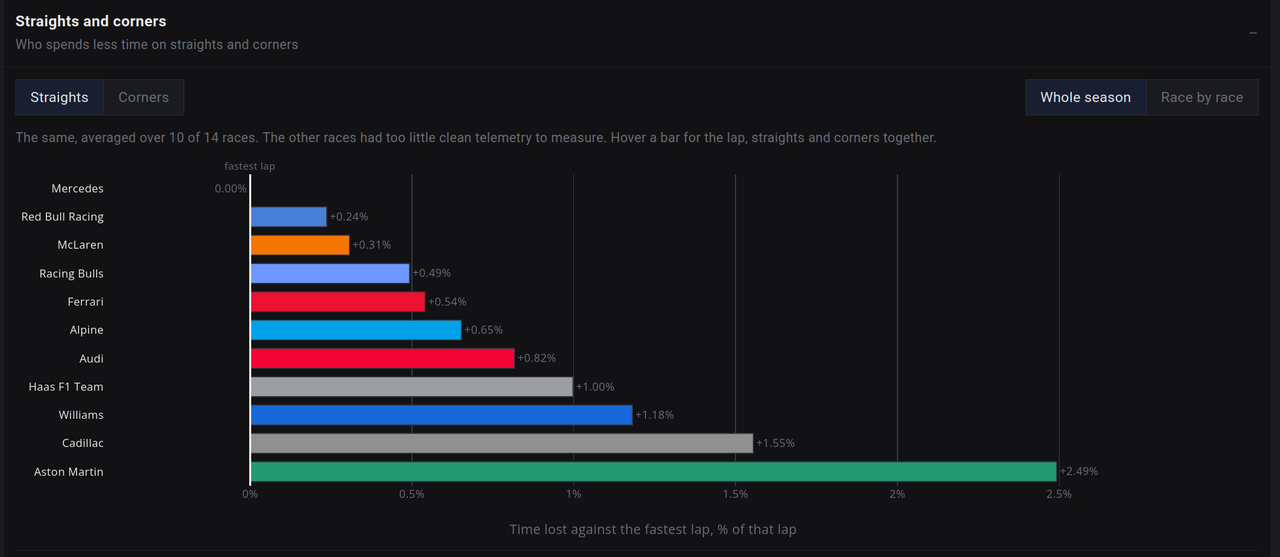
For each team I use the quicker driver's clean qualifying lap, or the team mate if the quicker lap is corrupted and the alternative is still within 1% of the team's best. Everything is then referenced to the fastest measured qualifying lap of that race, normally pole. That means 0 is an actual reference, and the straight + corner deltas add back up exactly to the total lap delta. And by doing it this way I go results that I am actually pretty happy with because it behaves the way you'd expect.

The ranking is not the same as the one you posted, but color me shocked, McLaren is actually not that bad on the straights when you look at it from a time spent on straights perspective. Across the usable races they lose only 0.31% of a lap on the straights to the reference, third best behind Mercedes at 0.00% and Red Bull (which for me was 2nd) at +0.24%.

Mercedes is also about where you'd expect this time. 0.00% on average, and even their worst race is only around 0.32% off on the straights. This was recorded in Hungary which makes sense from the telemetry as well where you see what it considers as straights are also short parts after critical traction zones between corners where you would expect McLaren to be very strong. Ferrari, meanwhile, is also interesting because they actually gain about 0.17% in the corners on average but lose around 0.54% on the straights, which gives roughly their +0.37% overall lap deficit. And it's also more in line with what you would expect considering their philosophy for the car this year. So the pecking order is generally preserved. On average across the season we have Mercedes->Ferrari>=McLaren>RedBull, although I expect this to change if McLaren continues like this.

Also, on your earlier point about Mercedes floating around ~0.5% despite supposedly being the reference, you were right that it didn't add up. The original methodology was effectively referencing straights and corners to different "best" cars and then averaging both drivers, so the pieces were never guaranteed to add up to the actual lap gap. That alone can inflate even the fastest team's average.

Here is the result I ended up with :
Image

It's live on the website now : https://f1insightshub.com/car_breakdown

Scroll to the bottom and expand corners & straights. You can go race by race and also read the methodology in detail.

Developer of F1InsightsHub

User avatar
AR3-GP
643
Joined: 06 Jul 2021, 01:22

Re: 2026 McLaren Mastercard F1 Team

Post

Emag wrote:
18 Sep 2026, 11:09
AR3-GP wrote:
17 Sep 2026, 20:54
The other thing that's confusing me with the picture (https://i.postimg.cc/pLSB8M89/image.png) is that it's not referenced to 0. Easy enough to offset, but still, it's also suggesting that Mercedes is somehow as much as 0.54% off the fastest car in the straights on a rolling basis. That doesn't add up to me. It's as if the plot says there is no consistently quick car on the straights even though each team has had the same PU all year and the active aero stuff has eliminated 99% of track specific wings. What would cause these fluctuations when we can assume that all teams use the full energy allocation across all of the straights (and thus track specific deployment differences have a very small role to play).

Will await the update.
I am a little bit of an early bird, so I tried a bunch of stuff today before heading off to work. There were quite a few problems to work around for 2026 in particular.

The biggest one is telemetry quality. In some races the speed channel is genuinely terrible. It has random freezes for hundreds of metres while the car is clearly braking or accelerating, then suddenly jump to catch up. China was particularly bad. Even one of those random "spasms" can move time from the corners into the straights or vice versa and produce rankings that made no sense when I looked at it closer. Particularly the gaps, which were completely unreasonable.

And in 2026 you can't really solve that by just cutting out the bad sections of track either, because deployment strategy matters. If one team happens to make a lot of its time on the straight you removed and another doesn't, you've biased the result. So I ended up taking the stricter approach. bad lap = discard the lap, and if too few teams have clean data, discard the race entirely. China, Suzuka, Canada and Barcelona didn't make the cut for example because it was full of these data inconsistencies.

I also changed the way the split itself is calculated. Corners are defined from the field as a whole. Flat-out stuff like 130R stay in the "straight" bucket, because I think it would not be fair to consider corners these sections where you keep building up speed while you turn or you don't lose speed at all. But in any case, you can also look into the per-race breakdown and look at the map and judge if the split between what is straight and what is corner makes sense. From what I saw, it's not bad. The only thing I would disagree with was Puohon being considered a straight, but that's a quirk of these 2026 cars. They turn corners into straights by superclipping so no brake is necessary. I didnt want to change the whole logic because of it, because in a way, it makes sense for them to be straights.

For each team I use the quicker driver's clean qualifying lap, or the team mate if the quicker lap is corrupted and the alternative is still within 1% of the team's best. Everything is then referenced to the fastest measured qualifying lap of that race, normally pole. That means 0 is an actual reference, and the straight + corner deltas add back up exactly to the total lap delta. And by doing it this way I go results that I am actually pretty happy with because it behaves the way you'd expect.

The ranking is not the same as the one you posted, but color me shocked, McLaren is actually not that bad on the straights when you look at it from a time spent on straights perspective. Across the usable races they lose only 0.31% of a lap on the straights to the reference, third best behind Mercedes at 0.00% and Red Bull (which for me was 2nd) at +0.24%.

Mercedes is also about where you'd expect this time. 0.00% on average, and even their worst race is only around 0.32% off on the straights. This was recorded in Hungary which makes sense from the telemetry as well where you see what it considers as straights are also short parts after critical traction zones between corners where you would expect McLaren to be very strong. Ferrari, meanwhile, is also interesting because they actually gain about 0.17% in the corners on average but lose around 0.54% on the straights, which gives roughly their +0.37% overall lap deficit. And it's also more in line with what you would expect considering their philosophy for the car this year. So the pecking order is generally preserved. On average across the season we have Mercedes->Ferrari>=McLaren>RedBull, although I expect this to change if McLaren continues like this.

Also, on your earlier point about Mercedes floating around ~0.5% despite supposedly being the reference, you were right that it didn't add up. The original methodology was effectively referencing straights and corners to different "best" cars and then averaging both drivers, so the pieces were never guaranteed to add up to the actual lap gap. That alone can inflate even the fastest team's average.

Here is the result I ended up with :

https://i.postimg.cc/rFLpb2wj/image.png

It's live on the website now : https://f1insightshub.com/car_breakdown

Scroll to the bottom and expand corners & straights. You can go race by race and also read the methodology in detail.
On mobile now so can’t explore the web yet, but the new picture that you shared seems much more sensible. It will be interesting to check later this year with more of Ferrari’s ADUO 2 data. (And I guess Merc’s too…)

Now that you mention it, yeah there were quite a few weekends this year with unusuable telemetry. Maybe that’s why that other guy cut so many races out.
Working on the balance.

User avatar
AR3-GP
643
Joined: 06 Jul 2021, 01:22

Re: 2026 McLaren Mastercard F1 Team

Post

Emag wrote:
18 Sep 2026, 11:09

https://i.postimg.cc/rFLpb2wj/image.png

It's live on the website now : https://f1insightshub.com/car_breakdown

Scroll to the bottom and expand corners & straights. You can go race by race and also read the methodology in detail.
Having a LOT of fun with the website now. :lol:

The interesting thing about Mclaren is that you can see how the first 3 race weekend supress Mclaren's straight line performance averages, and we know that is partially because Mercedes more or less tried to screw them. After Miami, Mclaren is basically level with Red Bull on the time on straight metric in the GPs that were analyzed. +0.1% in Monza/Austria, but even everywhere else. It is showing how acceleration in the earlier part of the straight pays off (like Ruth Buscombe hinted at), first and foremost, but also that Mercedes simply has the overwhelmingly best because neither Mercedes nor Mclaren have had the Macarena wing for these races.

Austria: Mcl +0.28, RBR, + 0.06 (high altitude PU outlier)
Belgium: Mcl +0.34, RBR, + 0.32
Britain: Mcl +0.44, RBR, + 0.40
Hungary: Mcl +0.00, RBR, + 0.14
Zandvoort: Mcl +0.00, RBR, + 0.26
Monza: Mcl +0.57, RBR, + 0.44
Madrid: Mcl +0.00, RBR, + 0.03


Mclaren is about as effective as any other team down the straights not named Mercedes.
Last edited by AR3-GP on 18 Sep 2026, 20:46, edited 1 time in total.
Working on the balance.

Emag
Emag
137
Joined: 11 Feb 2019, 14:56

Re: 2026 McLaren Mastercard F1 Team

Post

AR3-GP wrote:
18 Sep 2026, 20:35
Emag wrote:
18 Sep 2026, 11:09

https://i.postimg.cc/rFLpb2wj/image.png

It's live on the website now : https://f1insightshub.com/car_breakdown

Scroll to the bottom and expand corners & straights. You can go race by race and also read the methodology in detail.
Having a LOT of fun with the website now. :lol:

The interesting thing about Mclaren is that you can see how the first 3 race weekend supress Mclaren's straight line performance averages, and we know that is partially because Mercedes more or less tried to screw them. After Miami, Mclaren is basically level with Red Bull on the time on straight metric in the GPs that were analyzed. +0.1% in Monza/Austria, but even everywhere else. It is showing how acceleration in the earlier part of the straight pays off (like Ruth Buscombe hinted at), first and foremost, but also that Mercedes simply has the overwhelmingly best because neither Mercedes nor Mclaren have had the Macarena wing for these races.
That's what I was looking into as well. Difference between Australia and elsewhere is particularly striking. And not just between Mercedes customers. Mercedes was running laps around everyone when it comes to deployment from day 1.

I am starting to get suspicious that there's more than just a compression ratio trick going on. They might have thrown ash to everyone's eyes w.r.t to the ICE and maybe found a loophole in the electrical side, because it genuinely seems like they have more battery than others when you look at some races. And if the trick does exist, it doesn't look like the customers have it. Or maybe they don't know how to take full advantage of it.
Developer of F1InsightsHub

User avatar
AR3-GP
643
Joined: 06 Jul 2021, 01:22

Re: 2026 McLaren Mastercard F1 Team

Post

Emag wrote:
18 Sep 2026, 20:44
That's what I was looking into as well. Difference between Australia and elsewhere is particularly striking. And not just between Mercedes customers. Mercedes was running laps around everyone when it comes to deployment from day 1.
don't remind me... :lol:
Emag wrote:
18 Sep 2026, 20:44
I am starting to get suspicious that there's more than just a compression ratio trick going on. They might have thrown ash to everyone's eyes w.r.t to the ICE and maybe found a loophole in the electrical side, because it genuinely seems like they have more battery than others when you look at some races. And if the trick does exist, it doesn't look like the customers have it.
I have no doubt they are doing something, but I can't explain it. We can only observe it.
Working on the balance.