Ferrari SF-26

A place to discuss the characteristics of the cars in Formula One, both current as well as historical. Laptimes, driver worshipping and team chatter do not belong here.
Owen.C93
Owen.C93
187
Joined: 24 Jul 2010, 17:52

Re: Ferrari SF-26

Post

vorticism wrote:
28 Feb 2026, 21:34
I see. I read through that section too quickly. The volume does rise at a 32* angle just aft of the tailpipe allowance. At the standard position (diff and wheel axles inline) this already allows the 30mm of coverage I mentioned plus 32mm, which is about what was seen on the Ferrari. So it’s not necessarily about diff placement per se, in order to get at least half the exhaust covered.
Kyle covered this in his video, including the legality boxes at the limits of most forward and rearward allowed diff positions. He came up with a figure of about half the exhaust can be covered.

From about 3:25 onwards.
Motorsport Graduate in search of team experience ;)

vorticism
vorticism
443
Joined: 01 Mar 2022, 20:20
Location: YooEssay

Re: Ferrari SF-26

Post

That area of his model doesn’t appear to reflect the Issue 14 coordinates. Looks to have about a twenty degree slope at the top, should be 32*.
🏴󠁧󠁢󠁥󠁮󠁧󠁿

johnnycesup
johnnycesup
4
Joined: 13 Sep 2024, 11:31

Re: Ferrari SF-26

Post

vorticism wrote:
28 Feb 2026, 21:34
I see. I read through that section too quickly. The volume does rise at a 32* angle just aft of the tailpipe allowance. At the standard position (diff and wheel axles inline) this already allows the 30mm of coverage I mentioned plus 32mm, which is about what was seen on the Ferrari. So it’s not necessarily about diff placement per se, in order to get at least half the exhaust covered.

Ferrari may simply have the diff inline with the wheels. The further back the diff is placed the more coverage will be allowed at a run:rise ratio of .63 i.e. for every mm further back from standard alignment you get .63mm more vertical coverage on top of 62mm base max. If the diff is 50mm behind the wheel axles f.e. then you’d have 93.5mm of coverage, or greater than 100% of the min exhaust outlet diameter. Which seems crazy. Huge. Elephant in the room. Why isn't anyone discussing this? Someone could conceivable arrive with a ramp so large that the exhaust outlet cant be seen. Might be time to do some more sketches... Or alert Qvist Designs. How far back can the diff be legally placed?

The same applies in reverse although the minimum amount of coverage even for a diff placed very far forward (50mm or more) would still be 30mm. So this trick is potentially available to everyone, by varying degrees. Will anyone turn out to have a very far rearward diff and thus a totally covered exhaust?

AMR brought a rearward oriented rear suspension setup with arms mounted on the RW pylons. Coincidence?

Someone will have to do a study of half shaft angles to determine roughly how for forward or rearward the teams have placed their diffs.
Are you considering that there should be some space between the pipe and the little plate so that the gases can actually leave? You could fit a plate that would completely hide the exhaust in the x direction, but it would be right up to the pipe, wouldn't it?

I don't think that the solution is that readily available for everybody.

wuzak
wuzak
527
Joined: 30 Aug 2011, 03:26

Re: Ferrari SF-26

Post

johnnycesup wrote:
01 Mar 2026, 01:58
I don't think that the solution is that readily available for everybody.
Haas could probably use it, as they have teh same gearbox as Ferrrari.

Cadillac use the Ferrari gearbox cassette, but their own gearbox casing, so they may not.

vorticism
vorticism
443
Joined: 01 Mar 2022, 20:20
Location: YooEssay

Re: Ferrari SF-26

Post

johnnycesup wrote:
01 Mar 2026, 01:58
Are you considering that there should be some space between the pipe and the little plate so that the gases can actually leave? You could fit a plate that would completely hide the exhaust in the x direction, but it would be right up to the pipe, wouldn't it?
Good point, I was thinking about the origin/datum and not factoring in clearance. Would need around 25mm clearance to achieve a cylindrical exit area equal to a 90mm dia pipe. Starting from there, the tailpipe exit placement window is 10mm fore-aft, so that gives that amount; 15mm more would be found as an offset rearward from RV-Tailpipe. Working from there, update the numbers I mentioned to: 52mm of coverage (not 62) at standard diff-wheel alignment, 84mm coverage (not 94) at 50mm rearward diff placement. 60mm rearward diff placement would give 90mm or ~100% coverage. Coverage further erodes with more clearance. Check my head math.
Last edited by vorticism on 02 Mar 2026, 17:32, edited 1 time in total.
🏴󠁧󠁢󠁥󠁮󠁧󠁿

johnnycesup
johnnycesup
4
Joined: 13 Sep 2024, 11:31

Re: Ferrari SF-26

Post

vorticism wrote:
01 Mar 2026, 05:05
johnnycesup wrote:
01 Mar 2026, 01:58
Are you considering that there should be some space between the pipe and the little plate so that the gases can actually leave? You could fit a plate that would completely hide the exhaust in the x direction, but it would be right up to the pipe, wouldn't it?
Good point, I was thinking about the origin/datum and not factoring in clearance. Would need around 25mm clearance to achieve a cylindrical exit area equal to a 90mm dia pipe. Starting from there, the tailpipe exit placement window is 10mm fore-aft, so that gives that amount; 15mm more would be found as an offset rearward from RV-Tailpipe. Working from there, update the numbers I mentioned to: 52mm of coverage (not 62) at standard diff-wheel alignment, 84mm coverage (not 94) at 50mm rearward diff placement. 110mm rearward diff placement would give 90mm or ~100% coverage, but this is getting excessive (driveshaft angles). Coverage further erodes with more clearance. Check my head math.

Not as promising as I thought, although there's potential to make it taller than the test item Ferrari used. At what cost though? As far as loopholes go, this is a very convoluted one. That Ferrari were the only ones at the test with it suggests to me: it was such an obscure arrangement that no one else deciphered it, or it's of little benefit, or both.
The point of that structure would be to get the flow moving up eventually, I don't think you'd want any exhaust flow to move down or to the sides as it exits the pipe. You can see Ferrari has some type of U shaped structure at the end of the pipe to force that flow direction

That would require more even more clearance IMO, and the Ferrari solution is probably at the limit of effectiveness.

As for the benefit, from my napkin calculation the 2026 cars should move about as much air (mass ratio) as the 2010 cars (half the revs and 33% les displacement, but up to 4.8bar of boost), and we all remember how impactful was the usage of exhaust gases back then.

Farnborough
Farnborough
139
Joined: 18 Mar 2023, 14:15

Re: Ferrari SF-26

Post

wuzak wrote:
01 Mar 2026, 02:36
johnnycesup wrote:
01 Mar 2026, 01:58
I don't think that the solution is that readily available for everybody.
Haas could probably use it, as they have teh same gearbox as Ferrrari.

Cadillac use the Ferrari gearbox cassette, but their own gearbox casing, so they may not.
The gearbox cassette has differential integral in a homogeneous unit.

Obviously dependant on outer monocoque casing for ultimate dimensions, the diff and drive shaft location "should" be the same as Ferrari in relation to PU architecture.

User avatar
venkyhere
40
Joined: 10 Feb 2024, 06:17

Re: Ferrari SF-26

Post

noob Q : how much 'freedom' is there to 'angle' the driveshaft/halfshaft from the diff to the center of the wheel ? Is this considered a 'full freedom variable' or are there constraints from a mechanical reliability viewpoint w.r.t how much can the CV joints can 'take' ?

wuzak
wuzak
527
Joined: 30 Aug 2011, 03:26

Re: Ferrari SF-26

Post

venkyhere wrote:
01 Mar 2026, 14:01
noob Q : how much 'freedom' is there to 'angle' the driveshaft/halfshaft from the diff to the center of the wheel ? Is this considered a 'full freedom variable' or are there constraints from a mechanical reliability viewpoint w.r.t how much can the CV joints can 'take' ?
C9.5.1 Layout
The axis of the final drive (at XDIF=0) must be between XR= −60 and XR=60, between Z=260 and Z=280, and be between 390mm and 450mm behind the front lateral gear−tooth faces of both gears of the forward−most forward gear ratio pair.

C2.2 Principal Planes
e. The planes XF = 0 and XR = 0 are defined as the X−Planes which respectively pass through the origin of the two front or two rear Wheel Coordinate Systems, with the wheels in the straight−ahead position and the car at Legality Setup.

C2.1.3 Wheel Coordinate System
The “Wheel Coordinate System” is a local right-handed Cartesian [XW, YW, ZW] coordinate system and is defined in the following way for each wheel:
a. The origin of the Wheel Coordinate System is the intersection of the rotational axis of the wheel and the inboard plane of the Wheel Rim.
b. The XW axis lies in the inboard plane of the Wheel Rim and increases in the rearward direction. With the wheel in the straight−ahead position and the car at Legality Setup, the XW axis is parallel to the car’s X−Axis.
c. The YW axis is coincident with the wheel’s axis of rotation and increases towards the plane Y=0. Referring to this axis, the terms “inboard” or “outboard” respectively refer to closer to or further away from the plane Y = 0.
d. The ZW axis lies in the inboard plane of the Wheel Rim and increases upwards.
e. Once the Wheel Coordinate System is defined as above, then it maintains a fixed orientation relative to the suspension upright at all other suspension articulations.

User avatar
atanatizante
133
Joined: 10 Mar 2011, 15:33

Re: Ferrari SF-26

Post

atanatizante wrote:
25 Feb 2026, 23:12
1. I wonder why the former DRS wing had to rotate 270 degrees forward when it would have been much easier to rotate it backward by only 90 degrees. This way, not only would the movement have been much faster, but it would also have avoided the braking/parachute phase.

2. Why didn’t they use the old central actuator on the main plane, configuring it to push the former DRS wing upward so that it could rotate backward by only 90 degrees?

3. Why didn’t they design a system that moves both the main plane and the former DRS wing together as a single unit? Could the movement be either a forward 270-degree rotation or a rearward rotation of only 90 degrees?
...

Alternatively, the DRS flap could slide along guides in the endplate to sit above or beneath the main element, essentially acting as a dual-element main profile. Which of these positions offers better performance?
"I don`t have all the answers. Try Google!"
Jesus

User avatar
atanatizante
133
Joined: 10 Mar 2011, 15:33

Re: Ferrari SF-26

Post

Image

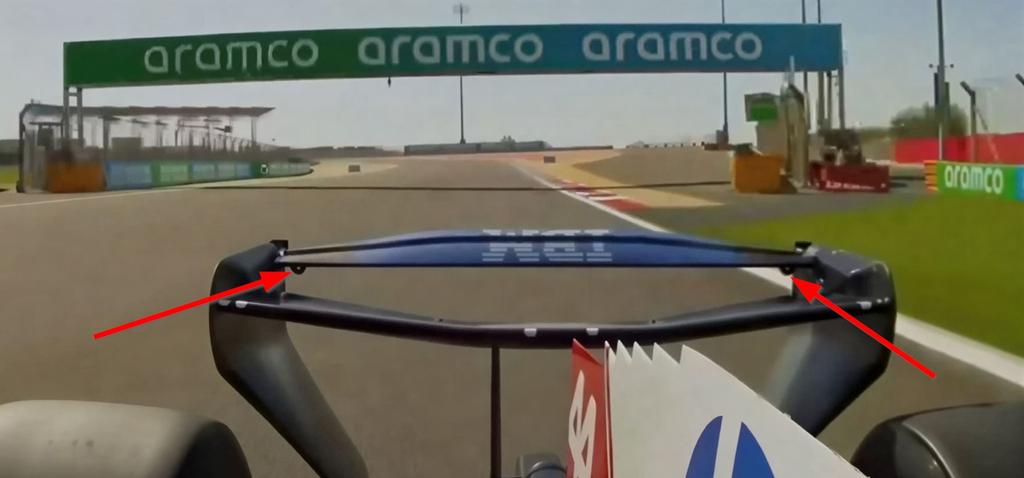
The connector between the two sections of the former DRS wing is curved and angled; in the position shown, it helps divert airflow along the endplates further outward, potentially resulting in a slight increase in diffuser downforce
"I don`t have all the answers. Try Google!"
Jesus

wuzak
wuzak
527
Joined: 30 Aug 2011, 03:26

Re: Ferrari SF-26

Post

Farnborough wrote:
01 Mar 2026, 08:31
wuzak wrote:
01 Mar 2026, 02:36
johnnycesup wrote:
01 Mar 2026, 01:58
I don't think that the solution is that readily available for everybody.
Haas could probably use it, as they have teh same gearbox as Ferrrari.

Cadillac use the Ferrari gearbox cassette, but their own gearbox casing, so they may not.
The gearbox cassette has differential integral in a homogeneous unit.

Obviously dependant on outer monocoque casing for ultimate dimensions, the diff and drive shaft location "should" be the same as Ferrari in relation to PU architecture.
Haas also use the same suspension as Ferrari, Cadillac don't.

Cadillac could have different alignment of the hweels to the diff.

matteosc
matteosc
31
Joined: 11 Sep 2012, 17:07

Re: Ferrari SF-26

Post

Rumors are that the flipping rear wing would be worth 4-5 kW on the straights:
https://www.formulapassion.it/f1/f1-new ... ro-il-7-gp

Any idea of what this would mean in terms of Cd reduction?

User avatar
venkyhere
40
Joined: 10 Feb 2024, 06:17

Re: Ferrari SF-26

Post

matteosc wrote:
04 Mar 2026, 12:13
Rumors are that the flipping rear wing would be worth 4-5 kW on the straights:
https://www.formulapassion.it/f1/f1-new ... ro-il-7-gp

Any idea of what this would mean in terms of Cd reduction?
The link goes to another link, which is "members only", so haven't seen how they derived the 4-5KW number. But for a moment we can assume they are correct, and back-calculate in a back-of-the-envelope crude way :

Lets say we are talking of speeds less than 340kph (which is when the tapering of MGU-K deployment is forced) and hence the full 750KW is available to deploy. Cd1 is the SLM drag with typical wing and Cd2 is the SLM drag with the macarena wing. Let's also make the blunt assumption that all the 750KW is consumed by aero-drag, with very little mechanical friction or rolling resistance losses :

we have 750KW = const x Cd1 x (V1)^3 = const x Cd2 x (V2)^3
The claim is that if it were Cd2 in place of Cd1, the car would need only 745KW.
we have 745KW = const x Cd2 x (V1)^3 , which in turn would mean Cd2 = 0.9933 x Cd1 , a.k.a reduction of Cd by 0.67%
With the full 750KW, the equation now becomes : (V1)^3 = 0.9933 x (V2)^3 , which in turn would mean V2 = 1.002243 x V1 , a.k.a increase in top speed by 0.22% , with the extra 5 KW. If we are talking of V1=330kph, we would get V2=330.74kph. Not much top speed benefit, really.

So I doubt whether the 5KW is a correct estimate, because Ferrari spent quite a few millions developing the macarena wing.

Frank73
Frank73
0
Joined: 28 Jan 2026, 12:53

Re: Ferrari SF-26

Post

venkyhere wrote:
04 Mar 2026, 14:04
matteosc wrote:
04 Mar 2026, 12:13
Rumors are that the flipping rear wing would be worth 4-5 kW on the straights:
https://www.formulapassion.it/f1/f1-new ... ro-il-7-gp

Any idea of what this would mean in terms of Cd reduction?
The link goes to another link, which is "members only", so haven't seen how they derived the 4-5KW number. But for a moment we can assume they are correct, and back-calculate in a back-of-the-envelope crude way :

Lets say we are talking of speeds less than 340kph (which is when the tapering of MGU-K deployment is forced) and hence the full 750KW is available to deploy. Cd1 is the SLM drag with typical wing and Cd2 is the SLM drag with the macarena wing. Let's also make the blunt assumption that all the 750KW is consumed by aero-drag, with very little mechanical friction or rolling resistance losses :

we have 750KW = const x Cd1 x (V1)^3 = const x Cd2 x (V2)^3
The claim is that if it were Cd2 in place of Cd1, the car would need only 745KW.
we have 745KW = const x Cd2 x (V1)^3 , which in turn would mean Cd2 = 0.9933 x Cd1 , a.k.a reduction of Cd by 0.67%
With the full 750KW, the equation now becomes : (V1)^3 = 0.9933 x (V2)^3 , which in turn would mean V2 = 1.002243 x V1 , a.k.a increase in top speed by 0.22% , with the extra 5 KW. If we are talking of V1=330kph, we would get V2=330.74kph. Not much top speed benefit, really.

So I doubt whether the 5KW is a correct estimate, because Ferrari spent quite a few millions developing the macarena wing.

Are you sure of your calculations? 5kW=6.5CV is in the ballpark of rumored benefit of CR trick.,