Supercritical CO2 for engine cooling and energy recovery

All that has to do with the power train, gearbox, clutch, fuels and lubricants, etc. Generally the mechanical side of Formula One.
autodoctor911
autodoctor911
1
Joined: 05 Aug 2012, 14:35

Supercritical CO2 for engine cooling and energy recovery

Post

Has anyone investigated supercritical CO2 for ICE engine cooling and energy recovery with an integral compact turbine assembly on the exhaust. Surely would increase efficiency if it is possible. 3d printed blocks and heads made of stainless super alloys and small high pressure lines to the condenser/radiator. That would be a true mgu-H

User avatar
hollus
Moderator
Joined: 29 Mar 2009, 01:21
Location: Copenhagen, Denmark

Re: Supercritical CO2 for engine cooling and energy recovery

Post

Phase changes for cooling are forbidden in the rules.
¡Puxa Sporting!

Greg Locock
Greg Locock
239
Joined: 30 Jun 2012, 00:48

Re: Supercritical CO2 for engine cooling and energy recovery

Post

There are no phases when its supercritical, just a very dense gas. Take that with a pinch of salt, 40+years ago I was good at thermo my limit is Carnot these days! (well I suppose carnot is everybody's limit)

User avatar
joseff
11
Joined: 24 Sep 2002, 11:53

Re: Supercritical CO2 for engine cooling and energy recovery

Post

I think he's referring to the chinese turbine thingy that's designed for nuclear power plants. It's supercritical (flows like gas, dense like liquid) not far above room temp, but at like 70+bar of pressure. I don't think heat exchange involves phase change.

Not sure if the benefit (lower pumping losses) would outweigh the substantial challenges.

Cold Fussion
Cold Fussion
95
Joined: 19 Dec 2010, 04:51

Re: Supercritical CO2 for engine cooling and energy recovery

Post

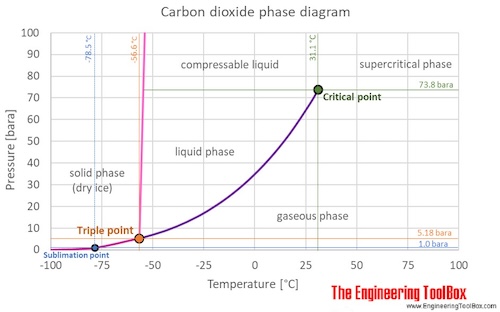
Image

To be supercritical in an ICE you'll need your cooling system to be operating above 80 bar (and maybe higher to make sure it stays supercritical). I asked chatgpt what the thermo properties are of supercritical CO2 (so take the numbers with a mountain of salt) and it said using the Span–Wagner EOS, cp=1.1–1.3 kJ/kg·K, density=230–260 kg/m³, 0.045–0.055 W/m·K. Assuming these numbers are correct, this means vs water, the mass flow rate has to be ~3.5x higher, and a ~14x higher volumetric flow rate for the same heat rejection. I'm no expert on supercritical CO2 so I'm not sure if there is some other benefit vs using water in an ICE, but it doesn't look very favourable given the operating temperature is so low on an ICE.