2026 Aerodynamic & Chassis Regulations

Here are our CFD links and discussions about aerodynamics, suspension, driver safety and tyres. Please stick to F1 on this forum.
User avatar
FW17
172
Joined: 06 Jan 2010, 10:56

Re: 2026 Aerodynamic & Chassis Regulations

Post

yinlad wrote:
25 Nov 2025, 21:16
TeamKoolGreen wrote:
25 Nov 2025, 01:55
According to this, the floor will generate more downforce as a percentage than the wings than the 2022 car did.

2026 was originally just a power unit regs change. But they hacked up the chassis and aero just to accommodate the Frankenstein power units
I wouldn’t pay much attention to this video. The number are very dubious to say the least. The floor on the current regs makes nearer to 50% of the overall downforce, how he had it at somewhere in the 30s is baffling
Front wing closer to ground has a huge amount of downforce potential, this will allow the rear wing to be cranked up as well. this will increase the wing downforce contribution to overall downforce

The 2026 front wing is lifted off the road surface at the ends like in 2004. This reduces the overall wing downforce potential of front and rear wings. That increases the floor percentage contribution

vorticism
vorticism
367
Joined: 01 Mar 2022, 20:20

Re: 2026 Aerodynamic & Chassis Regulations

Post

vorticism wrote:
25 Nov 2025, 22:39
The 2026 plank & skid regs across several issues are worded differently from 2025. It might be worth comparing.
Some highlights from C3.6 in Issue 14:

-Plank assembly when new: 10mm (same as current), may abrade to 8mm (down from 9mm 2025 and prior)
-Three inspection holes, inline along the vehicle centerline at the front, center, and rear of the plank assembly
-Three skids which must surround the inspection holes
-Some spec skid geometry features are implied (team exclusive CAD file)
-Skids may be made of Ti or SS
-Middle and rear skid may be made of plank material
-Rear skid if composed of plank material may be integrated totally into the plank but must maintain spec skid geometry features like bolt holes (aero & mass parity)
-Inspection of plank assembly depth occurs only at inspection holes with the skids dismounted and measured with a micrometer

The rearmost skids being optionally non-metallic implies some cars may use rake. The rear axle might never bottom out as was the case pre-2022, and a lighter part (0,25 specific gravity or less for plank material) would be wanted for CoG lowering.

vorticism wrote:
18 Jul 2025, 15:07
Another detail that hasn't been picked up yet is the change to the wording of the "coolers" (radiators, heat exchangers) which seem to no longer demand planar or right angle cubical forms, so we might see cylindrically shaped radiator cores. No, the main radiators ("primary" heat exchangers) cannot be 3D printed; only "secondary" heat exchangers (air-water intercoolers) are worded freely enough to permit that, which the teams may already be doing, as seems to be the case on the more recent Mercedes power units, for example.
Could be interesting. "...must be planar..." was omitted. It could permit more spacially-efficient/spatially-symmetric cooling assemblies. Assembly envelopes approaching something more cubical or spherical rather than planar & elongated. Radial influx and efflux would turn the radiator itself into part of the ductwork, and allows perpendicular flow vectors that could be well paired with the bigger louver envelopes.

Image
Image

User avatar
FW17
172
Joined: 06 Jan 2010, 10:56

Re: 2026 Aerodynamic & Chassis Regulations

Post

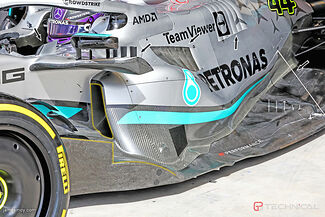
What are the chances of seeing the zero pad next year?

Image

Image

User avatar
jjn9128
782
Joined: 02 May 2017, 23:53

Re: 2026 Aerodynamic & Chassis Regulations

Post

FW17 wrote:
03 Dec 2025, 11:39
What are the chances of seeing the zero pad next year?

https://f1tcdn.net/t/m/f1devblog/2022/b ... idepod.jpg

https://preview.redd.it/the-red-bull-rb ... 3655364260
Somewhere between 0 and 100%
#aerogandalf
"There is one big friend. It is downforce. And once you have this it’s a big mate and it’s helping a lot." Robert Kubica

User avatar
djos
116
Joined: 19 May 2006, 06:09
Location: Melbourne, Australia

Re: 2026 Aerodynamic & Chassis Regulations

Post

Some interesting CFD on the 2026 regs:

"In downforce we trust"

Martin Keene
Martin Keene
8
Joined: 11 May 2010, 09:02

Re: 2026 Aerodynamic & Chassis Regulations

Post

djos wrote:
04 Dec 2025, 11:47
Some interesting CFD on the 2026 regs:

That is great video. You can see what the FIA are trying to do with the barge boards and floor edge to try and separate the different elements of the front tyre wake and manage it.

Lets see how successful it is.

TheKillingDoll
TheKillingDoll
0
Joined: 11 Mar 2013, 20:36

Re: 2026 Aerodynamic & Chassis Regulations

Post

FW17 wrote:
03 Dec 2025, 11:39
What are the chances of seeing the zero pad next year?

https://f1tcdn.net/t/m/f1devblog/2022/b ... idepod.jpg

https://preview.redd.it/the-red-bull-rb ... 3655364260
I have been thinking the same thing for the last couple of months. Unless I have misunderstood the new regulations, the zero pods would seem to fit here.

User avatar
CAEdevice
52
Joined: 09 Jan 2014, 15:33
Location: Erba, Italy

Re: 2026 Aerodynamic & Chassis Regulations

Post

FW17 wrote:
03 Dec 2025, 11:39
What are the chances of seeing the zero pad next year?
I do not believe teams will choose the zero-pod route.
With the new regulations it becomes more difficult to condition the airflow by creating differentiated pressure zones and vortices.
The shape of the sidepods will be crucial because it will be one of the few areas, especially in the section where the minimum fillet radius rule does not yet apply, where it will still be possible to manage the airflow.
So I expect differentiation and focused development in the sidepod area.

User avatar
djos
116
Joined: 19 May 2006, 06:09
Location: Melbourne, Australia

Re: 2026 Aerodynamic & Chassis Regulations

Post

Martin Keene wrote:
04 Dec 2025, 12:18
djos wrote:
04 Dec 2025, 11:47
Some interesting CFD on the 2026 regs:

That is great video. You can see what the FIA are trying to do with the barge boards and floor edge to try and separate the different elements of the front tyre wake and manage it.

Lets see how successful it is.
Agreed, admirable goals, but let’s see what the teams do with it.
"In downforce we trust"

vorticism
vorticism
367
Joined: 01 Mar 2022, 20:20

Re: 2026 Aerodynamic & Chassis Regulations

Post

Most of the conceptual renderings of the 2026 cars seen thus far, including the FIA’s, depict familiar ’09-’21 type coke-bottle/radish-shaped engine covers. Nothing wrong with that, as it seems like the most realistic assumption and the one that I also am most expecting to see. However, one major thing is different compared to that previous era: the outboard, inwashing bargeboards (FIA: “Floor board” & “Floor foot”). It makes me think we could be missing a beat. Could they inform new sidepod & engine cover concepts?

Where can, for example, inwash concepts be taken? Can the vortex generated by the “floor board” be entrained inboard between the rear wheels?

1. Given that inwash seems to be a key part of these regulations (inwashing FW, inwashing bargeboard): could there be such a thing as an inwashing sidepod or engine cover? What would it look like, what benefits could it offer, etc.

2. Furthermore, since the new bargeboards are such a focal point of the overall 2026 concept, how can their effect be accentuated?

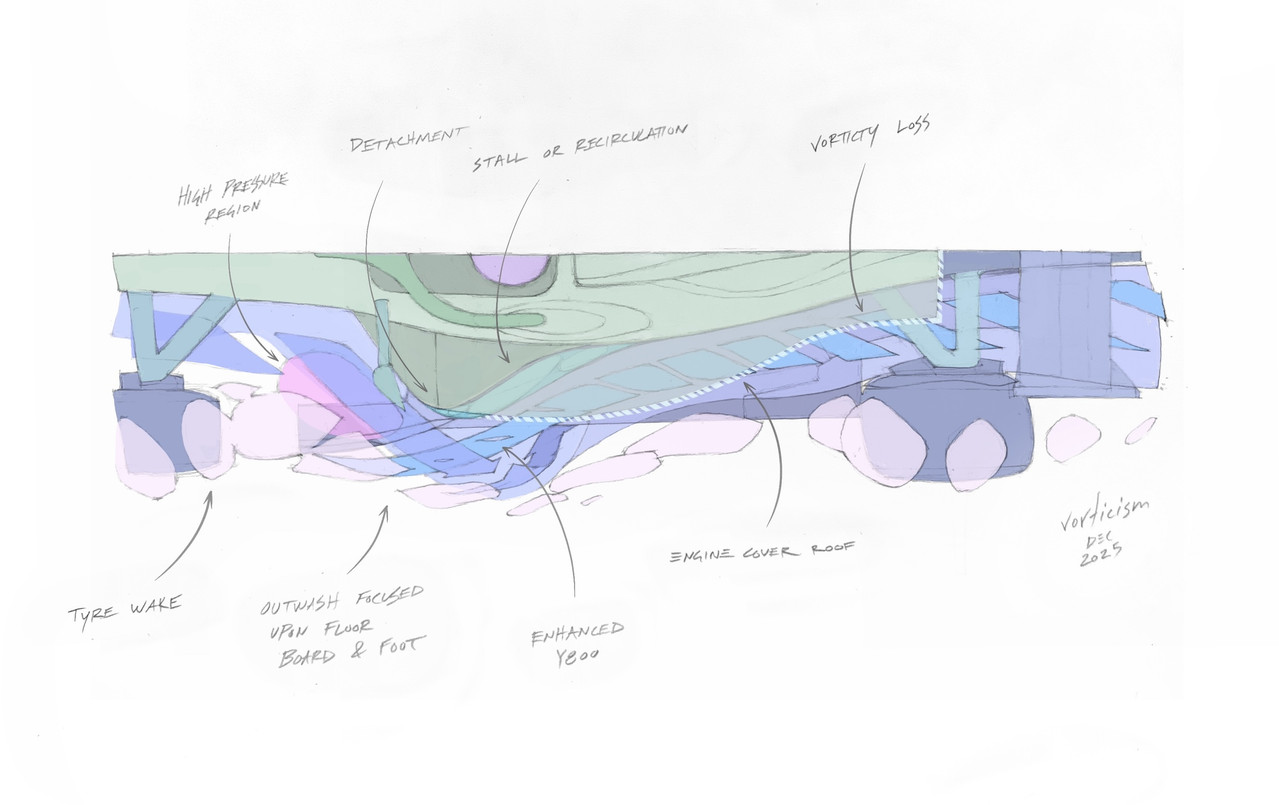
3. Could these approaches be used to manage the vortex that the floor board is producing? (Let’s call it the Y800 vortex.)

Some initial thoughts:
-An inwashing sidepod might be able to entrain the Y800 inboard toward the area above the diffuser instead of losing it to the rear tire or further outwash
-A blunt sidepod placed as far forward as possible within the legality box could direct airflow outward toward the floor board, displacing or adding more energy to the front tire wake
-A higher energy vortex should attach better to bodywork, in this case, an inwashing sidepod
-DF produced by the floor board & foot may increase with this approach

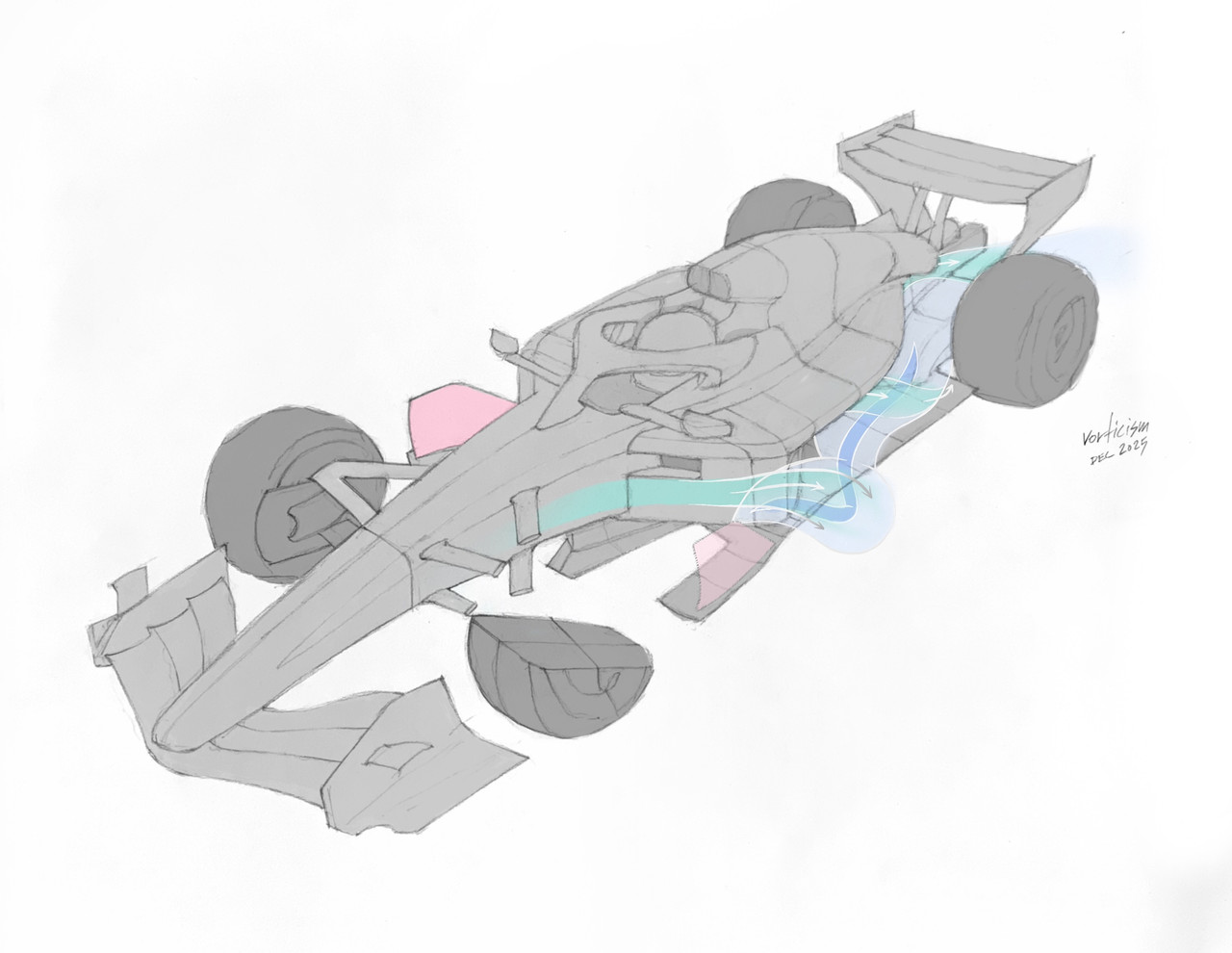
A traditional coke-bottle/radish engine cover poses a problem: it lies in the path between the floor board and the area above the diffuser. If that traditional sidepod volume can be moved farther forward, or removed by some other means, that path becomes more direct. By this we might supply the structured, energetic flow of the Y800 to the area above the diffuser. The “inwash” thus arrives in the form of the inward traverse of the Y800. All hypothetical.

Sketch of the concept, below. Another way to describe it is: a waterslide on the side of the engine cover instead of the top and carried as far forward, as close to the floor board, as possible. The footprint/g-line/groundline would still have a coke bottle/radish-shaped footprint, just with its widest point brought far forward near to the trailing end of the floor board, and more severely tapered rearward. So severely that flow detachment may occur, although that may also be beneficial similar to what occurs with an over-expanded diffuser. The result is a sidepod that is strongly outwashing at the blunt front end and inwashing along most of its trailing surface. In contrast to a traditional coke-bottle engine cover which I would describe as outwashing at the front and downwashing along its trailing surface.
Image

Image

Another approach to this could be variations on deeply undercut sidepod concepts such as that seen on the STR6 and F92A; basically just like the above, but with the front of the side-waterslide open at the front. Less energetic Y800 but still offering a less obstructed path to the area above the diffuser.
Last edited by vorticism on 07 Dec 2025, 04:51, edited 1 time in total.

User avatar
BassVirolla
12
Joined: 20 Jul 2018, 23:55

Re: 2026 Aerodynamic & Chassis Regulations

Post

vorticism wrote:
05 Dec 2025, 04:15
Most of the conceptual renderings of the 2026 cars seen thus far, including the FIA’s, depict familiar ’09-’21 type coke-bottle/radish-shaped engine covers. Nothing wrong with that, as it seems like the most realistic assumption and the one that I also am most expecting to see. However, one major thing is different compared to that previous era: the outboard, inwashing bargeboards (FIA: “Floor board” & “Floor foot”). It makes me think we could be missing a beat. Could they inform new sidepod & engine cover concepts?

Where can, for example, inwash concepts be taken? Can the vortex generated by the “floor board” be entrained inboard between the rear wheels?

1. Given that inwash seems to be a key part of these regulations (inwashing FW, inwashing bargeboard): could there be such a thing as an inwashing sidepod or engine cover? What would it look like, what benefits could it offer, etc.

2. Furthermore, since the new bargeboards are such a focal point of the overall 2026 concept, how can their effect be accentuated?

3. Could these approaches be used to manage the vortex that the floor board is producing? (Let’s call it the Y800 vortex.)

Some initial thoughts:
-An inwashing sidepod might be able to entrain the Y800 inboard toward the area above the diffuser instead of losing it to the rear tire or further outwash
-A blunt sidepod placed as far forward as possible within the legality box could direct airflow outward toward the floor board, displacing or adding more energy to the front tire wake
-A higher energy vortex should attach better to bodywork, in this case, an inwashing sidepod
-DF produced by the floor board & foot may increase with this approach

A traditional coke-bottle/radish engine cover poses a problem: it lies in the path between the floor board and the area above the diffuser. If that traditional sidepod volume can be moved farther forward, or removed by some other means, that path becomes more direct. By this we might supply the structured, energetic flow of the Y800 to the area above the diffuser. The “inwash” thus arrives in the form of the inward traverse of the Y800. All hypothetical.

Sketch of the concept, below. Another way to describe it is: a waterslide on the side of the engine cover instead of the top and carried as far forward, as close to the floor board, as possible. The footprint/g-line/groundline would still have a coke bottle/radish-shaped footprint, just with its widest point brought far forward near to the trailing end of the floor board, and more severely tapered rearward. So severely that flow detachment may occur, although that may also be beneficial similar to what occurs with an over-expanded diffuser. The result is a sidepod that is strongly outwashing at the blunt front end and inwashing along most of its trailing surface. In contrast to a traditional coke-bottle engine cover which I would describe as outwashing at the front and downwashing along its trailing surface.

https://i.postimg.cc/CLqfWRbg/bluntfront2026.jpg

Another approach to this could be variations on deeply undercut sidepod concepts such as that seen on the STR6 and F92A; basically just like the above, but with the front of the side-waterslide open at the front. Less energetic Y800 but still offering a less obstructed path to the area above the diffuser.

I have no idea in aero, but just makes sense taking advantage of the mandated elements rather than fighting against them.

quincalla
quincalla
8
Joined: 24 May 2023, 17:09

Re: 2026 Aerodynamic & Chassis Regulations

Post

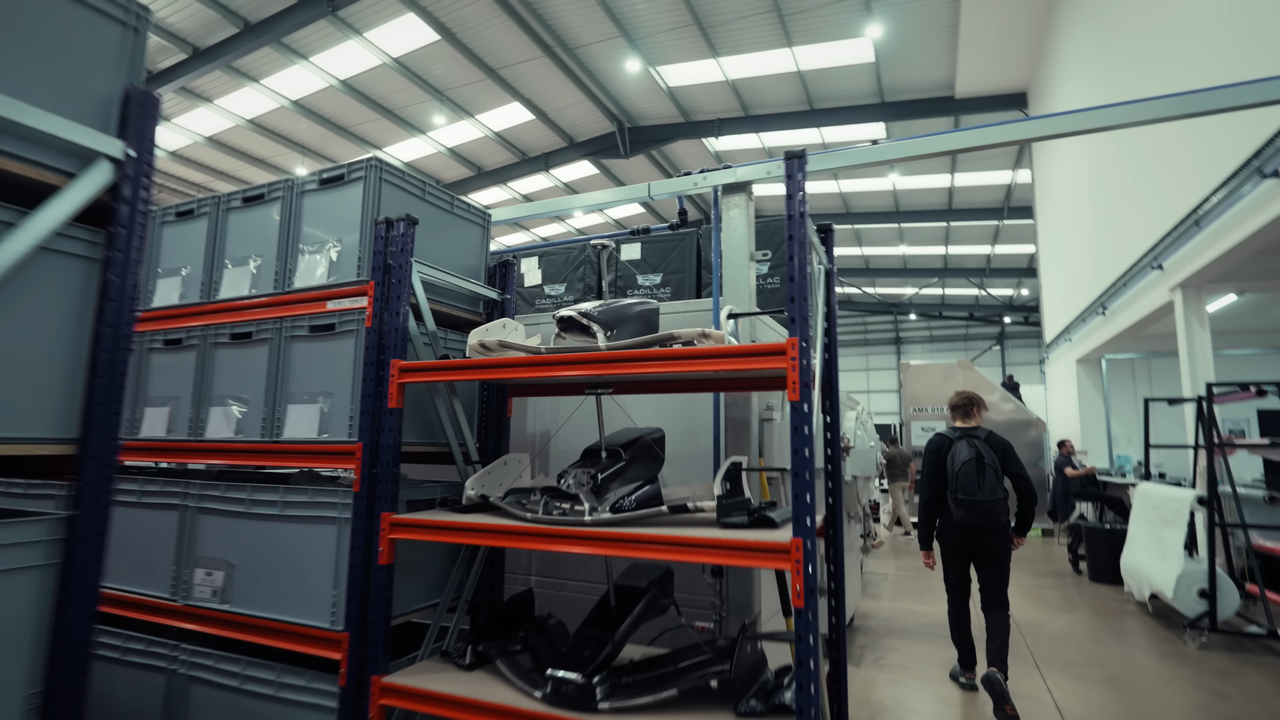
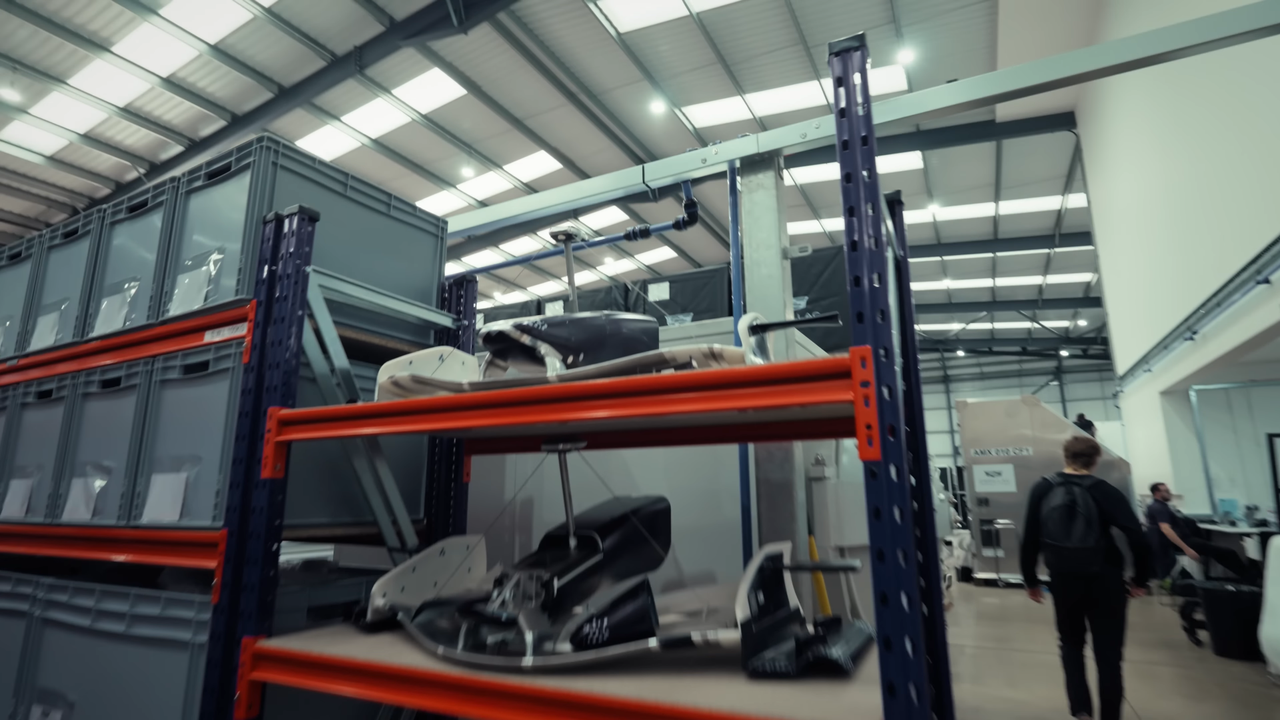
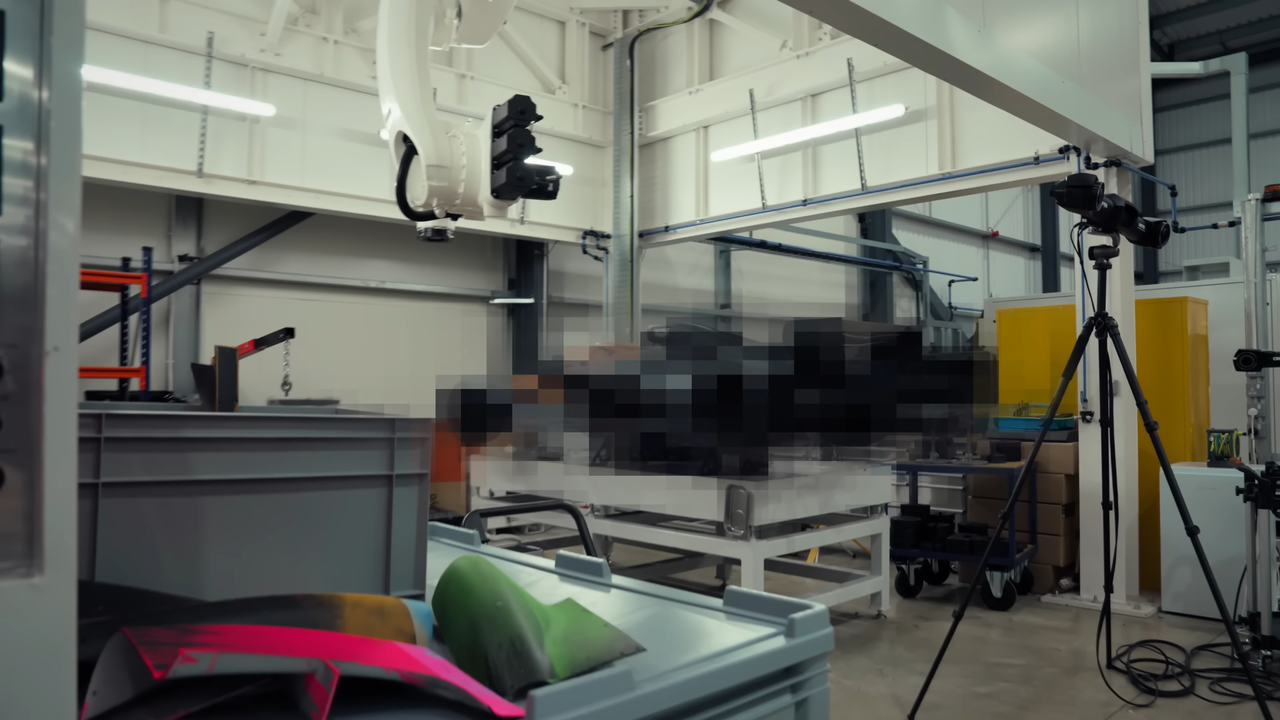
Not sure if this is the right thread to post this on but here's a first (?) look at some 2026 front wing wind tunnel models, from Cadillac's latest youtube video. Also a peek at their rollhoop and some flo-vized parts.
Image
Image
Image
Last edited by quincalla on 07 Dec 2025, 23:59, edited 1 time in total.

vorticism
vorticism
367
Joined: 01 Mar 2022, 20:20

Re: 2026 Aerodynamic & Chassis Regulations

Post

BassVirolla wrote:
06 Dec 2025, 10:02
vorticism wrote:
05 Dec 2025, 04:15
...
I have no idea in aero, but just makes sense taking advantage of the mandated elements rather than fighting against them.
It was just staring me in the face. The sidepod volume allows you to place a ramp right into the floor board/foot wing. The main rulebook limits are the legality box, section rules, and a minimum 50mm/2" gap to the floor board bodywork (the vertical part, not the foot). If there's a wing on the car, wouldn't you want to try aiming the airstream at it? Instead of mostly tyre wake. There are pluses and minuses to any concept; I'm only suggesting it as a hypothetical.

Plus, in my specific implementation in the sketch, you reduce engine cover positive lift with the flat top, and, if the side channel is tall enough, the cooling louvers can be placed within it, on the underside of the overhang, such that the energy of the Y800 could be put to work in two ways: enhance cooling efflux & bring energy to the area above the diffuser, powering the diffuser a bit more, perhaps. A Y800-blown diffuser, if you will. If you don't do something like this, you would presumably have a less powerful Y800 that would be lost to outwash or the flow around the rear tyre; which may be ultimately the better choice, depending upon what R&D would reveal.

mzso
mzso
69
Joined: 05 Apr 2014, 14:52

Re: 2026 Aerodynamic & Chassis Regulations

Post

Not being an aerodynamicist, I wonder: Since they spend so much effort on trying to guide air with wortices, winglets, nooks and crannies, and all sorts of tricks... Wouldn't it make sense to just make a giant inlet and guide the air within a bloated cover to where it is most useful?
Sure, I guess it would create drag, but so do all these features they use.