- Login or Register
No account yet? Sign up
I think Aston probably has the best control. There aren't even have customer teams to consider, they are the team the PU is made for, and made with. They even have an "engine guy" as the second in rank at the team.Badger wrote: ↑27 Jan 2026, 15:04Ferrari have the resources but have not been the most radical on packaging (in recent times). McLaren and Aston no, I think such a solution requires total control and integration of the PU and chassis. But maybe they'll prove me wrong.
Though I wouldn't call RB22 a "zeropod" now that we've seen the pictures up closer, it's not quite that radical. The solution RB has would be possible for several teams in time, but to pull it off out of the gates in a total rules reset is impressive.

I looked at 2021 cars, they had an 'optional secondary exit', but they were not 'so high up' relative to the sidepod inlet and were more 'on the sidepod roof itself' (different from the hot-race specific extra louvres) rather than on the 'main-body' - the only exception being Ferrari, with their S-duct that they had on the SF-21 where the exit was much higher than the inlet.michl420 wrote: ↑27 Jan 2026, 16:05Look at some photos where the bodywork is removed. The cooler sits directly vertical under it or even in front of it. In 2021 every car had exits there.
beautiful pics...the car does look blue (sometimes black, I don't know whether my eyes are cheating me).
What's going on with the diffuser? is the sidewall completely missing? Look like the brake duct cover has an extension that's acting like a sidewall.
That’s what I posted earlier! (Post is now in moderation I believe) but this might be a loophole to create a larger diffuser!
What I was getting at last month. The main difference being that I suggested a roofed version of what RBR have here. By moving the sidepod forward, they've lengthened the inwashing trailing section of the sidepod and engine cover, now almost a straight shot from the floor board to the diffuser, rather than having bodywork in the way like the other teams. Also this energizes the floor board with a more direct outwash from the more blunt sidepod. I suspect that their blunt sidepod might get progressively wider as they revise the design, in the same way the leading edge of their sidepod was raised higher and higher across the RB18 to RB19 revisions.Farnborough wrote: ↑27 Jan 2026, 18:32That rear 3/4 view in which you can see the full height of sidepod along with its juxtaposition with barge board, looks like they are "baulking" (for want of a better descriptor) the air to force exit upwards through the barge board vane to ultimately exit vertically in virtual chimney fashion.
In essence, taking the mess of wheel wake energy and pushing that out through the horizontal turning vanes incorporated into barge board.
vorticism wrote: ↑05 Dec 2025, 04:15Most of the conceptual renderings of the 2026 cars seen thus far, including the FIA’s, depict familiar ’09-’21 type coke-bottle/radish-shaped engine covers. Nothing wrong with that, as it seems like the most realistic assumption and the one that I also am most expecting to see. However, one major thing is different compared to that previous era: the outboard, inwashing bargeboards (FIA: “Floor board” & “Floor foot”). It makes me think we could be missing a beat. Could they inform new sidepod & engine cover concepts?
Where can, for example, inwash concepts be taken? Can the vortex generated by the “floor board” be entrained inboard between the rear wheels?
1. Given that inwash seems to be a key part of these regulations (inwashing FW, inwashing bargeboard): could there be such a thing as an inwashing sidepod or engine cover? What would it look like, what benefits could it offer, etc.
2. Furthermore, since the new bargeboards are such a focal point of the overall 2026 concept, how can their effect be accentuated?
3. Could these approaches be used to manage the vortex that the floor board is producing? (Let’s call it the Y800 vortex.)
Some initial thoughts:
-An inwashing sidepod might be able to entrain the Y800 inboard toward the area above the diffuser instead of losing it to the rear tire or further outwash
-A blunt sidepod placed as far forward as possible within the legality box could direct airflow outward toward the floor board, displacing or adding more energy to the front tire wake
-A higher energy vortex should attach better to bodywork, in this case, an inwashing sidepod
-DF produced by the floor board & foot may increase with this approach
A traditional coke-bottle/radish engine cover poses a problem: it lies in the path between the floor board and the area above the diffuser. If that traditional sidepod volume can be moved farther forward, or removed by some other means, that path becomes more direct. By this we might supply the structured, energetic flow of the Y800 to the area above the diffuser. The “inwash” thus arrives in the form of the inward traverse of the Y800. All hypothetical.
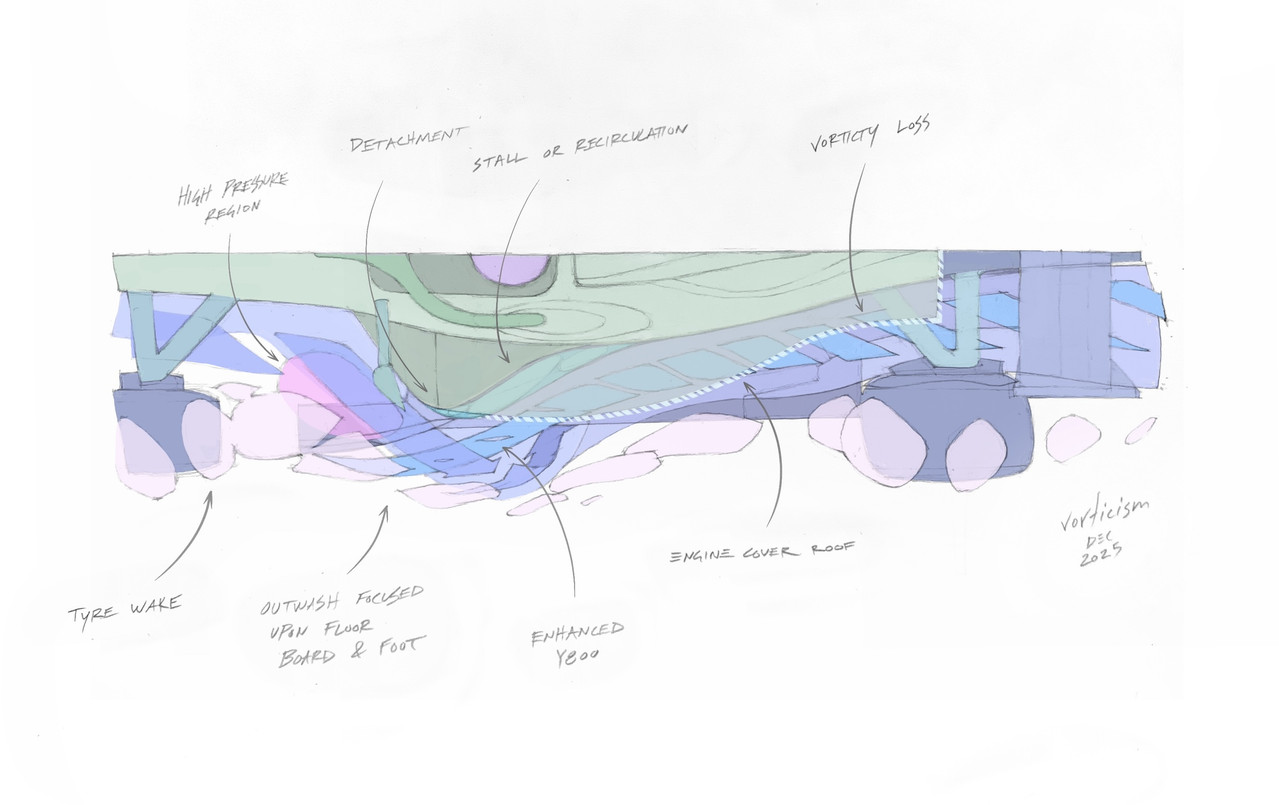
Sketch of the concept, below. Another way to describe it is: a waterslide on the side of the engine cover instead of the top and carried as far forward, as close to the floor board, as possible. The footprint/g-line/groundline would still have a coke bottle/radish-shaped footprint, just with its widest point brought far forward near to the trailing end of the floor board, and more severely tapered rearward. So severely that flow detachment may occur, although that may also be beneficial similar to what occurs with an over-expanded diffuser. The result is a sidepod that is strongly outwashing at the blunt front end and inwashing along most of its trailing surface. In contrast to a traditional coke-bottle engine cover which I would describe as outwashing at the front and downwashing along its trailing surface.
https://i.postimg.cc/CLqfWRbg/bluntfront2026.jpg
...


Yes, that aspect is the widely held understanding : marked in the below pic - the 'venetian blind' bargeboard acts as a chimney to create suction and draw some the 'turning air' from the 'undercut region' of the sidepod front (leaving the rest to go to the rear) and bulldozing the front wheel wake upwards.Farnborough wrote: ↑27 Jan 2026, 18:32That rear 3/4 view in which you can see the full height of sidepod along with its juxtaposition with barge board, looks like they are "baulking" (for want of a better descriptor) the air to force exit upwards through the barge board vane to ultimately exit vertically in virtual chimney fashion.
In essence, taking the mess of wheel wake energy and pushing that out through the horizontal turning vanes incorporated into barge board.

How do you know their packaging? Do you have pics?Badger wrote:Ferrari have the resources but have not been the most radical on packaging (in recent times). McLaren and Aston no, I think such a solution requires total control and integration of the PU and chassis. But maybe they'll prove me wrong.
Though I wouldn't call RB22 a "zeropod" now that we've seen the pictures up closer, it's not quite that radical. The solution RB has would be possible for several teams in time, but to pull it off out of the gates in a total rules reset is impressive.