2026 Aerodynamic & Chassis Regulations

Here are our CFD links and discussions about aerodynamics, suspension, driver safety and tyres. Please stick to F1 on this forum.
User avatar
FW17
176
Joined: 06 Jan 2010, 10:56

Re: 2026 Aerodynamic & Chassis Regulations

Post

Image
Image


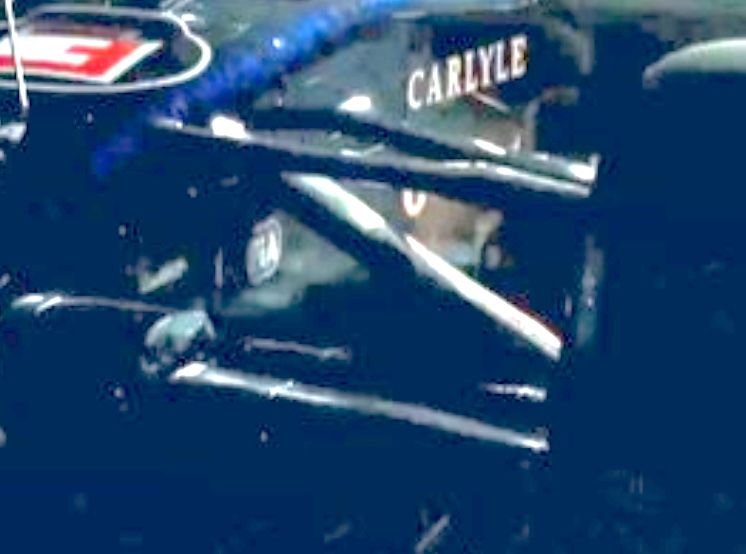
I guess the big anti-dive geometry is to prevent the weight transfer forward and get the best platform for the rear harvesting to happen.

Other than the engine power the amount of harvesting that can happen in a lap with braking is going to be key for laptime. 3 sec additional deployment in a lap is going to be a lot as beneficial as having additional 30 hp form ICE.

That would be around 0.6 sec a lap time gain.

Tommy Cookers
Tommy Cookers
666
Joined: 17 Feb 2012, 16:55

Re: 2026 Aerodynamic & Chassis Regulations

Post

FW17 wrote:
23 Jan 2026, 07:58
... I guess the big anti-dive geometry is to prevent the weight transfer forward and get the best platform for the rear harvesting to happen.
well .....
anti-dive doesn't really prevent 'weight transfer' - (it's to conserve suspension travel)

nice photo though

User avatar
dren
228
Joined: 03 Mar 2010, 14:14

Re: 2026 Aerodynamic & Chassis Regulations

Post

Tommy Cookers wrote:
23 Jan 2026, 11:13
FW17 wrote:
23 Jan 2026, 07:58
... I guess the big anti-dive geometry is to prevent the weight transfer forward and get the best platform for the rear harvesting to happen.
well .....
anti-dive doesn't really prevent 'weight transfer' - (it's to conserve suspension travel)

nice photo though
Which conserves suspension geometry which are secondary (or primary) aero devices.
Honda!

vorticism
vorticism
443
Joined: 01 Mar 2022, 20:20
Location: YooEssay

Re: 2026 Aerodynamic & Chassis Regulations

Post

I wonder what the logic is behind maintaining these so-called anti-dive arragnements. Considering that in the last regs set the common reasoning was to create a more stable aero platform for the floor tunnels. The previous flat floor regs did not have these arragnements to this degree--that's one reasone the RB18 stood out so much compared to 2021 cars. Was it simply an unturned stone? The complaint from drivers was said to be that it reduced brake feel--if so it's being ignored in favor of its continued aero/mechanical advantages?

vorticism wrote:
23 Jan 2026, 22:55
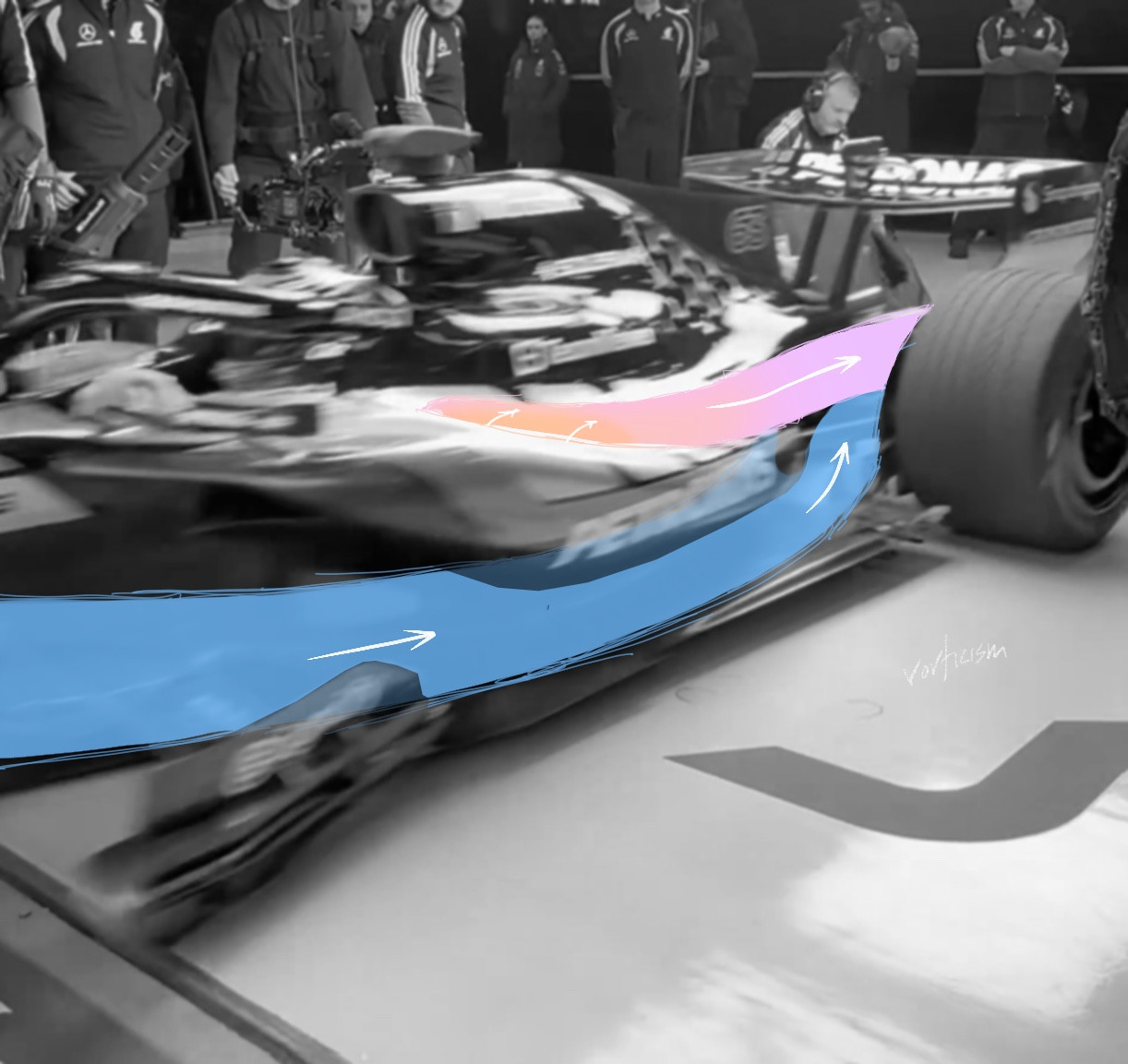
Those Coanda type sidepods lofted the exhaust over top the inflow arriving from the undercut. If they end up using big cooling louvers or sidepod cannons it might again be a way to loft a heated airstream over the undercut inwash. Not necessarily to energize the diffuser but simply to steer the efflux through the rear suspension members which cause drag & turbulence anyway, so why not blast them with the radiator efflux while the diffuser gets clean undercut inwash.
Instead of exhaust jumping over the inwash flow, radiator efflux might instead jump into the suspension members. If the rear suspension members receive lower energy air they should experience less drag. But would this proximity harm the diffuser? It would allow more free stream air directly beneath the RW via a smaller central cannon. Sidepod efflux in general should reduce sidepod lift.

Image
🏴󠁧󠁢󠁥󠁮󠁧󠁿

User avatar
Stu
Moderator
Joined: 02 Nov 2019, 10:05
Location: Norfolk, UK

Re: 2026 Aerodynamic & Chassis Regulations

Post

Just a random thought…
Why haven’t we seen front wing activation pods integrated into the wing mounting struts?
Perspective - Understanding that sometimes the truths we cling to depend greatly on our own point of view.

Farnborough
Farnborough
137
Joined: 18 Mar 2023, 14:15

Re: 2026 Aerodynamic & Chassis Regulations

Post

vorticism wrote:
23 Jan 2026, 20:41
I wonder what the logic is behind maintaining these so-called anti-dive arragnements. Considering that in the last regs set the common reasoning was to create a more stable aero platform for the floor tunnels. The previous flat floor regs did not have these arragnements to this degree--that's one reasone the RB18 stood out so much compared to 2021 cars. Was it simply an unturned stone? The complaint from drivers was said to be that it reduced brake feel--if so it's being ignored in favor of its continued aero/mechanical advantages?

vorticism wrote:
23 Jan 2026, 22:55
Those Coanda type sidepods lofted the exhaust over top the inflow arriving from the undercut. If they end up using big cooling louvers or sidepod cannons it might again be a way to loft a heated airstream over the undercut inwash. Not necessarily to energize the diffuser but simply to steer the efflux through the rear suspension members which cause drag & turbulence anyway, so why not blast them with the radiator efflux while the diffuser gets clean undercut inwash.
Instead of exhaust jumping over the inwash flow, radiator efflux might instead jump into the suspension members. If the rear suspension members receive lower energy air they should experience less drag. But would this proximity harm the diffuser? It would allow more free stream air directly beneath the RW via a smaller central cannon. Sidepod efflux in general should reduce sidepod lift.

https://i.postimg.cc/d3FYyDvs/image-(2).jpg
The topic was looked at in here and F1 commentary in general through the optic of this effect, specifically in relation to preserve/conserve GE floor geometry and associated aero platform performance.

However, its been very useful prior to this recent "publicity" for many other applications related to suspension effects.

To define it may help in understanding. Effectively, its a geometric conflict within the design that promotes or restricts movement against load/torque/mass leverage in dynamic response.
Most importantly, it lives in parallel with the spring medium, but can be separated effectively within the same system.

The practical application that's important here, is to have it only responding to braking forces (in this restricted topic) which allows more free choice of ultimate spring rate used to support the platform when not braking.
It can therefore leave much more optimal suspension compliance in approach to track irregularities (high speed corners etc) while just using the brake induced effect when needed. Like running two "concentric" system within the same hardware.

This https://en.wikipedia.org/wiki/DW-link although for rear wheel application, gives good overview of possibilities from someone with leading interpretation of related topic. He effectively changed the whole approach with his work in cycle racing.

The driver effect, we can see clearly who (just one person :D ) responded so well to this architecture, making absolutely maximum use of this effect but with odd feeling characteristics not sitting well with many others. Last two years saw more drivers start to really understand its potential, and adapt their driving in incorporating this into positive responses, rather than fighting the effects and claiming huge variation in chassis response from track to track.

vorticism
vorticism
443
Joined: 01 Mar 2022, 20:20
Location: YooEssay

Re: 2026 Aerodynamic & Chassis Regulations

Post

Farnborough wrote:
26 Jan 2026, 10:02
The driver effect, we can see clearly who (just one person :D ) responded so well to this architecture, making absolutely maximum use of this effect but with odd feeling characteristics not sitting well with many others. Last two years saw more drivers start to really understand its potential, and adapt their driving in incorporating this into positive responses, rather than fighting the effects and claiming huge variation in chassis response from track to track.
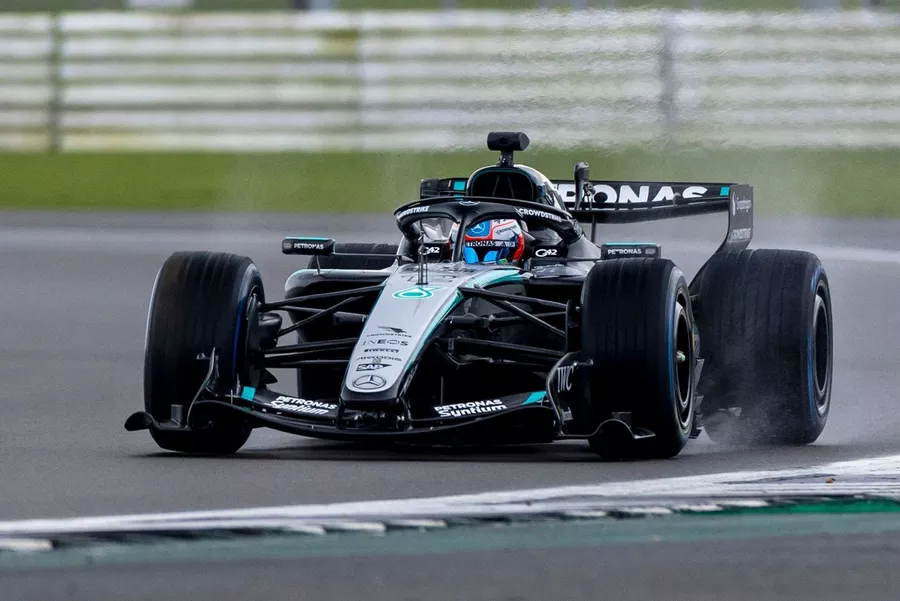
You're right in that he did adapt to it, which brings into question all the claims that the car was tailored to him. It wasn't, it was tailored to aero and mechanical requirements, tailoring which all the other teams later adopted themselves. He coped with it, as did the other drivers later, hence the purported complaints from drivers about how it impacted driving feel.

With the RB22, RBR are back to normal with their front control arm angles that look more like the '21 and prior designs. Why I was surprised to see that some teams maintained the 'anti-dive' high inclination arms. I don't think it's needed with the return to flat floors and high rear ride heights.

Image
🏴󠁧󠁢󠁥󠁮󠁧󠁿

Hoffman900
Hoffman900
239
Joined: 13 Oct 2019, 03:02

Re: 2026 Aerodynamic & Chassis Regulations

Post

Because the anti dive everyone has been dragging on about is about aero, not suspension kinematics.

Some FSAE student who probably just learned what anti-dive means made a reddit post about “anti-dive” and the internet talking heads ran with it. Most of them wouldn’t know a piston from a valve…

All race cars have had anti-dive since the 1960s, how much depends.

mzso
mzso
72
Joined: 05 Apr 2014, 14:52

Re: 2026 Aerodynamic & Chassis Regulations

Post

vorticism wrote:
26 Jan 2026, 12:47
You're right in that he did adapt to it, which brings into question all the claims that the car was tailored to him. It wasn't, it was tailored to aero and mechanical requirements, tailoring which all the other teams later adopted themselves. He coped with it, as did the other drivers later, hence the purported complaints from drivers about how it impacted driving feel.
I don't think only the suspension geometry made those cars obnoxious to drive.

Farnborough
Farnborough
137
Joined: 18 Mar 2023, 14:15

Re: 2026 Aerodynamic & Chassis Regulations

Post

mzso wrote:
26 Jan 2026, 16:51
vorticism wrote:
26 Jan 2026, 12:47
You're right in that he did adapt to it, which brings into question all the claims that the car was tailored to him. It wasn't, it was tailored to aero and mechanical requirements, tailoring which all the other teams later adopted themselves. He coped with it, as did the other drivers later, hence the purported complaints from drivers about how it impacted driving feel.
I don't think only the suspension geometry made those cars obnoxious to drive.
That has not been said "only" and really not part of this conversation, implied or otherwise.

There's myriad reason in any era that need accommodation by driver approach, this just one of them. Acceptance and adaptions to the peculiarities of regulation set are simply a necessary part of a successful outcome.

The difference in claiming faults OR understanding the nuance to positive effect, clearly logged in the history of last 4 seasons.

TeamKoolGreen
TeamKoolGreen
0
Joined: 22 Feb 2024, 01:49

Re: 2026 Aerodynamic & Chassis Regulations

Post

We have the same variation of designs as we did in 2022. I am not saying this is a good or bad thing.

Audi's design is broadly similar to the launch spec Aston Martin of 2022, with the high waist line sidepod

The Cadillac is the closest thing to the launch spec Red Bull sidepods from 2022

The Red Bull is broadly similar to the launch spec Williams sidepods from 2022

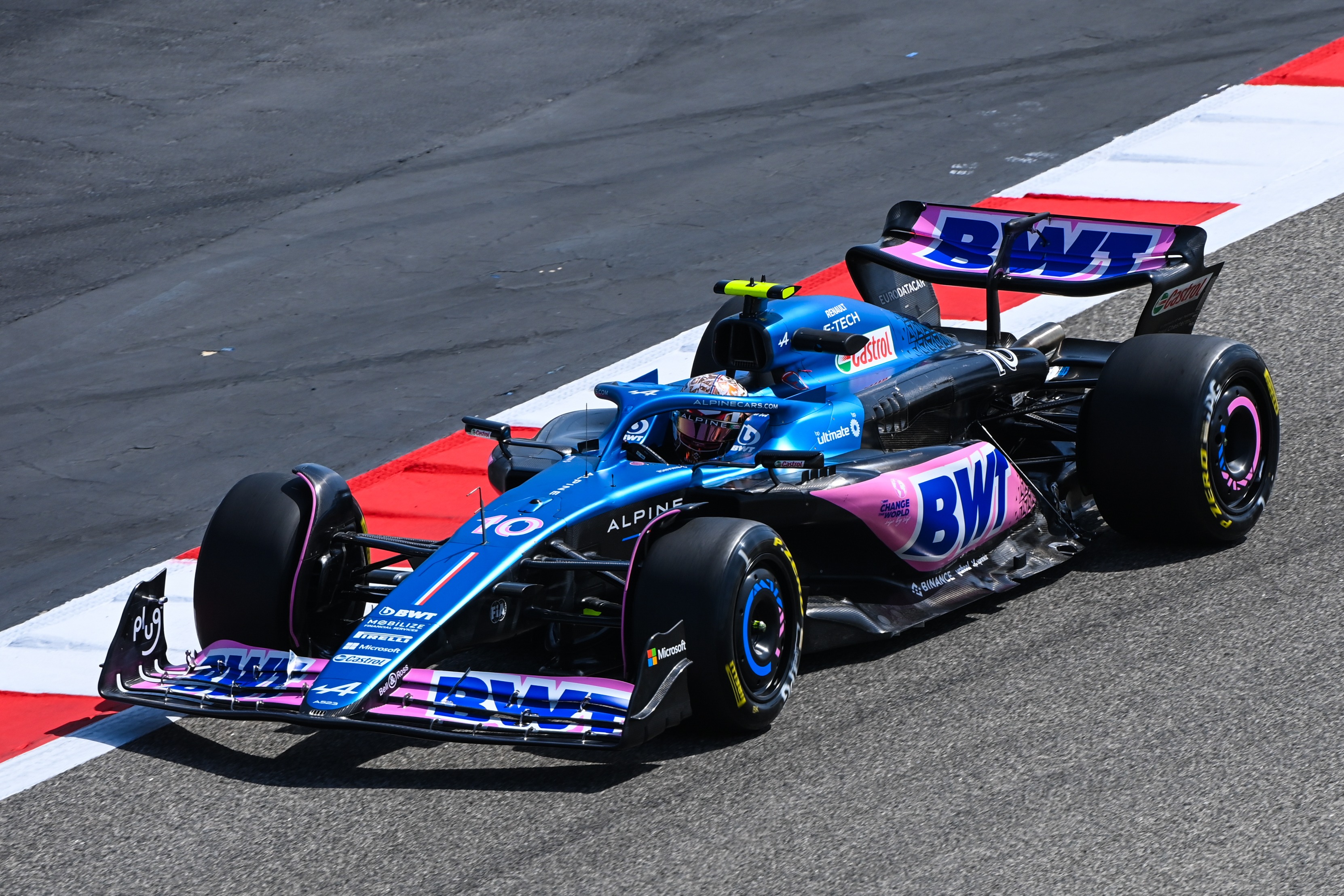
The Mercedes and Alpine look similar to the 2022 Alpine's sidepods

Image

Farnborough
Farnborough
137
Joined: 18 Mar 2023, 14:15

Re: 2026 Aerodynamic & Chassis Regulations

Post

vorticism wrote:
26 Jan 2026, 12:47
Farnborough wrote:
26 Jan 2026, 10:02
The driver effect, we can see clearly who (just one person :D ) responded so well to this architecture, making absolutely maximum use of this effect but with odd feeling characteristics not sitting well with many others. Last two years saw more drivers start to really understand its potential, and adapt their driving in incorporating this into positive responses, rather than fighting the effects and claiming huge variation in chassis response from track to track.
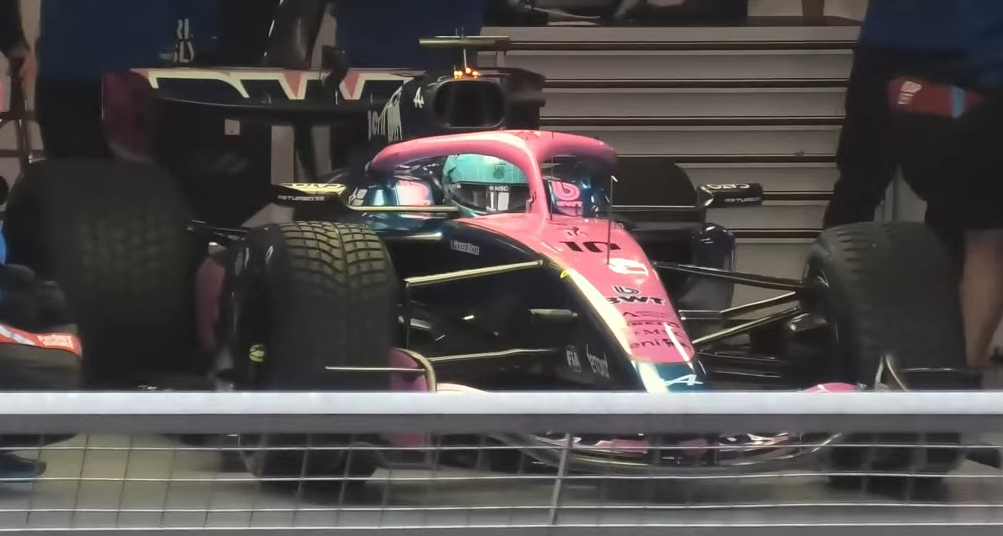
You're right in that he did adapt to it, which brings into question all the claims that the car was tailored to him. It wasn't, it was tailored to aero and mechanical requirements, tailoring which all the other teams later adopted themselves. He coped with it, as did the other drivers later, hence the purported complaints from drivers about how it impacted driving feel.

With the RB22, RBR are back to normal with their front control arm angles that look more like the '21 and prior designs. Why I was surprised to see that some teams maintained the 'anti-dive' high inclination arms. I don't think it's needed with the return to flat floors and high rear ride heights.

https://i.postimg.cc/zvfbQqMD/rb22arms.jpg
It'll interesting to see the net effect of these decisions as track experience builds to more competitive levels.

They all generally chase ride height downwards (F1 in general) at which area of operation there's more value in ramping up support under braking phase.

Another obvious area desirable in separation of dive control from spring rate is curb riding. Promoting braking support while still having competent spring damper rates that will more facilitate the unusual wheel deflection needed to thump it over curbing when needed.

As we've discussed, driver adaption is going to be interesting with now many changes incorporated into this rules shift.

User avatar
JonoNic
5
Joined: 05 Mar 2015, 15:54

Re: 2026 Aerodynamic & Chassis Regulations

Post

I not sure if I'm asking this correctly, but here goes. When a car is in low-drag straight-line running, could there be any benefit to guiding the front-wheel wake airflow toward the rear wing? When the front wing actuator/s returns it back to normal (end of a straight), then the front-wheel wake is pushed away from the rear wing. Is this possible with those barge boards? If so, how would a team do it? Are they any teams that look like they are actually trying this?


Always find the gap then use it.

vorticism
vorticism
443
Joined: 01 Mar 2022, 20:20
Location: YooEssay

Re: 2026 Aerodynamic & Chassis Regulations

Post

vorticism wrote:
05 Dec 2025, 04:15

Most of the conceptual renderings of the 2026 cars seen thus far, including the FIA’s, depict familiar ’09-’21 type coke-bottle/radish-shaped engine covers. Nothing wrong with that, as it seems like the most realistic assumption and the one that I also am most expecting to see. However, one major thing is different compared to that previous era: the outboard, inwashing bargeboards (FIA: “Floor board” & “Floor foot”). It makes me think we could be missing a beat. Could they inform new sidepod & engine cover concepts?

Where can, for example, inwash concepts be taken? Can the vortex generated by the “floor board” be entrained inboard between the rear wheels?

1. Given that inwash seems to be a key part of these regulations (inwashing FW, inwashing bargeboard): could there be such a thing as an inwashing sidepod or engine cover? What would it look like, what benefits could it offer, etc.
2. Furthermore, since the new bargeboards are such a focal point of the overall 2026 concept, how can their effect be accentuated?
3. Could these approaches be used to manage the vortex that the floor board is producing? (Let’s call it the Y800 vortex.)

Some initial thoughts:
-An inwashing sidepod might be able to entrain the Y800 inboard toward the area above the diffuser instead of losing it to the rear tire or further outwash
-A blunt sidepod placed as far forward as possible within the legality box could direct airflow outward toward the floor board, displacing or adding more energy to the front tire wake
-A higher energy vortex should attach better to bodywork, in this case, an inwashing sidepod
-DF produced by the floor board & foot may increase with this approach

A traditional coke-bottle/radish engine cover poses a problem: it lies in the path between the floor board and the area above the diffuser. If that traditional sidepod volume can be moved farther forward, or removed by some other means, that path becomes more direct. By this we might supply the structured, energetic flow of the Y800 to the area above the diffuser. The “inwash” thus arrives in the form of the inward traverse of the Y800. All hypothetical.

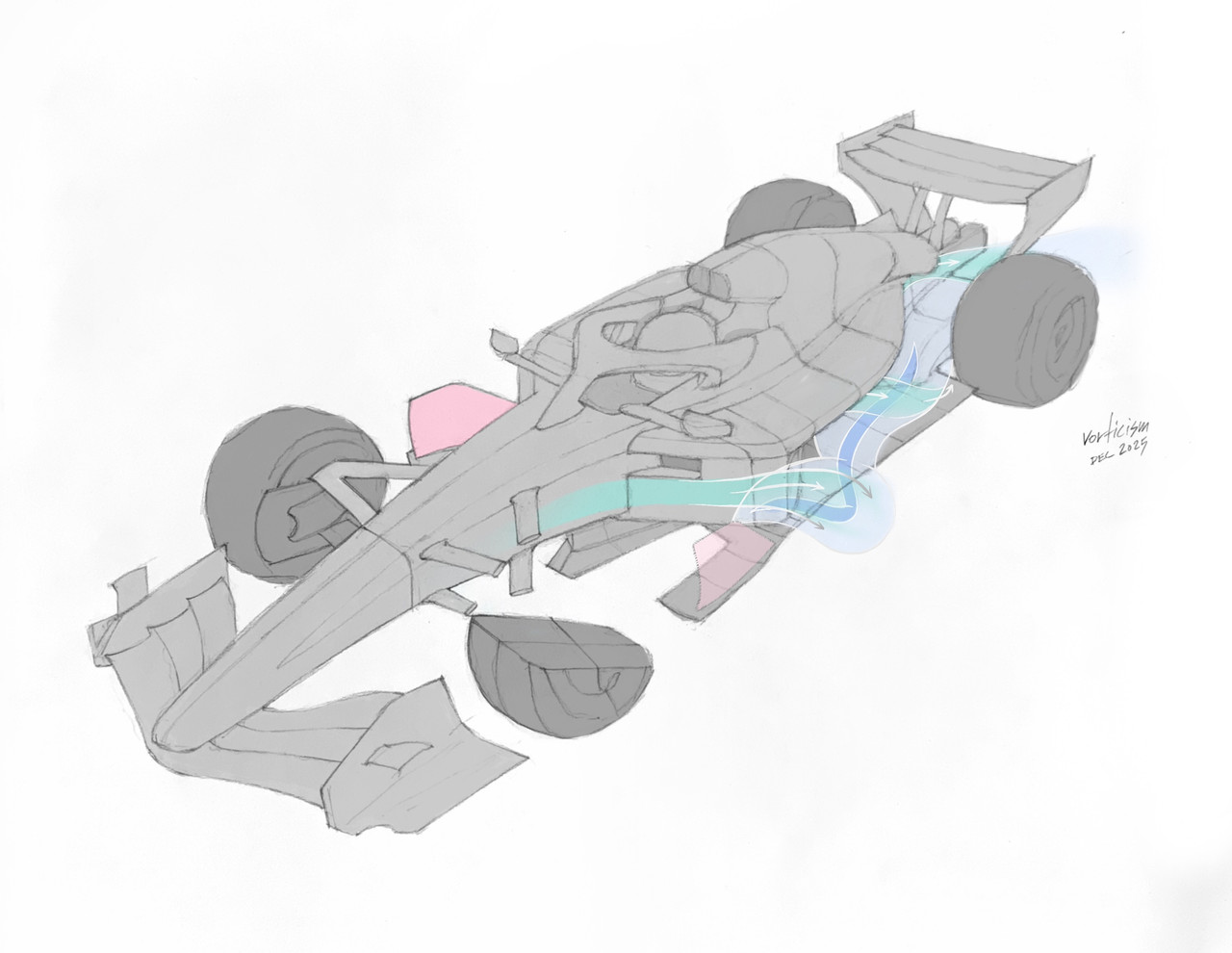
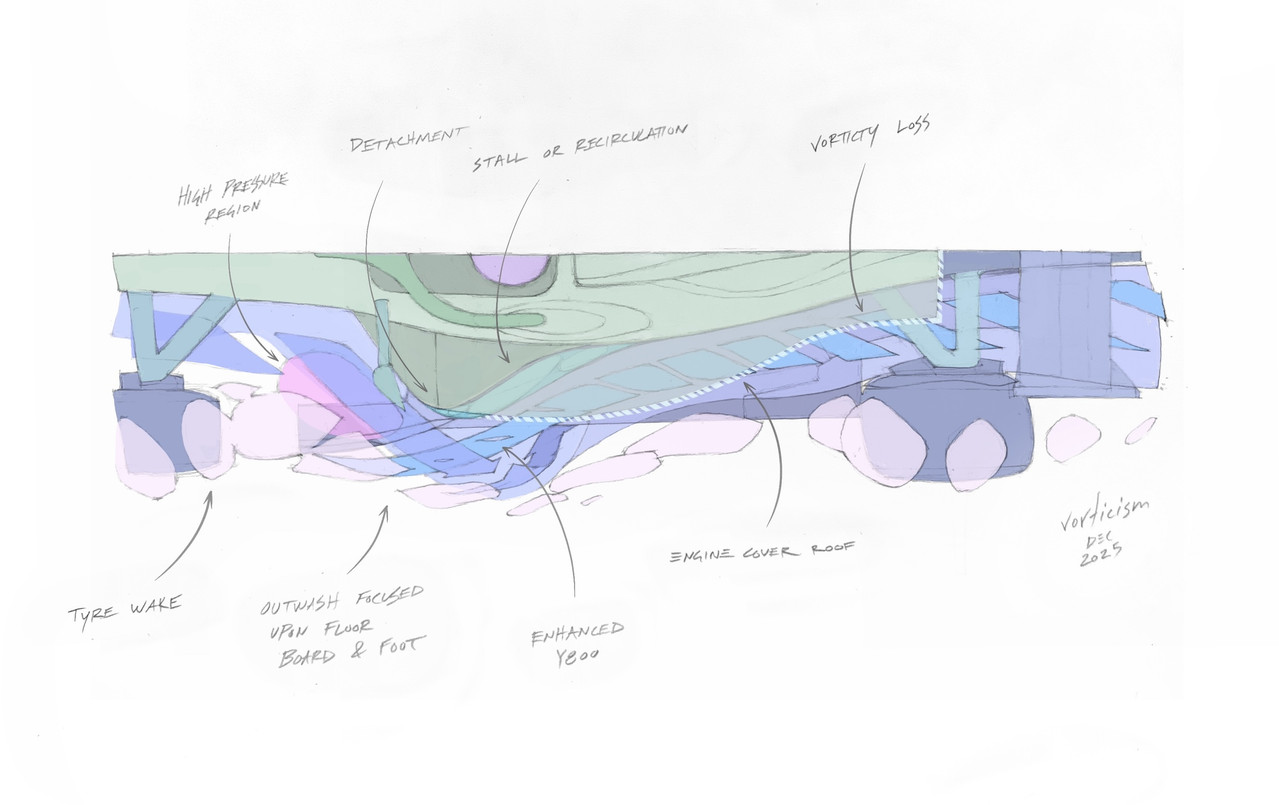
Sketch of the concept, below. Another way to describe it is: a waterslide on the side of the engine cover instead of the top and carried as far forward, as close to the floor board, as possible. The footprint/g-line/groundline would still have a coke bottle/radish-shaped footprint, just with its widest point brought far forward near to the trailing end of the floor board, and more severely tapered rearward. So severely that flow detachment may occur, although that may also be beneficial similar to what occurs with an over-expanded diffuser. The result is a sidepod that is strongly outwashing at the blunt front end and inwashing along most of its trailing surface. In contrast to a traditional coke-bottle engine cover which I would describe as outwashing at the front and downwashing along its trailing surface.

Image
Image
...

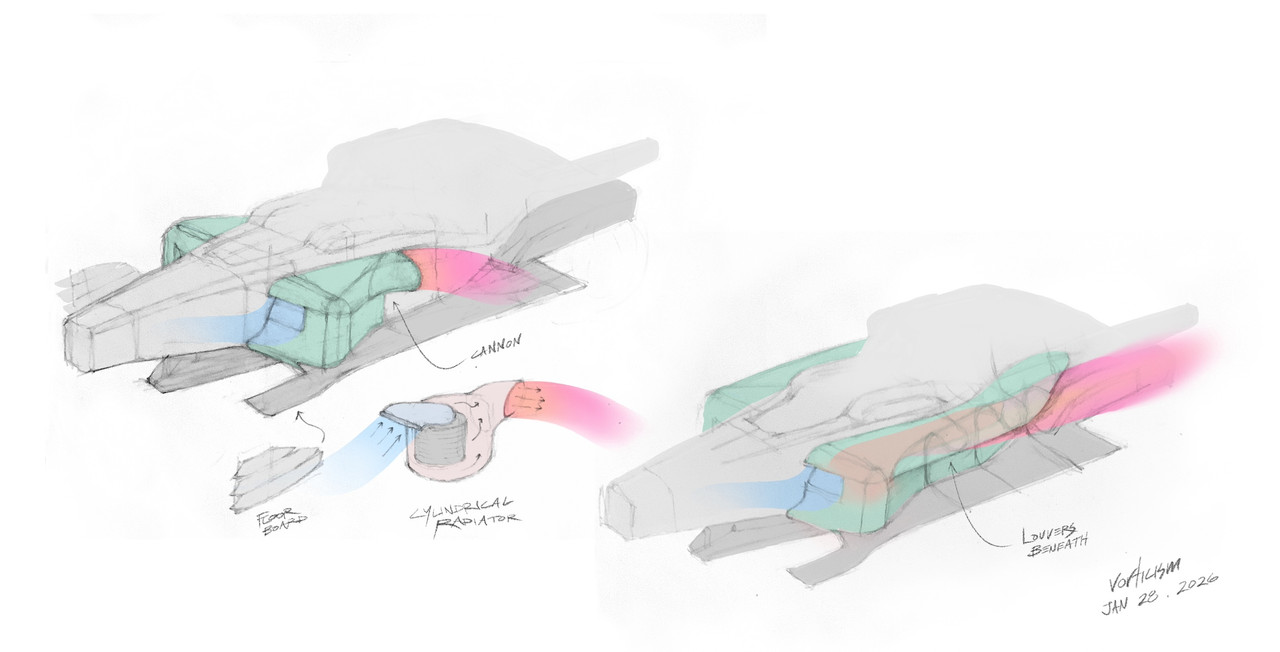
Meant to post more about this earlier. The quoted concept (blunt sidepods + “long inwash” engine cover) I presented in December could be paired with unique cooling arrangements that are now permitted by the regulations, namely curved radiators and the taller louver allowance. Here I’ve paired a cylindrical radiator with two outlet outlet options:

--a single large cannon opening on a shorter sidepod
--an array of louvers hidden beneath a long overhang

The latter might work better with a supposed Y800 vortex, which could serve as an extraction force and an energizer of the outflow ahead of the rear suspension area.

I suspect that if Newey shows up with something unique it will involve cooling and interactions with the floor boards. Already RBR have shown with the RB22 that I might be on the right track with regards to the floor board interaction and with providing a longer inwashing region i.e. a straight shot to the diffuser from the floor board via a longer g-line taper. As for cooling generally, it seems to me to be the final frontier in these regs--the greatest potential differentiator, as it can inform new bodywork and chassis arrangements. I could also be barking up the wrong tree, and the regs (and physics) may ultimately force more familiar designs. Though I'd like to see something new!

Image
🏴󠁧󠁢󠁥󠁮󠁧󠁿

vorticism
vorticism
443
Joined: 01 Mar 2022, 20:20
Location: YooEssay

Re: 2026 Aerodynamic & Chassis Regulations

Post

Nothing too crazy revealed by any of the teams yet, then. Oh, well. Still early days. I hope the hopium I've offered has been enjoyable over the past few months, Eurobros. Everything I've suggested in various posts would be legal to the best of my knowledge (please prove me wrong)--but physics is the ultimate arbiter and tends to not care if you think an idea is entertaining.

List of things I did accurately predict last year:
✅the return of rake https://www.f1technical.net/forum/viewt ... 3#p1300383
✅front pushrod suspension https://www.f1technical.net/forum/viewt ... 3#p1315883
✅rear pushrod suspension https://www.f1technical.net/forum/viewt ... 3#p1315883
✅horizontal floor board elements https://www.f1technical.net/forum/viewt ... 1#p1293691
✅greater use of the now-taller sidepod louver allowance (only RBR & AMR so far) https://www.f1technical.net/forum/viewt ... 1#p1293691
✅blunt sidepods (only RBR so far) to work the floorboard and energize tyre wake https://www.f1technical.net/forum/viewt ... 1#p1313121
✅sidepod as front floor extension (only RBR so far, in part) https://www.f1technical.net/forum/viewt ... 1#p1298371
🏴󠁧󠁢󠁥󠁮󠁧󠁿