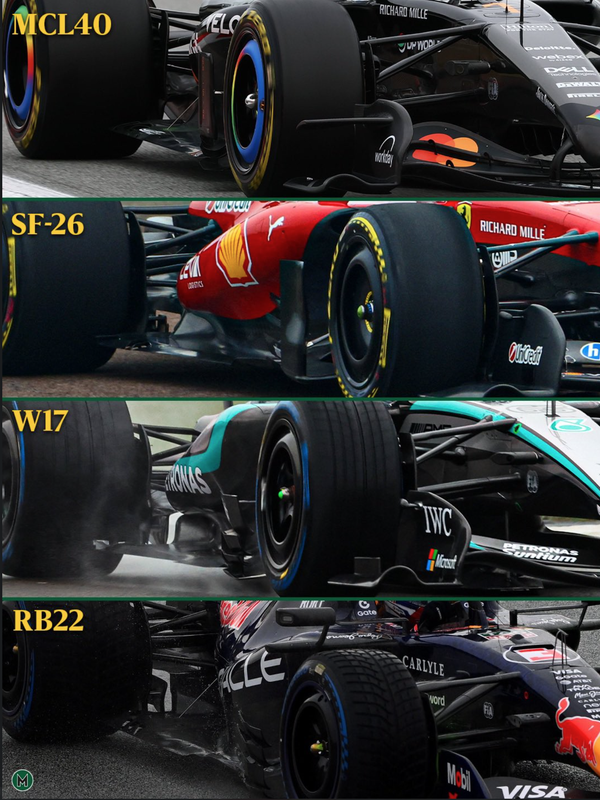
Mclaren MCL40

A place to discuss the characteristics of the cars in Formula One, both current as well as historical. Laptimes, driver worshipping and team chatter do not belong here.
the EDGE
the EDGE
68
Joined: 13 Feb 2012, 18:31
Location: Bedfordshire ENGLAND

Re: Mclaren MCL40

Post

Farnborough wrote:
29 Jan 2026, 12:51
the EDGE wrote:
29 Jan 2026, 12:37
michl420 wrote:
29 Jan 2026, 10:15
Last year mclaren had this very long upper rear leg in the front suspension, this year it is the lower one. I guess primary for aerodynamic reasons.

About rake of the car. The rear of the car can not go down on the straight in the same way like pre 22 because suspensions have a different regulation. Maybe they can do it another way (if disired).
They won’t need the rear of the car to compress on the straights, active aero will shed the required drag
My understanding is that stalling the diffuser at higher speed always gives welcome, and significant, benefit in drag reduction. That's regardless of of wing level.
Use of changing leverage ratio within support design can and does do this, without the need of any control device. Belleville springs give a natural drop in rate as they pass through critical geometry, often seen on heave damper and tea-tray support for this reason.
Okay, I think I understand what you’re saying, but what force would be capable of compressing the rear, if you have shed the drag from the use of the active Aero?

matteosc
matteosc
30
Joined: 11 Sep 2012, 17:07

Re: Mclaren MCL40

Post

the EDGE wrote:
29 Jan 2026, 13:03
Farnborough wrote:
29 Jan 2026, 12:51
the EDGE wrote:
29 Jan 2026, 12:37


They won’t need the rear of the car to compress on the straights, active aero will shed the required drag
My understanding is that stalling the diffuser at higher speed always gives welcome, and significant, benefit in drag reduction. That's regardless of of wing level.
Use of changing leverage ratio within support design can and does do this, without the need of any control device. Belleville springs give a natural drop in rate as they pass through critical geometry, often seen on heave damper and tea-tray support for this reason.
Okay, I think I understand what you’re saying, but what force would be capable of compressing the rear, if you have shed the drag from the use of the active Aero?
That is a good point. What happened to the rear when the DRS opened in the past seasons, especially pre-ground effect? We should have something similar, but more powerful.

Andi76
Andi76
471
Joined: 03 Feb 2021, 20:19

Re: Mclaren MCL40

Post

LionsHeart wrote:
27 Jan 2026, 08:56
Andi76 wrote:
27 Jan 2026, 07:53
LionsHeart wrote:
26 Jan 2026, 16:35


After seeing the first renderings, I also wanted to raise the question of the front suspension. Judging by the mounting of the upper rear control arms, it's the same as last year. The anti-dive system is in place. It's nice that some features can be carried over to the completely new chassis, which has undergone critical changes to the technical regulations in all areas. If the rear suspension is still pushrod-based, how optimal will the balance be in slow corners? Any suspension experts?
In general, if we stay with the same car dimensions, if the rear suspension remains pushrod-based while the front switches from pullrod to pushrod with largely unchanged geometry, the suspension layout change alone would not fundamentally alter slow-corner balance. With the same pickup points, anti-dive characteristics, roll centres and kinematics, the basic mechanical grip distribution stays comparable. However, a pushrod front does change load paths and packaging, typically placing rockers and dampers higher in the chassis. This can slightly raise the local front-end centre of gravity and alter compliance, friction and effective wheel rates—effects that are most noticeable in low-speed corners, where small suspension movements dominate vehicle behaviour.

But if this is combined with a shorter wheelbase and a car that is around 10 cm narrower, like it is because of the new regulations, the balance implications become much more pronounced. A shorter wheelbase increases yaw response and rotation on turn-in, making the car feel more agile but also less inherently stable at the apex. A reduced track width increases lateral load transfer (that's why I would have placed a strong focus on the lowest possible center of gravity for these cars while also using the maximum permitted wheelbase, as this reduces the overall lateral load transfer, which doesn't mean that I would have chosen pull rods, which i wouldn't because of aerodynamic reasons) have shrinking the mechanical grip margin and making the balance far more sensitive to roll-stiffness distribution and tyre characteristics.

In this configuration, the car is likely to show strong initial turn-in from the shorter wheelbase, but a narrower operating window in slow corners. Depending on how well front compliance, mass distribution and roll balance are controlled, this can manifest as mild low-speed understeer or, if the rear reaches its limit first, snap oversteer at or just after the apex.

In summary, while the pullrod-to-pushrod change at the front is a secondary factor on its own, the combination of pushrod front and rear, shorter wheelbase and significantly reduced width makes slow-corner balance much more sensitive.

So - this is definetely not the suspension of 2025 in pushrod only. This would be highly negligent, because if the car becomes narrower and the wheelbase shorter, an adjustment of the suspension geometry is practically imperative, because of the negative influences of a "narrower and shorter" car. A shorter wheelbase increases yaw sensitivity and reduces the vehicle's inherent stability, while a narrower track width increases lateral load transfer per axle, thereby reducing the mechanical grip window. Without geometric countermeasures, the car would be very sensitive to steering inputs and load changes in slow corners. By adjusting the roll center heights, anti-dive and anti-squat values, as well as the camber and toe settings, the load transfer can be controlled more effectively via the suspension and the reduced grip can be better utilized. In addition, finer tuning of the mechanical balance, especially the roll stiffness distribution, minimizes the negative effects on stability and predictability. Overall, a narrower vehicle and a shorter wheelbase almost inevitably necessitate a revision of the geometry to ensure controllable and consistent handling in slow corners.
A comprehensive and detailed answer! Thank you. While I generally understand the underlying physics and, to some extent, suspension kinematics, the use of pullrods in Ferrari's in 2012 front suspension has always been somewhat of a mystery to me. Then, in 2013, they switched back to pushrods, but now McLaren has switched to pullrods, and then they switched back to pushrods in 2014. General physics suggests aerodynamic gains? That's what I usually hear from technical experts. If I'm not mistaken, the same thing was said about Red Bull and McLaren in 2022. And now, from Rob Marshall, I learn that pushrod front suspension is dictated by aerodynamics. Let's assume that's true. As someone with a technical background, it's clear to me that some processes, in terms of tire-road interaction and how the chassis affects the tires, must change. In civilian vehicles, everything seems simpler. How much does the presence of a pushrod or pullrods affect the tires longitudinally during braking?

You mentioned dive. But in terms of sensitivity and operating range depending on the wheelbase and chassis width, I'm still pretty clear. Well, it's kind of logical. A short wheelbase gives a go-kart-like agility. In this context, I remember how Mercedes started lengthening the wheelbase every year to slightly extend the underbody, thereby increasing downforce and making the chassis more stable overall.

Overall, I was just trying to understand the critical point of swapping pushrods for pullrods, or vice versa, from a mechanical standpoint, without taking into account aerodynamics, the difficulty of setup for mechanics, and even the center of gravity due to the placement of the mechanisms within the chassis. Is there a direct correlation between how this affects corner entry, corner exit, and braking? Are there any balance changes depending on the pushrod-pusher relationship? About 13-14 years ago, when I first thought about this, I didn't get any definitive answers. It all came down to aerodynamics and how airflow flows through the suspension arms toward the sidepods and floor. From my perspective, I figured if the front suspension had pushrods, then the rear should have pullrods. If the front had pullrods, then the rear should have pushrods. Of course, in my mind, this was justified in the context of balance, not aerodynamics. From an aerodynamic standpoint, I can understand and accept it.

In any case, thank you for your detailed answer. There's something to understand and remember for the future.
I'll have some time tomorrow and will try to address some of your questions and see if I can answer one or two of them.

Farnborough
Farnborough
134
Joined: 18 Mar 2023, 14:15

Re: Mclaren MCL40

Post

matteosc wrote:
29 Jan 2026, 13:15
the EDGE wrote:
29 Jan 2026, 13:03
Farnborough wrote:
29 Jan 2026, 12:51


My understanding is that stalling the diffuser at higher speed always gives welcome, and significant, benefit in drag reduction. That's regardless of of wing level.
Use of changing leverage ratio within support design can and does do this, without the need of any control device. Belleville springs give a natural drop in rate as they pass through critical geometry, often seen on heave damper and tea-tray support for this reason.
Okay, I think I understand what you’re saying, but what force would be capable of compressing the rear, if you have shed the drag from the use of the active Aero?
That is a good point. What happened to the rear when the DRS opened in the past seasons, especially pre-ground effect? We should have something similar, but more powerful.
The diffuser will exhibit a curve (of accumulation in load) as it travels faster, and not affected by rear ring status to great degree.
That load, if its arranged to cross the threshold of spring curve, on Belleville arrangement, will lead to "collapse" of support from heave element.
Playing with the response curves of these two effects can keep it in that "collapsed" zone until driver applies brake.

matteosc
matteosc
30
Joined: 11 Sep 2012, 17:07

Re: Mclaren MCL40

Post

Farnborough wrote:
29 Jan 2026, 13:27
matteosc wrote:
29 Jan 2026, 13:15
the EDGE wrote:
29 Jan 2026, 13:03


Okay, I think I understand what you’re saying, but what force would be capable of compressing the rear, if you have shed the drag from the use of the active Aero?
That is a good point. What happened to the rear when the DRS opened in the past seasons, especially pre-ground effect? We should have something similar, but more powerful.
The diffuser will exhibit a curve (of accumulation in load) as it travels faster, and not affected by rear ring status to great degree.
That load, if its arranged to cross the threshold of spring curve, on Belleville arrangement, will lead to "collapse" of support from heave element.
Playing with the response curves of these two effects can keep it in that "collapsed" zone until driver applies brake.
The load acting on the spring must be the overall one on the car, it cannot be the one generated by the diffuser only. Therefore, once you open the DRS (on both axes), you will definitely see a reduction of the ovarall load.
Even if the load coming from the diffuser increases, the overall will decrease.

Only possibility would be the diffuser to "stall" before DRS opening.

Jef Patat
Jef Patat
66
Joined: 06 May 2011, 14:40

Re: Mclaren MCL40

Post

Dr Obbs wrote:
29 Jan 2026, 04:46
Badger wrote:
28 Jan 2026, 22:07
His evidence for that is that "it's there", and he draws a line where there is nothing. Sometimes I feel like these "analysts" are just engagement farming, telling fans what they want to hear. If you can't see it... https://pbs.twimg.com/media/G_xaag9XwAA ... name=large
Thanks for the reminder as to why I don’t post here. Real constructive….
Well, to be fair, the facts which support your case are not clear to me, so I agree with Badger that what you share is an opinion. For other cars there is clear evidence. Feel free to add facts that support your opinion and convince us.

Image

User avatar
bauc
35
Joined: 19 Jun 2013, 10:03
Location: Skopje, Macedonia

Re: Mclaren MCL40

Post

What is with the possession for the car to have this hole in the diffuser? This is not Brawn GP all over again, it's different areo philosophy, or maybe they have it but in different form and will bring it forward latter on.... :?:
Формула 1 на Македонски - The first ever Macedonian Formula 1 YouTube channel
https://www.youtube.com/channel/UCJkjCv ... 6rVRgKASwg

Hoffman900
Hoffman900
238
Joined: 13 Oct 2019, 03:02

Re: Mclaren MCL40

Post

bauc wrote:
29 Jan 2026, 16:25
What is with the possession for the car to have this hole in the diffuser? This is not Brawn GP all over again, it's different areo philosophy, or maybe they have it but in different form and will bring it forward latter on.... :?:
F1 teams have been ingesting air in this region and along the floor edge to continue to power vortex’s under the floor for 25+ years. This isn’t a new concept. You can see it in Willem Toet’s videos, and can find it in Dr Katz’s work in SAE papers from the late 1990s.

You can see it at 14:10 here (he points it out):
https://www.youtube.com/live/kixMMfEQ-F ... gqMFajbvMg

Figure 1-13 here (page 13 of the pdf)

https://porschecarshistory.com/wp-conte ... dition.pdf

User avatar
Xero
33
Joined: 28 Jan 2014, 15:11
Location: Moray, Scotland

Re: Mclaren MCL40

Post

Hoffman900 wrote:
29 Jan 2026, 17:19
bauc wrote:
29 Jan 2026, 16:25
What is with the possession for the car to have this hole in the diffuser? This is not Brawn GP all over again, it's different areo philosophy, or maybe they have it but in different form and will bring it forward latter on.... :?:
F1 teams have been ingesting air in this region and along the floor edge to continue to power vortex’s under the floor for 25+ years. This isn’t a new concept. You can see it in Willem Toet’s videos, and can find it in Dr Katz’s work in SAE papers from the late 1990s.
I don't get the obsession either. A sealed floor is more effective than a mousehole at producing maximum,consistent and efficient downforce through ground-effect. One look at the downwash sidepods and the bargeboard design shows they're fully behind the sealed approach, relying on rear floor detail to manage the tyre squirt. It could be argued the mousehole approach is a safe one, so McLaren are being very aggressive in this area.

Hoffman900
Hoffman900
238
Joined: 13 Oct 2019, 03:02

Re: Mclaren MCL40

Post

Xero wrote:
29 Jan 2026, 17:40
Hoffman900 wrote:
29 Jan 2026, 17:19
bauc wrote:
29 Jan 2026, 16:25
What is with the possession for the car to have this hole in the diffuser? This is not Brawn GP all over again, it's different areo philosophy, or maybe they have it but in different form and will bring it forward latter on.... :?:
F1 teams have been ingesting air in this region and along the floor edge to continue to power vortex’s under the floor for 25+ years. This isn’t a new concept. You can see it in Willem Toet’s videos, and can find it in Dr Katz’s work in SAE papers from the late 1990s.
I don't get the obsession either. A sealed floor is more effective than a mousehole at producing maximum,consistent and efficient downforce through ground-effect. One look at the downwash sidepods and the bargeboard design shows they're fully behind the sealed approach, relying on rear floor detail to manage the tyre squirt. It could be argued the mousehole approach is a safe one, so McLaren are being very aggressive in this area.
The sealed approach is how they managed the floors in the 1970s and 1980s. Back then they treated / assumed the air flow was laminar. The talking heads blabbered on with this theory because they just assumed that’s what they did despite plenty of literature since showing otherwise.

Since the mid 1990s both Indy Car / Champ Car / and F1 have been using vortex generators to activate the airflow under the car. Controlled leaks power these vortexes along their lengths. You can see it in Willem’s video especially, however this is documented in many places (some of which you have to pay for)

Think about it, you put high pressure next to the lowest pressure region on the car (under), where do people think this air is going to go? It’s going to go underneath.

I feel like I’m repeating myself here, with a bunch of posts on this topic with documentation from actual motorsports aerodynamicists, but people lack reading comprehension and will discount it with theories from people who aren’t motorsports aerodynamcists. Most are just copying each other and rewording it.

User avatar
bauc
35
Joined: 19 Jun 2013, 10:03
Location: Skopje, Macedonia

Re: Mclaren MCL40

Post

Hoffman900 wrote:
29 Jan 2026, 17:50
Xero wrote:
29 Jan 2026, 17:40
Hoffman900 wrote:
29 Jan 2026, 17:19


F1 teams have been ingesting air in this region and along the floor edge to continue to power vortex’s under the floor for 25+ years. This isn’t a new concept. You can see it in Willem Toet’s videos, and can find it in Dr Katz’s work in SAE papers from the late 1990s.
I don't get the obsession either. A sealed floor is more effective than a mousehole at producing maximum,consistent and efficient downforce through ground-effect. One look at the downwash sidepods and the bargeboard design shows they're fully behind the sealed approach, relying on rear floor detail to manage the tyre squirt. It could be argued the mousehole approach is a safe one, so McLaren are being very aggressive in this area.
The sealed approach is how they managed the floors in the 1970s and 1980s. Back then they treated / assumed the air flow was laminar. The talking heads blabbered on with this theory because they just assumed that’s what they did despite plenty of literature since showing otherwise.

Since the mid 1990s both Indy Car / Champ Car / and F1 have been using vortex generators to activate the airflow under the car. Controlled leaks power these vortexes along their lengths. You can see it in Willem’s video especially, however this is documented in many places (some of which you have to pay for)

Think about it, you put high pressure next to the lowest pressure region on the car (under), where do people think this air is going to go? It’s going to go underneath.

I feel like I’m repeating myself here, with a bunch of posts on this topic with documentation from actual motorsports aerodynamicists, but people lack reading comprehension and will discount it with theories from people who aren’t motorsports aerodynamcists. Most are just copying each other and rewording it.
You missed my point, what I was trying to say is why people are obsessed with this specific part, they behave like if there is no hole in the diffuser, its end of times, we are done.... this is why I said this is not Brown GP double diffuser thing, not even close... so I don't understand the obsession, as you might see it on the car as soon as 1 month from now, and then what, we are suddenly in contention again, this is the defining factor, this one alone?

It is hypothetical question ofcourse ;/
Формула 1 на Македонски - The first ever Macedonian Formula 1 YouTube channel
https://www.youtube.com/channel/UCJkjCv ... 6rVRgKASwg

McFAN
McFAN
21
Joined: 21 Feb 2020, 13:53

Re: Mclaren MCL40

Post

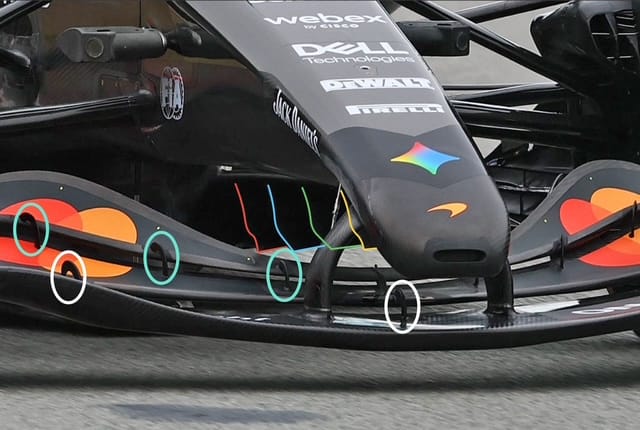
Others may have mentioned these before,
Gary Anderson has highlighted what seem like vanes coming off the underside of the nose structure.
Image

Emag
Emag
133
Joined: 11 Feb 2019, 14:56

Re: Mclaren MCL40

Post

McFAN wrote:
29 Jan 2026, 18:05
Others may have mentioned these before,
Gary Anderson has highlighted what seem like vanes coming off the underside of the nose structure.
https://www.the-race.com/content/images ... 28--1.jpeg
He drew on top of it with colored lines that make it hard to see what exactly is going on, but I am 90% certain that is the floor leading edge. All teams have that. It's just a weird angle making it look like it's coming out of the nose.
Developer of F1InsightsHub

McFAN
McFAN
21
Joined: 21 Feb 2020, 13:53

Re: Mclaren MCL40

Post

Emag wrote:
29 Jan 2026, 18:13
McFAN wrote:
29 Jan 2026, 18:05
Others may have mentioned these before,
Gary Anderson has highlighted what seem like vanes coming off the underside of the nose structure.
https://www.the-race.com/content/images ... 28--1.jpeg
He drew on top of it with colored lines that make it hard to see what exactly is going on, but I am 90% certain that is the floor leading edge. All teams have that. It's just a weird angle making it look like it's coming out of the nose.
I thought so too initially but it does appear on others pictures with a more side view of the car I think, I'm not sure though.

Hoffman900
Hoffman900
238
Joined: 13 Oct 2019, 03:02

Re: Mclaren MCL40

Post

Emag wrote:
29 Jan 2026, 18:13
McFAN wrote:
29 Jan 2026, 18:05
Others may have mentioned these before,
Gary Anderson has highlighted what seem like vanes coming off the underside of the nose structure.
https://www.the-race.com/content/images ... 28--1.jpeg
He drew on top of it with colored lines that make it hard to see what exactly is going on, but I am 90% certain that is the floor leading edge. All teams have that. It's just a weird angle making it look like it's coming out of the nose.
I’m quite certain too. Gary needs to retire. His line drawing rarely makes sense