Andi76 wrote: ↑27 Jan 2026, 07:53
LionsHeart wrote: ↑26 Jan 2026, 16:35
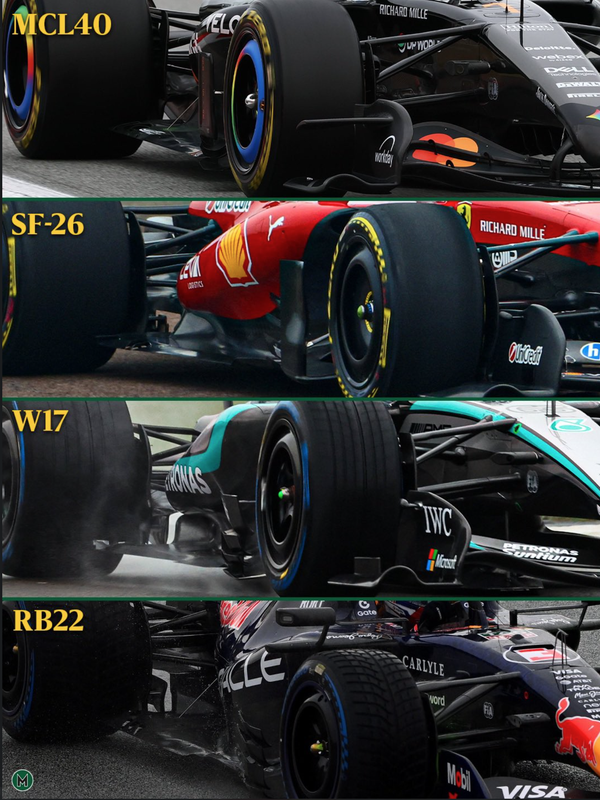
After seeing the first renderings, I also wanted to raise the question of the front suspension. Judging by the mounting of the upper rear control arms, it's the same as last year. The anti-dive system is in place. It's nice that some features can be carried over to the completely new chassis, which has undergone critical changes to the technical regulations in all areas. If the rear suspension is still pushrod-based, how optimal will the balance be in slow corners? Any suspension experts?
In general, if we stay with the same car dimensions, if the rear suspension remains pushrod-based while the front switches from pullrod to pushrod with largely unchanged geometry, the suspension layout change alone would not fundamentally alter slow-corner balance. With the same pickup points, anti-dive characteristics, roll centres and kinematics, the basic mechanical grip distribution stays comparable. However, a pushrod front does change load paths and packaging, typically placing rockers and dampers higher in the chassis. This can slightly raise the local front-end centre of gravity and alter compliance, friction and effective wheel rates—effects that are most noticeable in low-speed corners, where small suspension movements dominate vehicle behaviour.
But if this is combined with a shorter wheelbase and a car that is around 10 cm narrower, like it is because of the new regulations, the balance implications become much more pronounced. A shorter wheelbase increases yaw response and rotation on turn-in, making the car feel more agile but also less inherently stable at the apex. A reduced track width increases lateral load transfer (that's why I would have placed a strong focus on the lowest possible center of gravity for these cars while also using the maximum permitted wheelbase, as this reduces the overall lateral load transfer, which doesn't mean that I would have chosen pull rods, which i wouldn't because of aerodynamic reasons) have shrinking the mechanical grip margin and making the balance far more sensitive to roll-stiffness distribution and tyre characteristics.
In this configuration, the car is likely to show strong initial turn-in from the shorter wheelbase, but a narrower operating window in slow corners. Depending on how well front compliance, mass distribution and roll balance are controlled, this can manifest as mild low-speed understeer or, if the rear reaches its limit first, snap oversteer at or just after the apex.
In summary, while the pullrod-to-pushrod change at the front is a secondary factor on its own, the combination of pushrod front and rear, shorter wheelbase and significantly reduced width makes slow-corner balance much more sensitive.
So - this is definetely not the suspension of 2025 in pushrod only. This would be highly negligent, because if the car becomes narrower and the wheelbase shorter, an adjustment of the suspension geometry is practically imperative, because of the negative influences of a "narrower and shorter" car. A shorter wheelbase increases yaw sensitivity and reduces the vehicle's inherent stability, while a narrower track width increases lateral load transfer per axle, thereby reducing the mechanical grip window. Without geometric countermeasures, the car would be very sensitive to steering inputs and load changes in slow corners. By adjusting the roll center heights, anti-dive and anti-squat values, as well as the camber and toe settings, the load transfer can be controlled more effectively via the suspension and the reduced grip can be better utilized. In addition, finer tuning of the mechanical balance, especially the roll stiffness distribution, minimizes the negative effects on stability and predictability. Overall, a narrower vehicle and a shorter wheelbase almost inevitably necessitate a revision of the geometry to ensure controllable and consistent handling in slow corners.