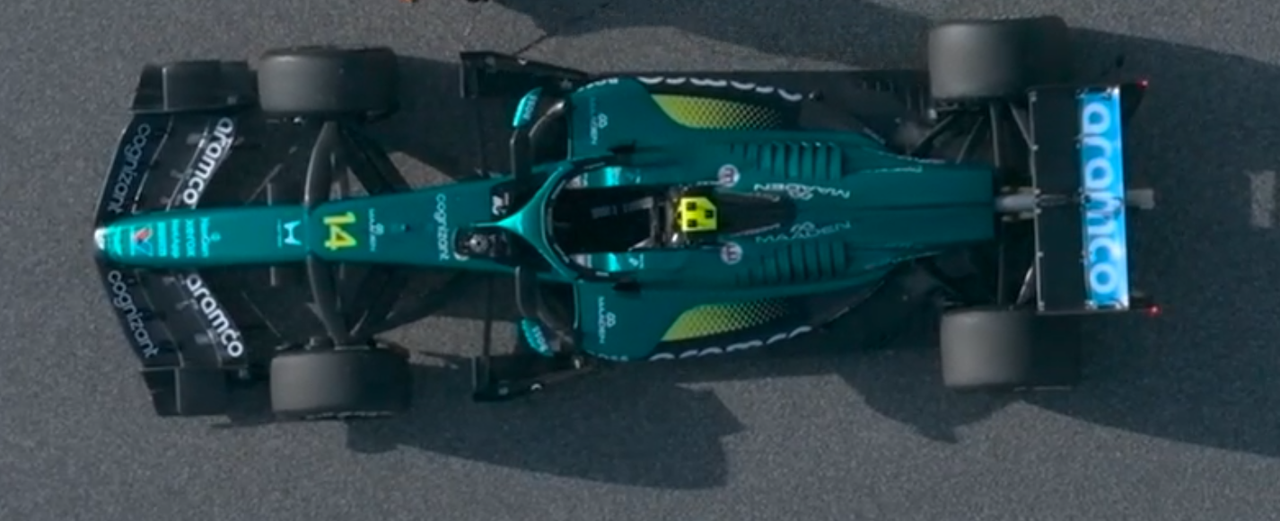
Aston Martin AMR26

A place to discuss the characteristics of the cars in Formula One, both current as well as historical. Laptimes, driver worshipping and team chatter do not belong here.
User avatar
dren
228
Joined: 03 Mar 2010, 14:14

Re: Aston Martin AMR26

Post

FNTC wrote:
18 Feb 2026, 17:19
Am I the only one who thinks that front wing, especially the third element is a dummy for the tests? It seems so flat and low angle, just look at for example the mclaren, there must be lots more front end downforce and outwash to gain there with an aggressive and curved third flap? They also keep locking up the fronts under braking still.
Don't you want to be more rear biased for regen?
Honda!

mzso
mzso
72
Joined: 05 Apr 2014, 14:52

Re: Aston Martin AMR26

Post

Stu wrote:
18 Feb 2026, 08:47
matteosc wrote:
18 Feb 2026, 02:21
mzso wrote:
18 Feb 2026, 01:04

I wasn't thinking of taking it away, more like integrating push/pull rod functionality into it. Whether it's too fantastic of an idea or not.
I understand, but for the push rod to do its job, it needs to move axially and it does not handle well lateral loads. Pull rod is even worse since it is designed to work in traction instead of in compression.
I think that @mzso is suggesting something like the old Triumph front suspension, where the torsion bar is driven directly by the wishbone end and carried longitudinally by the chassis (therefore allowing elimination of the push/pull rod.
What is that like exactly? Can you show images?

kudryavchik
kudryavchik
0
Joined: 20 Apr 2015, 23:48

Re: Aston Martin AMR26

Post

AR3-GP wrote:
15 Feb 2026, 20:48
Farnborough wrote:
15 Feb 2026, 17:59
"Are the parts machined or printed?"
The organic form bell crank links LOOK to be cast, in those images. I'm unsure that printed would fully accept that load and fatigue potential. They look also like magnesium content alloy, possibly the form made by 3D print to then from that original mold.
I have seen 3d printed structures like this before. Here is a picture of the control arm on the Bugatti Tourbillon. It is 3D printed.
https://www.supercars.net/blog/wp-conte ... lon-08.jpg
Toyota TS050
Image

User avatar
Real PJ's Beard
5
Joined: 26 Dec 2017, 21:29

Re: Aston Martin AMR26

Post

mzso wrote:
19 Feb 2026, 17:38
Stu wrote:
18 Feb 2026, 08:47
matteosc wrote:
18 Feb 2026, 02:21

I understand, but for the push rod to do its job, it needs to move axially and it does not handle well lateral loads. Pull rod is even worse since it is designed to work in traction instead of in compression.
I think that @mzso is suggesting something like the old Triumph front suspension, where the torsion bar is driven directly by the wishbone end and carried longitudinally by the chassis (therefore allowing elimination of the push/pull rod.
What is that like exactly? Can you show images?
This isn't that specific Triumph suspension, but it's the same idea.

Image

So the torsion bars are highlighted in red, and the idea is that as the wishbone is pushed up or down, it twists the bar (puts it in torsion), and that bar naturally wants to straighten out. It is a pretty old idea, and something that can be fine tuned by changing the shape or material of that bar.

It's used in F1 currently (only on the pullrods/pushrods) so not a new idea, but one that is never really seen as the bars are hidden in the chassis bulkhead.

Image

This is a pretty basic diagram but probably the best I can find for explaining.

The pushrod (green) gets pushed up going over a bounce, and it moves the rocker (yellow). That rocker is connected to a torsion bar (T) and then also another spring which acts as a damper.

Dear God let this be the year

User avatar
AR3-GP
560
Joined: 06 Jul 2021, 01:22

Re: Aston Martin AMR26

Post

johnnycesup wrote:
17 Feb 2026, 03:34
Leon Kennedy wrote:
14 Feb 2026, 22:52
Guys, I found some really interesting things on x and I'll tell you my theory.

https://x.com/i/status/2022758881986838925

The fact is that they cover the frame when they start the engine without the nose cone.
If it's true that:
they cover the front area and only do it with the engine running, with the engine off and then something related to the hydraulic pressure changes state.
Engine running = hydraulic pressure
In the F1: The ICE puts pressure on the hydraulic system, infact the hydraulics govern:
gearbox
clutch
differential
power steering
and especially suspension systems.

The most plausible hypotheses:
3.Hydraulic preload system
When there is pressure, could stabilizes
and with the engine off, it is "soft"
2. Pitch control via interconnection and could try to limit height variations
3. Platform anti-stall system and maintains a constant floor height as load increases.

What do you think about this? For me it's a gray area.
Real question, is there anything in the current F1 cars' suspension that is fed energy by something in the PU? Is it allowed?
Yes the power steering is fed by energy from the energy. In theory specific steering linkage geometries can change ride height and they may have wanted to stop anyone noticing the motion of the suspension as the power steering hydraulics became pressurized.
Beware of T-Rex

User avatar
AR3-GP
560
Joined: 06 Jul 2021, 01:22

Re: Aston Martin AMR26

Post

Image
Beware of T-Rex

mzso
mzso
72
Joined: 05 Apr 2014, 14:52

Re: Aston Martin AMR26

Post

Real PJ's Beard wrote:
20 Feb 2026, 01:02
mzso wrote:
19 Feb 2026, 17:38
Stu wrote:
18 Feb 2026, 08:47


I think that @mzso is suggesting something like the old Triumph front suspension, where the torsion bar is driven directly by the wishbone end and carried longitudinally by the chassis (therefore allowing elimination of the push/pull rod.
What is that like exactly? Can you show images?
This isn't that specific Triumph suspension, but it's the same idea.

https://upload.wikimedia.org/wikipedia/ ... on_bar.jpg

So the torsion bars are highlighted in red, and the idea is that as the wishbone is pushed up or down, it twists the bar (puts it in torsion), and that bar naturally wants to straighten out. It is a pretty old idea, and something that can be fine tuned by changing the shape or material of that bar.

It's used in F1 currently (only on the pullrods/pushrods) so not a new idea, but one that is never really seen as the bars are hidden in the chassis bulkhead.

https://sidepodcast.com/static/image/co ... 1dd1f.avif

This is a pretty basic diagram but probably the best I can find for explaining.

The pushrod (green) gets pushed up going over a bounce, and it moves the rocker (yellow). That rocker is connected to a torsion bar (T) and then also another spring which acts as a damper.
Interesting. The main difference would be with my vague idea compared to the pushrod F1 suspenion, is that suspension link couldn't be pushed, but could only swivel. So the rockers and whatnot would be a different.

By the way what are the orange, blue, red and purple parts? I guess one of the is the "another spring". One needs to be a hydraulic (?) shock absorber.
There's also that dark blue part that's asymmetric.

User avatar
dren
228
Joined: 03 Mar 2010, 14:14

Re: Aston Martin AMR26

Post

delsando53 wrote:
20 Feb 2026, 16:02
In theory, this could:

Increase rear vertical load during deceleration

Improve rear axle stability

Reduce the likelihood of rear locking or instability under peak braking

Potentially shorten braking distances due to additional aerodynamic drag
Wouldn't you rather have the DF provided by the wing being closed for more load to the rear tires when braking?
Honda!

User avatar
mcjamweasel
12
Joined: 18 Mar 2010, 15:23

Re: Aston Martin AMR26

Post

delsando53 wrote:
20 Feb 2026, 16:02
A lot of people are intrigued by the concept of the Ferrari-style 180° rear wing idea, and it raises an interesting theoretical question about whether a more extreme variable-geometry rear wing could be used not just for drag reduction, but also for braking stability.

In theory, when the wing is “open” (inverted profile, approximately 180° rotation), it could be configured to produce significantly reduced drag and possibly even slight lift, improving straight-line speed. The more interesting concept, however, is under braking. Instead of simply returning to a normal closed downforce-producing position, the wing could have an intermediate or secondary mode: partially closing to approximately 90° relative airflow, effectively acting as a large air brake during heavy braking zones. This would dramatically increase drag and rear downforce momentarily, similar in principle to the air brake concepts previously seen in endurance racing or historic F1 experiments.

Such a system, if linked to brake pressure sensors, could deploy only during high-speed, heavy braking events for example, at the end of long straights into slow corners or hairpins. When brake pressure is released, the wing would automatically return to its normal aerodynamic configuration.

In theory, this could:

Increase rear vertical load during deceleration

Improve rear axle stability

Reduce the likelihood of rear locking or instability under peak braking

Potentially shorten braking distances due to additional aerodynamic drag
That's against the regs. The wings can have only 2 positions and must switch within a defined time period (400ms iirc).

User avatar
McG
-24
Joined: 16 Feb 2011, 17:45

Re: Aston Martin AMR26

Post

Finally, everyone knows that Red Bull is a joke and Max Verstappen is overrated.

User avatar
Real PJ's Beard
5
Joined: 26 Dec 2017, 21:29

Re: Aston Martin AMR26

Post

mzso wrote:
20 Feb 2026, 16:20
Real PJ's Beard wrote:
20 Feb 2026, 01:02
mzso wrote:
19 Feb 2026, 17:38


What is that like exactly? Can you show images?
This isn't that specific Triumph suspension, but it's the same idea.

https://upload.wikimedia.org/wikipedia/ ... on_bar.jpg

So the torsion bars are highlighted in red, and the idea is that as the wishbone is pushed up or down, it twists the bar (puts it in torsion), and that bar naturally wants to straighten out. It is a pretty old idea, and something that can be fine tuned by changing the shape or material of that bar.

It's used in F1 currently (only on the pullrods/pushrods) so not a new idea, but one that is never really seen as the bars are hidden in the chassis bulkhead.

https://sidepodcast.com/static/image/co ... 1dd1f.avif

This is a pretty basic diagram but probably the best I can find for explaining.

The pushrod (green) gets pushed up going over a bounce, and it moves the rocker (yellow). That rocker is connected to a torsion bar (T) and then also another spring which acts as a damper.
Interesting. The main difference would be with my vague idea compared to the pushrod F1 suspenion, is that suspension link couldn't be pushed, but could only swivel. So the rockers and whatnot would be a different.

By the way what are the orange, blue, red and purple parts? I guess one of the is the "another spring". One needs to be a hydraulic (?) shock absorber.
There's also that dark blue part that's asymmetric.
The rockers would likely have to be the same, just instead of being attached to a rod, they'd be connected to the wishbone. The big drawback to this idea is that the ability to put in anti-dive geometry is reduced, as it would mean the bar is at an angle and therefore the chassis would need extra reinforcement to pass a crash test.

To run through the other parts, the red is the central damper, which engages when the two wheels want to compress (heavy braking, etc.). Blue is another damper but works independent to each side. Purple is an anti-roll bar, and navy is a roll damper, which is pretty much an either-or as they both do the same job in reducing roll in the car.
Dear God let this be the year

mzso
mzso
72
Joined: 05 Apr 2014, 14:52

Re: Aston Martin AMR26

Post

Thanks!

User avatar
Ashwinv16
60
Joined: 15 Jul 2017, 12:04

Re: Aston Martin AMR26

Post

I heard about recent rumors about the last minute changes Honda made in January and this Pic confirms turbo is no longer in the V. It defiantly on the full back

Image

https://x.com/carpentiers_f1/status/202 ... 17955?s=20
Halo not as bad as we thought

mzso
mzso
72
Joined: 05 Apr 2014, 14:52

Re: Aston Martin AMR26

Post

Ashwinv16 wrote:
21 Feb 2026, 14:44
I heard about recent rumors about the last minute changes Honda made in January and this Pic confirms turbo is no longer in the V. It defiantly on the full back

https://x.com/k_kuruma16B/status/20248 ... 7/photo/1

https://x.com/carpentiers_f1/status/202 ... 17955?s=20
Wasn't the rumor that the change was made to reduce turbo lag, which would mean smaller turbine, right? So it would only get more roomy in the V.

User avatar
AR3-GP
560
Joined: 06 Jul 2021, 01:22

Re: Aston Martin AMR26

Post

Ashwinv16 wrote:
21 Feb 2026, 14:44
I heard about recent rumors about the last minute changes Honda made in January and this Pic confirms turbo is no longer in the V. It defiantly on the full back

https://x.com/k_kuruma16B/status/20248 ... 7/photo/1

https://x.com/carpentiers_f1/status/202 ... 17955?s=20
Honda did not move their turbo from the V to the back "in january". Stop spreading things that are not true.
Beware of T-Rex