@euv2
Since we are on the topic,
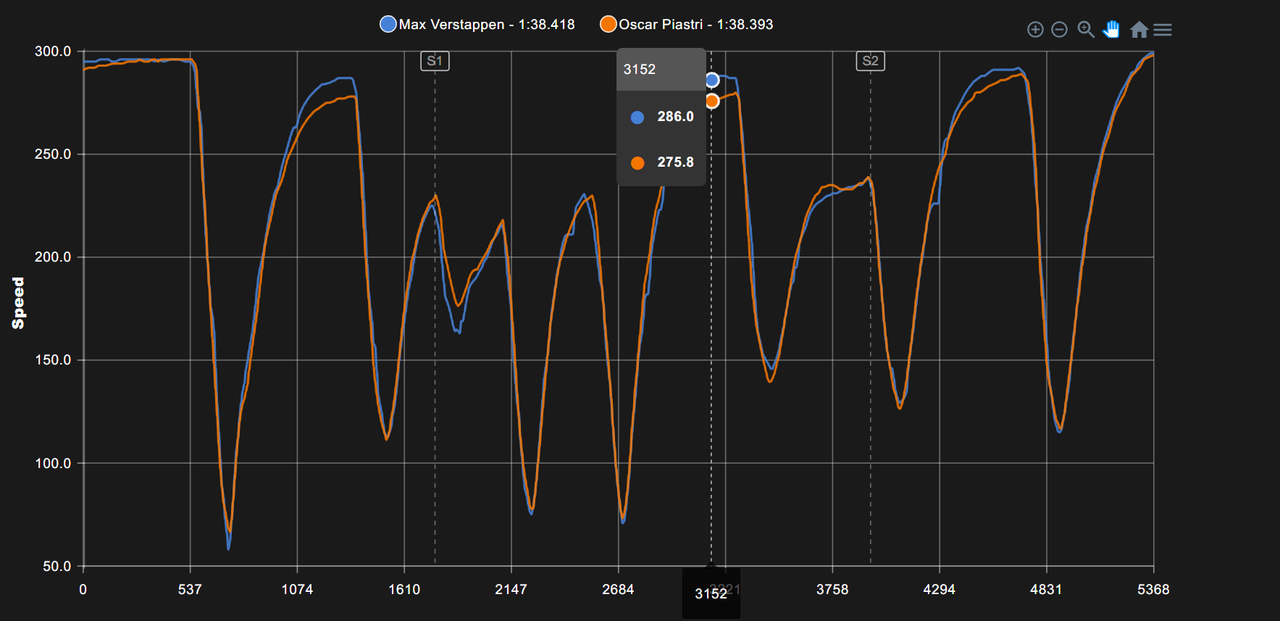
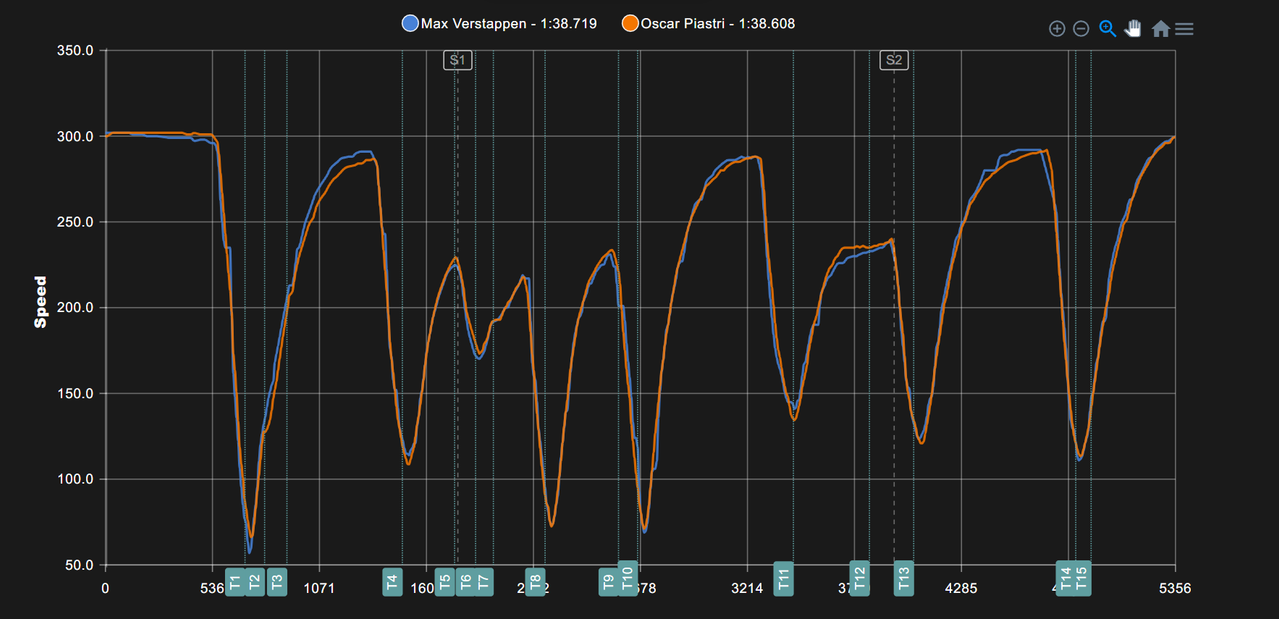
here is an example of 'final stint lowered fuel load' laps chosen at random (over multiple days) from Bahrain test2 :

In general,
- McLaren recharging on the straights & deploying in the ~100kph&below slow corners (only exception = bad entry into final 2 corners)
- Redbull recharging in the corners and deploying on the straights, their corner entry for speeds in-n-around 100kph is particularly bad (due to lifting very early for recharge or purposely being too sedate)
- Ferrari and Mercedes doing a 'more even spread' of deployment/recharge over corners/straights
Of particular interest is the medium speed T5-6-7 :
- Ferrari and Mercedes doing well here, McLaren and Redbull losing 0.25-0.30 in this small zone
- not sure whether it's because the McL40 and RB22 are 'unbalanced' here or whether they are hiding pace via 'driver input' or via recharge
Of particular interest is the high speed T11-12-13 :
- it's now Ferrari and McLaren, who look 'unbalanced' or recharging and losing 0.20-0.25 in this long corner
- Mercedes looks good
- Redbull has throttle pinned and doing some heavy recharging, doesn't look like the car is handicapped by anything other than recharge to the tune of losing 0.25
Overall, the feeling I get is that McLaren and Redbull are hiding pace either via needlessly high recharge rate or via driving too sedately , whilst Ferrari and Mercedes being 'faithful' to the car.
In conclusion, can we infer whatever reasons I inferred to be 'true' ? No. That's because we have no way to differentiate whether the 'limitations' that we see in the lap traces are due to the drivers or due to the deployment-strategy / aero-capabilty deltas. To me, looks like race stints (even Q) are going to be like chess-games between the teams, with less onus on drivers' "grip sensing capability" and more on "cerebral capability".