2026 Aerodynamic & Chassis Regulations

Here are our CFD links and discussions about aerodynamics, suspension, driver safety and tyres. Please stick to F1 on this forum.
vorticism
vorticism
438
Joined: 01 Mar 2022, 20:20
Location: YooEssay

Re: 2026 Aerodynamic & Chassis Regulations

Post

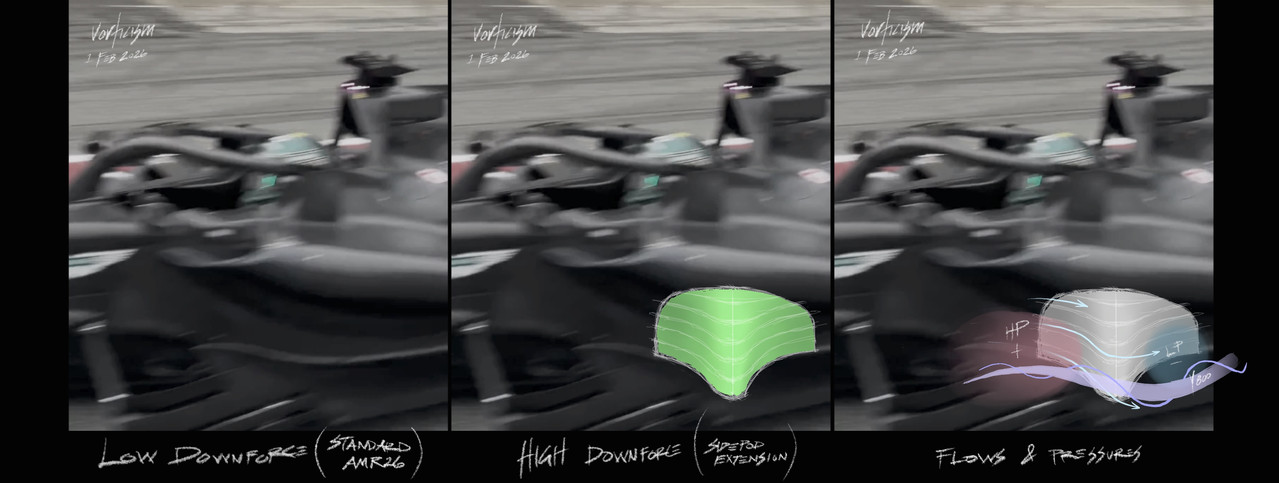
One more guess at what we’ll see this year now that I’ve seen most of the cars: track specific sidepods. AMR may have been, with the AMR26, testing what could be their low drag spec in Barcelona--their floating sidepod which has little outwash. It would be relatively easy to add modified lower sections beneath their floating sidepod to transform it into an outwashing sidepod to work the side wings (high drag, high downforce spec). I've illustrated the idea. Such a flair or extension of the lower sidepod could take a variety of forms, some with a longer trailing surface, f.e., or various fore-aft locating of the crest/apex, various widths and camber angles, etc. Perhaps that was their intention with such a clear area beneath their sidepod. Unhindered by componentry, they could place flares or extensions in the bodywork wherever they want as they develop the concept.

As for RBR, they may have been, with their RB22, testing what is their true sidepod that they intend to use regardless of track, or it could have been their high DF spec. Depending on how components are placed in their sidepods, one could imagine how an undercut could be added to the RB22 to convert it into a lower-drag spec. Which might explain the disparity between the two concepts. RBR brought their high DF spec, while AMR brought their low DF spec.

The polar-opposite disparity between those two concepts puzzled me. Could one team be getting it so wrong? Or is there something else at play?

With this formula's side wings, you have to consider how much downforce they can create independently and how they can be optimized. That’s why I’ve been pushing the blunt/bluff sidepod concept the past couple months. Previous formulas’ bargeboards did not produce much, if any, DF directly, but these do.

Image
🏴󠁧󠁢󠁥󠁮󠁧󠁿

johnnycesup
johnnycesup
3
Joined: 13 Sep 2024, 11:31

Re: 2026 Aerodynamic & Chassis Regulations

Post

vorticism wrote:
01 Feb 2026, 21:43
One more guess at what we’ll see this year now that I’ve seen most of the cars: track specific sidepods. AMR may have been, with the AMR26, testing what could be their low drag spec in Barcelona--their floating sidepod which has little outwash. It would be relatively easy to add modified lower sections beneath their floating sidepod to transform it into an outwashing sidepod to work the side wings (high drag, high downforce spec). I've illustrated the idea. Such a flair or extension of the lower sidepod could take a variety of forms, some with a longer trailing surface, f.e., or various fore-aft locating of the crest/apex, various widths and camber angles, etc. Perhaps that was their intention with such a clear area beneath their sidepod. Unhindered by componentry, they could place flares or extensions in the bodywork wherever they want as they develop the concept.

As for RBR, they may have been, with their RB22, testing what is their true sidepod that they intend to use regardless of track, or it could have been their high DF spec. Depending on how components are placed in their sidepods, one could imagine how an undercut could be added to the RB22 to convert it into a lower-drag spec. Which might explain the disparity between the two concepts. RBR brought their high DF spec, while AMR brought their low DF spec.

The polar-opposite disparity between those two concepts puzzled me. Could one team be getting it so wrong? Or is there something else at play?

With this formula's side wings, you have to consider how much downforce they can create independently and how they can be optimized. That’s why I’ve been pushing the blunt/bluff sidepod concept the past couple months. Previous formulas’ bargeboards did not produce much, if any, DF directly, but these do.

https://i.postimg.cc/NjTQcTPN/sidepodfl ... ticism.jpg
Instead of a vortex, wouldn't that sharp of an angle induce instant separation, and the creation of a massive pocket of low quality air in the most important part of the car?

vorticism
vorticism
438
Joined: 01 Mar 2022, 20:20
Location: YooEssay

Re: 2026 Aerodynamic & Chassis Regulations

Post

johnnycesup wrote:
01 Feb 2026, 23:20
Instead of a vortex, wouldn't that sharp of an angle induce instant separation, and the creation of a massive pocket of low quality air in the most important part of the car?
The vortex is off of the floor board in the foreground of the pic. Yes to separation. Although as stated the trailing surface could take a variety of forms.
🏴󠁧󠁢󠁥󠁮󠁧󠁿

User avatar
AR3-GP
541
Joined: 06 Jul 2021, 01:22

Re: 2026 Aerodynamic & Chassis Regulations

Post

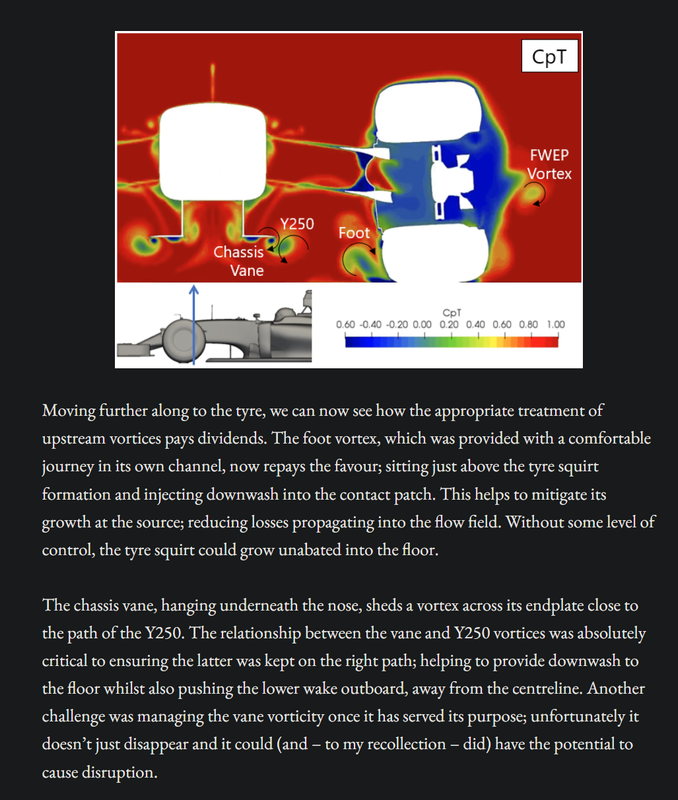
This SF16-H CFD gives some clues about front wing design possibilities in 2026
https://tameaero.wordpress.com/2023/08/ ... -h-part-i/
(1) Dive plane on the endplate can generate a vortex that helps to draw the tire wake outboard. Mclaren is the only one of the top 4 using it.
(2) Foot plate (all) and underwing strakes (Mercedes) can act as VGs that try and suppress the growth of the front tire squirt.

Image
Image


AR3-GP wrote:
08 Feb 2026, 16:27
Image
Beware of T-Rex

User avatar
AR3-GP
541
Joined: 06 Jul 2021, 01:22

Re: 2026 Aerodynamic & Chassis Regulations

Post

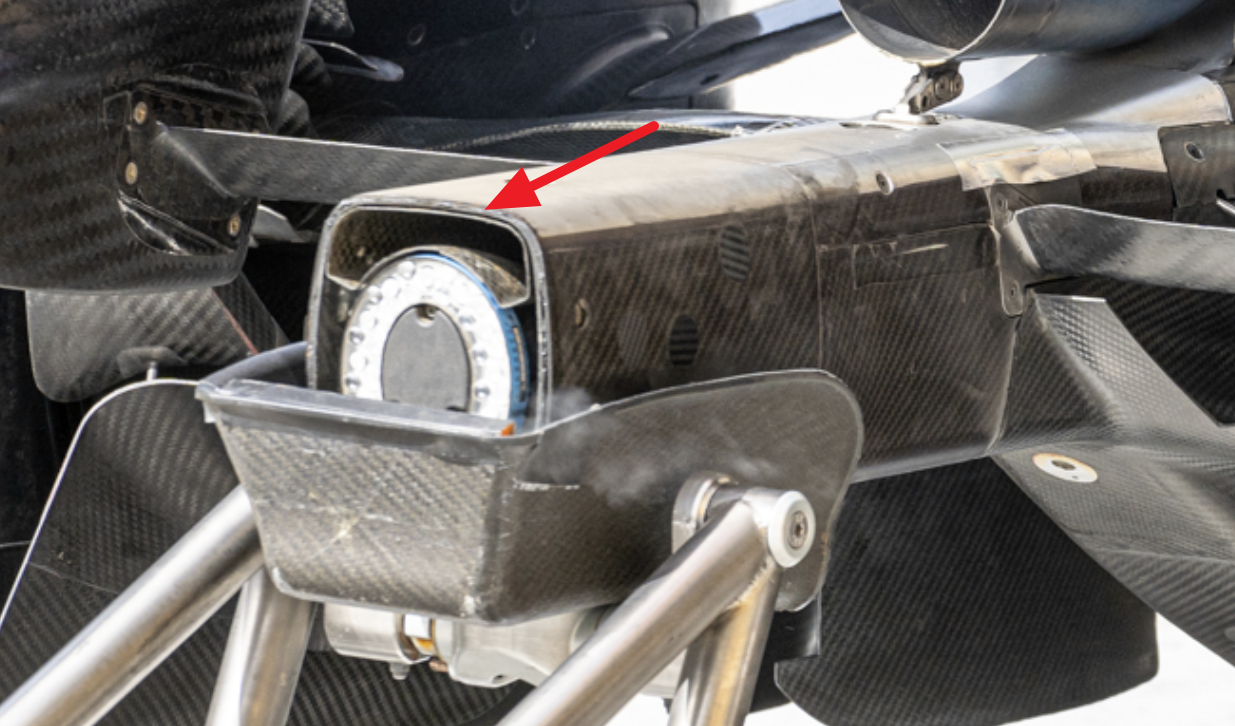
Do the 2026 regulations permit a cooling exit here:

Image
Beware of T-Rex

autodoctor911
autodoctor911
1
Joined: 05 Aug 2012, 14:35

Re: 2026 Aerodynamic & Chassis Regulations

Post

Is there enough restrictions on the active aero to prevent them from being deployed to dampen suspension oscillation?

michl420
michl420
25
Joined: 18 Apr 2010, 17:08
Location: Austria

Re: 2026 Aerodynamic & Chassis Regulations

Post

autodoctor911 wrote:
17 Feb 2026, 00:27
Is there enough restrictions on the active aero to prevent them from being deployed to dampen suspension oscillation?
The driver can close the wings whenever he want manually.

FNTC
FNTC
22
Joined: 03 Nov 2023, 21:27

Re: 2026 Aerodynamic & Chassis Regulations

Post

All these loopholes in this regulation set, lol. Now Ferrari has been able to make an exhaust blown diffuser extension :twisted:
Image

User avatar
AR3-GP
541
Joined: 06 Jul 2021, 01:22

Re: 2026 Aerodynamic & Chassis Regulations

Post

I have a theory on why teams are still running large amounts of anti-dive even though it's no longer venturi tunnels. The active aero is causing the cars to slam into the ground when it closes at the end of the straight. This is also when the braking occurs. So you have brake dive AND active aero sending the plank into the ground and compromising stability right when the driver hits the brakes and the active aero closes. Teams are therefore mitigating the level of bottoming by tuning out some of the brake dive with anti-dive geometry.
Beware of T-Rex

autodoctor911
autodoctor911
1
Joined: 05 Aug 2012, 14:35

Re: 2026 Aerodynamic & Chassis Regulations

Post

[/quote]
The driver can close the wings whenever he want manually.
[/quote]

But what about automatic control? Can there be a lockout for "safety reasons" that happens to override the deployment at up to 60hz while the ride height is increasing and decreasing due to track undulations?

User avatar
deadhead
81
Joined: 08 Apr 2022, 20:24

Re: 2026 Aerodynamic & Chassis Regulations

Post

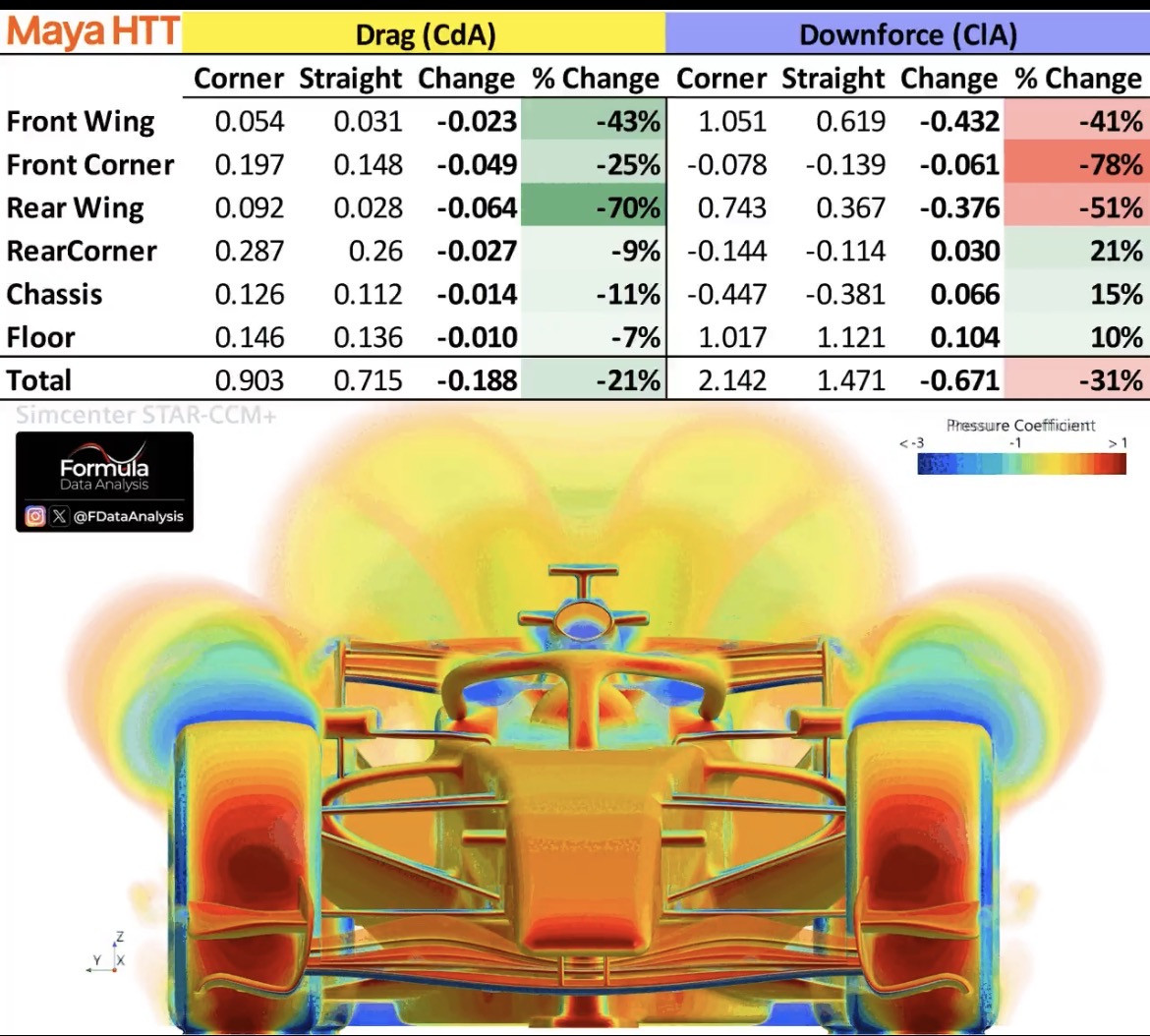
Why would there be a 10% change in the amount of DF produced by the floor in the two different modes?

Image

User avatar
AR3-GP
541
Joined: 06 Jul 2021, 01:22

Re: 2026 Aerodynamic & Chassis Regulations

Post

deadhead wrote:
28 Feb 2026, 16:50
Why would there be a 10% change in the amount of DF produced by the floor in the two different modes?
I would take the numbers with a grain of salt. It's a model car with it's own unique aerodynamic properties that might not have any relevance to a real 2026 F1 car.

With that caveat out of the way, the ride height increases when the wings open so the floor would lose some downforce.
Beware of T-Rex

Tee4K
Tee4K
2
Joined: 02 Mar 2026, 15:47

Re: 2026 Aerodynamic & Chassis Regulations

Post

Hi everyone,

My name is Tee, and I’ve been looking around here for some time, following the fascinating discussions on the 2026 "Agile Car" Aerodynamic and Chassis regulations. I’m relatively new to this technical space, but the "Stability Gap" and the reported "snap oversteer" issues in 2026 simulations really caught my attention.

I’ve spent the last few weeks researching a potential solution and have put together a technical white paper on what I call the "Y-Mode" (Automatic Asymmetric Synchronization). The core idea is moving away from the "Symmetry Mandate" for the secondary active flap. By splitting the flap into independent left/right segments, we can create an aerodynamic counter-force to level the chassis during high-G lateral loading; essentially a form of "Aerodynamic ESC."

In the paper, I’ve explored:
- The Split-Flap Architecture: Keeping the main plane and primary flap unified while modularizing the secondary element.
- The Operational Logic: How the system sheds load on the outside tire to prevent sidewall crushing and aerodynamic stalls.
- The Commercial Context: How this system could act as a "Cost Cap Insurance" policy by preventing high-speed total loss accidents.

I know I’m an outsider looking in, but I’m really interested in getting some "peer review" from this community. Does the physics of an asymmetric secondary flap hold up in your eyes, or does the mechanical complexity outweigh the aero benefits?

You can read the full paper here: [https://docs.google.com/document/d/1Joh ... sp=sharing]

I’m looking to connect with more people in the industry as I continue my research into F1 strategy and vehicle dynamics. Feel free to reach out to me on LinkedIn as well: [https://www.linkedin.com/in/phattarapha ... akulseree/]

Looking forward to your feedback and a healthy debate!

Cheers,
Tee

vorticism
vorticism
438
Joined: 01 Mar 2022, 20:20
Location: YooEssay

Re: 2026 Aerodynamic & Chassis Regulations

Post

A few Super Tail concepts for the tail & tailpipe area. Ferrari hinted at what can be done here with the SF26 at testing, but there is so, so much more that can be done (on paper). If the differential is placed 60mm rearward then the tail volume can completely eclipse the lowest tailpipe position. The lesser that figure is than 60mm, the less coverage the tailpipe will have. Teams with their differentials at zero (with respect to the rear wheel centers) or further inward toward the engine will still have options since the minimum possible in all cases is a 30mm overlap. The forms which can be place in the area can also be paired with a high tailpipe position.

from a capped-off radial outflow cover, to ramps and capes beneath tall tailpipes, to exhaust flow reversing ducts formed by the union of the tailpipe and tail body, and perhaps most enticing of all, the potential for a blown rear wing. If any of these shapes look funny, remember that I have to conform to cross section limits. Before asking: please consider the relevant coordinates and details like legality slits.

Downsides to ducting would be the weight of insulation, metals, and leakage through legality and assembly gaps.

Image
alt: https://i.postimg.cc/wB7Zv5D8/Super-Tai ... ticism.jpg
🏴󠁧󠁢󠁥󠁮󠁧󠁿

User avatar
AR3-GP
541
Joined: 06 Jul 2021, 01:22

Re: 2026 Aerodynamic & Chassis Regulations

Post

Wouldn't the trade off of moving the differential rearward be the loss of diffuser volume? The only thing stopping the diffuser being larger is the gearbox itself. They will have to make sure the net effect is still positive.
Beware of T-Rex