BorisTheBlade wrote: ↑11 Mar 2026, 21:18
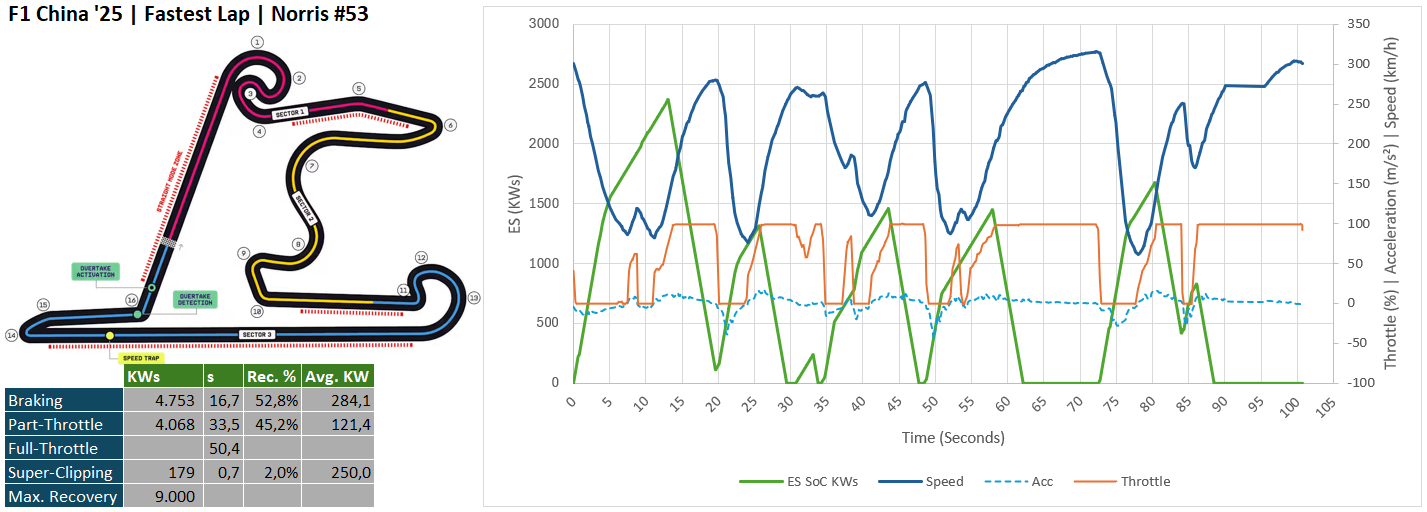
Armchair expert simulation/indication of what to expect regarding energy management in China '26 based on telemetry data of the fastest race lap of '25. Trace starts at braking zone to T1 with an empty ES. Map is just for reference.
https://s1.directupload.eu/images/260311/6k5dr2sz.png
Key takeaways for me:
- As the max. 9 KWs can be recovered entirely and in a sustainable fashion from braking and part-throttle recovery alone, we should see next to no super clipping in China.
- ES capacity is not a limiting factor, as enough can be deployed between each two harvesting zones.
- Both assumptions can be totally wrong depending on the deployment strategies of the teams. They might want to store quite some energy up to turn 10 to enter the straights-section with the max. 4 KWs. This could lead to super clipping on occasion even if that means giving up recovery potential during part-throttle and braking later on. Not sure if would be worth it laptime-wise (fuel/weight tax).
Nice, appreciate the work.
Two questions :
a) t=90 to t=100 which represent the stretch from the start-finish-line to the T1 braking zone, what's happening to the speed trace with an empty battery ? If it's Vmax at max ICE output frpm t=90 to t=95, why is there a jump in speed from t=95 to t=100 when the braking hasn't started and battery SoC is still 0 ? What am I missing ?
b) t=0 to t=13 is a GIANT ~2300KWs regen window involving braking, LiCo and partial throttle, right ? Since T1-2-3 is a decreasing radius corner, the drivers will not want understeer and will inevitably setup a heavily forwards brake bias, and will revert to a balanced brake bias only when approaching turn3 (where we see a slight throttle spike). Are you sure so much recharging is possible in that state ?