Aston Martin AMR26

A place to discuss the characteristics of the cars in Formula One, both current as well as historical. Laptimes, driver worshipping and team chatter do not belong here.
FNTC
FNTC
22
Joined: 03 Nov 2023, 21:27

Re: Aston Martin AMR26

Post

AR3-GP wrote:
14 Feb 2026, 20:22
matteosc wrote:
14 Feb 2026, 19:45
MtthsMlw wrote:
14 Feb 2026, 15:04
Front wing details and adjustment
https://img.auto-motor-und-sport.de/_/b ... 271770.jpg
[...]
Probably I am missing or misreading something, but how can the last flap rotate if it is connected with a metal bracket to the fixed flap? Or is the connection point on the pivot?
The connection to the 3rd flap is hinged. The hinge is coincident with the rotation axis of the flap.
Yeah, you see the slot in the carbon fiber behind the metal connector to the right of the "o" in aramco there. So its hinged there. There are pics and videos with the 3rd flap going down.

Leon Kennedy
Leon Kennedy
0
Joined: 22 Jan 2026, 18:55

Re: Aston Martin AMR26

Post

Guys, I found some really interesting things on x and I'll tell you my theory.

https://x.com/i/status/2022758881986838925

The fact is that they cover the frame when they start the engine without the nose cone.
If it's true that:
they cover the front area and only do it with the engine running, with the engine off and then something related to the hydraulic pressure changes state.
Engine running = hydraulic pressure
In the F1: The ICE puts pressure on the hydraulic system, infact the hydraulics govern:
gearbox
clutch
differential
power steering
and especially suspension systems.

The most plausible hypotheses:
3.Hydraulic preload system
When there is pressure, could stabilizes
and with the engine off, it is "soft"
2. Pitch control via interconnection and could try to limit height variations
3. Platform anti-stall system and maintains a constant floor height as load increases.

What do you think about this? For me it's a gray area.

Brahmal
Brahmal
58
Joined: 19 Oct 2024, 05:07

Re: Aston Martin AMR26

Post

FNTC wrote:
14 Feb 2026, 21:18
Yeah, you see the slot in the carbon fiber behind the metal connector to the right of the "o" in aramco there. So its hinged there. There are pics and videos with the 3rd flap going down.
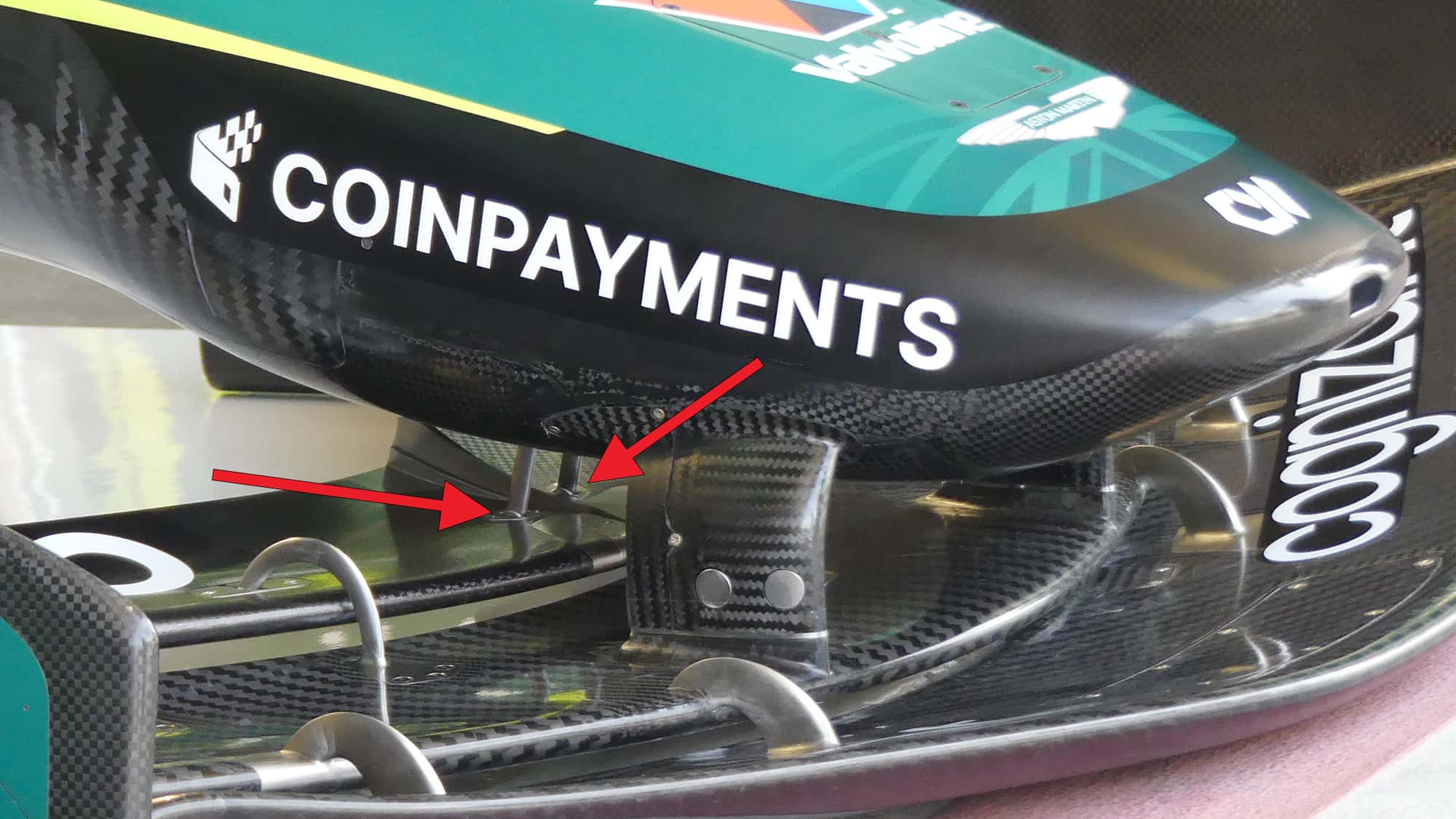
I believe he's asking about the swan-neck stays between 2nd and 3rd element to either side of the nose actuators. The actuators are indicated by the red arrows to be clear, don't know if those are your arrows and maybe we're talking about the same thing.

Image

It's difficult to see, but the plate on the third element has a hinge built into it. You can barely see that the swan-neck is not one piece with the plate. The plate also has a gap directly behind where the swan-neck attaches to keep it from binding when the flap flips up and down.

matteosc
matteosc
31
Joined: 11 Sep 2012, 17:07

Re: Aston Martin AMR26

Post

Brahmal wrote:
15 Feb 2026, 01:46
FNTC wrote:
14 Feb 2026, 21:18
Yeah, you see the slot in the carbon fiber behind the metal connector to the right of the "o" in aramco there. So its hinged there. There are pics and videos with the 3rd flap going down.
I believe he's asking about the swan-neck stays between 2nd and 3rd element to either side of the nose actuators. The actuators are indicated by the red arrows to be clear, don't know if those are your arrows and maybe we're talking about the same thing.

https://img.auto-motor-und-sport.de/_/b ... 271770.jpg

It's difficult to see, but the plate on the third element has a hinge built into it. You can barely see that the swan-neck is not one piece with the plate. The plate also has a gap directly behind where the swan-neck attaches to keep it from binding when the flap flips up and down.
I was actually asking about the bracket and indeed I missed the hinge, so now everything makes sense again in my world (at least for its F1 part :lol: ).

User avatar
sucof
38
Joined: 23 Nov 2012, 12:15

Re: Aston Martin AMR26

Post

Leon Kennedy wrote:
14 Feb 2026, 22:52
Guys, I found some really interesting things on x and I'll tell you my theory.

https://x.com/i/status/2022758881986838925

The fact is that they cover the frame when they start the engine without the nose cone.
If it's true that:
they cover the front area and only do it with the engine running, with the engine off and then something related to the hydraulic pressure changes state.
Engine running = hydraulic pressure
In the F1: The ICE puts pressure on the hydraulic system, infact the hydraulics govern:
gearbox
clutch
differential
power steering
and especially suspension systems.

The most plausible hypotheses:
3.Hydraulic preload system
When there is pressure, could stabilizes
and with the engine off, it is "soft"
2. Pitch control via interconnection and could try to limit height variations
3. Platform anti-stall system and maintains a constant floor height as load increases.

What do you think about this? For me it's a gray area.
I am not sure if I read your post correctly, but if you suggest a hydraulic suspension that changes, then that is strictly forbidden in F1. No active suspension is allowed.
There are multiple rules in F1 just to prohibit interlinked suspension systems, or anything that change its properties in any way.

Farnborough
Farnborough
139
Joined: 18 Mar 2023, 14:15

Re: Aston Martin AMR26

Post

NotAdrianNewey wrote:
14 Feb 2026, 17:32
PlatinumZealot wrote:
14 Feb 2026, 17:19
Farnborough wrote:
14 Feb 2026, 15:19


You named one item specifically, the exhaust pipe, that's clear. My comment of "they are all like this" is entirely true.

"Intermingling" doesn't define much, and certainly not on a technical forum.

This "What a sweeping statement! :shock: " demonstrates your own ineptness and isn't needed. A simple question asking for clarification would be appropriate.
So you start throwing insults when you are on the back foot?

It's OK if you didn't see what's special about the supension components. It's nothing to be ashamed of.
Let’s just agree that whilst it is common for teams to exit the exhaust in this position, AM seems to be extremely unique in that it has suspension component positioned 360°around the exhaust.

Interested to know how they would design for these temps!

Are the parts machined or printed? :idea:
No, this isn't unique. Pick one of the chassis in 2022~25 regulation set and look at them. Its typically the same, with anti-roll plus heave damper/spring links etc, sited in this location for push rod suspension layout.

This design is the most extreme in its location of upper rear wishbone link, having that in as far remote location (integrated within rear wing pylon support) position that we've so far seen.

"Are the parts machined or printed?"
The organic form bell crank links LOOK to be cast, in those images. I'm unsure that printed would fully accept that load and fatigue potential. They look also like magnesium content alloy, possibly the form made by 3D print to then from that original mold.

mzso
mzso
72
Joined: 05 Apr 2014, 14:52

Re: Aston Martin AMR26

Post

FNTC wrote:
14 Feb 2026, 21:18
AR3-GP wrote:
14 Feb 2026, 20:22
matteosc wrote:
14 Feb 2026, 19:45

Probably I am missing or misreading something, but how can the last flap rotate if it is connected with a metal bracket to the fixed flap? Or is the connection point on the pivot?
The connection to the 3rd flap is hinged. The hinge is coincident with the rotation axis of the flap.
Yeah, you see the slot in the carbon fiber behind the metal connector to the right of the "o" in aramco there. So its hinged there. There are pics and videos with the 3rd flap going down.
Isn't the split where the C is sliced through, on screen right. I can't see anything near any of the O-s.

User avatar
AR3-GP
560
Joined: 06 Jul 2021, 01:22

Re: Aston Martin AMR26

Post

Farnborough wrote:
15 Feb 2026, 17:59
"Are the parts machined or printed?"
The organic form bell crank links LOOK to be cast, in those images. I'm unsure that printed would fully accept that load and fatigue potential. They look also like magnesium content alloy, possibly the form made by 3D print to then from that original mold.
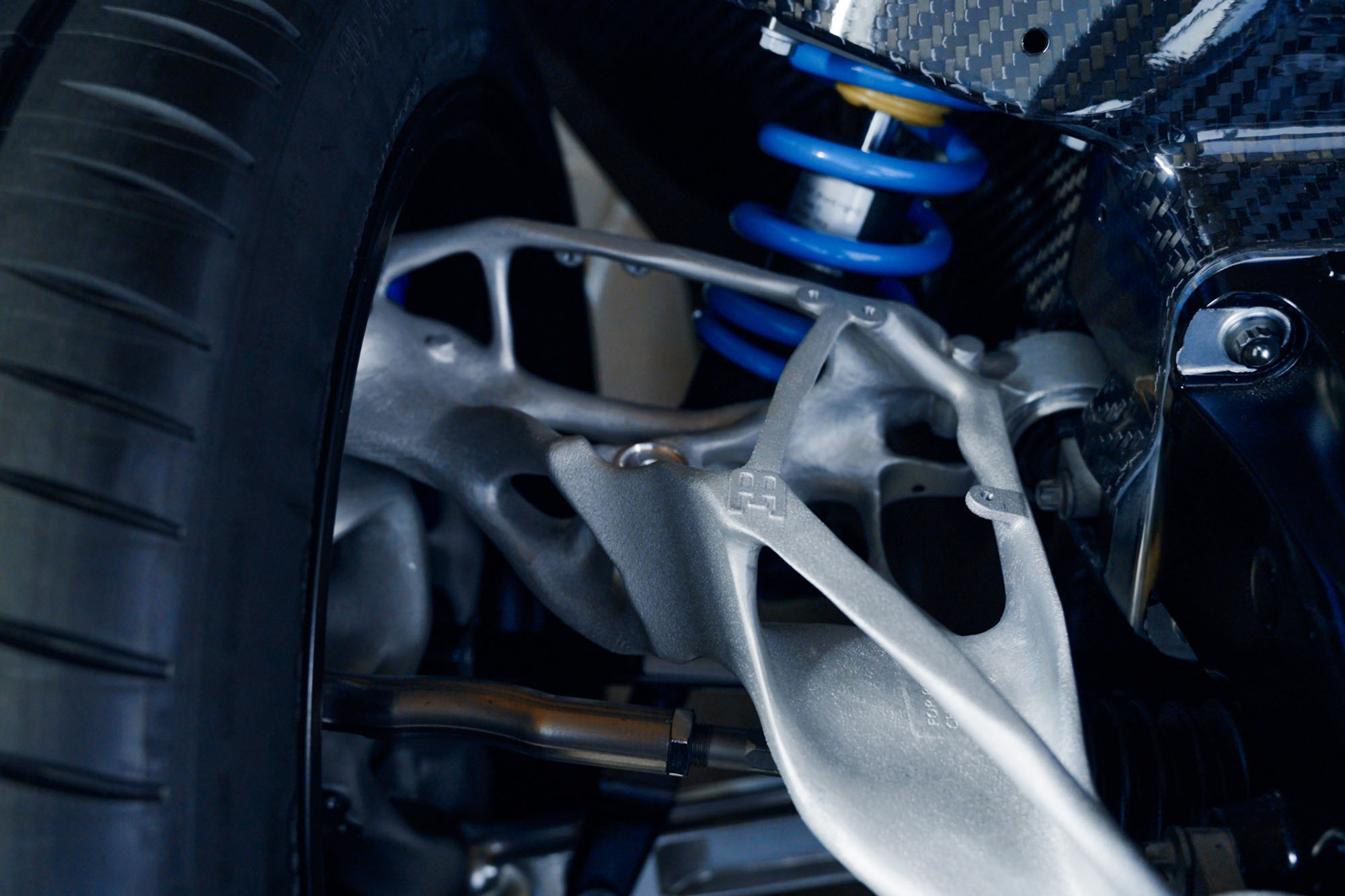
I have seen 3d printed structures like this before. Here is a picture of the control arm on the Bugatti Tourbillon. It is 3D printed.
Image
Beware of T-Rex

Farnborough
Farnborough
139
Joined: 18 Mar 2023, 14:15

Re: Aston Martin AMR26

Post

AR3-GP wrote:
15 Feb 2026, 20:48
Farnborough wrote:
15 Feb 2026, 17:59
"Are the parts machined or printed?"
The organic form bell crank links LOOK to be cast, in those images. I'm unsure that printed would fully accept that load and fatigue potential. They look also like magnesium content alloy, possibly the form made by 3D print to then from that original mold.
I have seen 3d printed structures like this before. Here is a picture of the control arm on the Bugatti Tourbillon. It is 3D printed.
https://www.supercars.net/blog/wp-conte ... lon-08.jpg
There's some very good, and fascinating, design and manufacture capabilities, aren't there.

That's a very elegant piece in the image, significant in its osteo leaning of form. The thinner web like sections appear there to control and limit ultimate flexibility in the primary section and larger link portions. You can see the spring and damper "rod" passing straight through the whole structure, coming out the bottom to directly link to wheel upright, leaving the 3D structure as wishbone only.

The difference with this and the Aston F1, and significant in structural performance terms, is that the spring and damping forces are actioned separately in bypassing that structure to support the vehicle load.
Whereas the AM F1 structure is wholly responsible for spring and damping load control with that "bell crank" assembly. Ultimately with the load gearing that involves from linkage ratios.

quincalla
quincalla
10
Joined: 24 May 2023, 17:09

Re: Aston Martin AMR26

Post

Anybody got any clue as to what that white material that you can see under the forwardmost cooling gills is or what it's doing? Just a way to blank some of them off? Looks like someone stuffed a pillow in there.
Image

User avatar
PlatinumZealot
565
Joined: 12 Jun 2008, 03:45

Re: Aston Martin AMR26

Post

Simulating hotter condtions under the engine cover.
🖐️✌️☝️👀👌✍️🐎🏆🙏

Racing Green in 2028

Leon Kennedy
Leon Kennedy
0
Joined: 22 Jan 2026, 18:55

Re: Aston Martin AMR26

Post

sucof wrote:
15 Feb 2026, 13:10
Leon Kennedy wrote:
14 Feb 2026, 22:52
Guys, I found some really interesting things on x and I'll tell you my theory.

https://x.com/i/status/2022758881986838925

The fact is that they cover the frame when they start the engine without the nose cone.
If it's true that:
they cover the front area and only do it with the engine running, with the engine off and then something related to the hydraulic pressure changes state.
Engine running = hydraulic pressure
In the F1: The ICE puts pressure on the hydraulic system, infact the hydraulics govern:
gearbox
clutch
differential
power steering
and especially suspension systems.

The most plausible hypotheses:
3.Hydraulic preload system
When there is pressure, could stabilizes
and with the engine off, it is "soft"
2. Pitch control via interconnection and could try to limit height variations
3. Platform anti-stall system and maintains a constant floor height as load increases.

What do you think about this? For me it's a gray area.
I am not sure if I read your post correctly, but if you suggest a hydraulic suspension that changes, then that is strictly forbidden in F1. No active suspension is allowed.
There are multiple rules in F1 just to prohibit interlinked suspension systems, or anything that change its properties in any way.
Actually, is forbidden any system that: Actively changes ride height, changes stiffness based on electronic inputs, reacts via control unit and uses sensors and actuators to stabilize.

While things like following systems are permitted:purely mechanical, purely hydraulic but passive without electronic control that react only to applied forces
Example: A hydraulic system that stiffens under load because it naturally increases pressure (without an ECU) is legal. It's a subtle but crucial difference.

Since 2022, they have severely limited interconnected systems (such as FRIC).
But they have not banned all forms of mechanical connections. They have banned: systems that control pitch artificially, that actively maintain a constant platform. But you can still design a suspension that: has nonlinear behavior, uses internal hydraulics and exploits a pressure accumulator works intelligently but passively.
Newey is a master at precisely this.
"anything that changes its properties in any way."
That's not quite right.
Suspensions ALWAYS change their properties under load. It's their nature.
Doing so with active control or external logic is prohibited. In my opinion and view, they might have designed a borderline passive suspension. The front suspension arms are really extreme, they might have found something along with maybe some s ducts that helps stabilize.
There's not just Newey, there's also a certain Bob Bell who few people talk about and who was one of the creators of the Mass Damper.

johnnycesup
johnnycesup
4
Joined: 13 Sep 2024, 11:31

Re: Aston Martin AMR26

Post

Leon Kennedy wrote:
14 Feb 2026, 22:52
Guys, I found some really interesting things on x and I'll tell you my theory.

https://x.com/i/status/2022758881986838925

The fact is that they cover the frame when they start the engine without the nose cone.
If it's true that:
they cover the front area and only do it with the engine running, with the engine off and then something related to the hydraulic pressure changes state.
Engine running = hydraulic pressure
In the F1: The ICE puts pressure on the hydraulic system, infact the hydraulics govern:
gearbox
clutch
differential
power steering
and especially suspension systems.

The most plausible hypotheses:
3.Hydraulic preload system
When there is pressure, could stabilizes
and with the engine off, it is "soft"
2. Pitch control via interconnection and could try to limit height variations
3. Platform anti-stall system and maintains a constant floor height as load increases.

What do you think about this? For me it's a gray area.
Real question, is there anything in the current F1 cars' suspension that is fed energy by something in the PU? Is it allowed?

mzso
mzso
72
Joined: 05 Apr 2014, 14:52

Re: Aston Martin AMR26

Post

Speaking of extreme suspenions: Why don't they just do away push/pull rods? And let some of the suspension linkages take over that purpose. Which wouldn't be mounted to the chassis surface but would continue inside and work the ~same way as the separate rods, apart from being suspension links.

Farnborough
Farnborough
139
Joined: 18 Mar 2023, 14:15

Re: Aston Martin AMR26

Post

mzso wrote:
17 Feb 2026, 13:08
Speaking of extreme suspenions: Why don't they just do away push/pull rods? And let some of the suspension linkages take over that purpose. Which wouldn't be mounted to the chassis surface but would continue inside and work the ~same way as the separate rods, apart from being suspension links.
That's cantilevered, with attendant local loading (support of pivot etc) and structure within the moving (see-saw arrangement) far more substantial than these system currently employ.

These current system also allow great freedom of displacement in location for the spring medium via the linkages used.

The rear especially, as its packed around the gear train components in exoskeleton fashion to fit it in, but still be largely centralised for mass placement.